
Initial Setup
Compliance
Changes & Filings
Resolve
Protect & Legal
Learn
Excellent
7,984 reviews

To register an LLC in New Hampshire, you pick a name that clears the state's naming rules, line up a registered agent with a New Hampshire address, and file a Certificate of Formation with the New Hampshire Secretary of State for a $100 filing fee. Here is how each step actually works to start an LLC in New Hampshire:
Every great business starts with a name. When choosing a name for your New Hampshire LLC, look for something that represents your brand, is easy for customers to remember, and leaves room for growth. But before you put the name on your website or business cards, make sure it checks all the right boxes under New Hampshire law.
Your LLC in New Hampshire name must:
Include an approved designator: The name must end with “Limited Liability Company,” “LLC,” or “L.L.C.”
Be distinctive: Your name must be sufficiently different from existing business names registered with the state.
Avoid misleading government references: Don't choose words that could make your business appear connected to a government agency, such as “FBI” or “Treasury.”
Handle restricted words carefully: Certain words, including terms such as “Bank” or “Attorney,” may require additional approval, licensing, or documentation.
New Hampshire does not run a free public name-availability tool the way some states do. Search existing business records through NH QuickStart before you file, and if your first choice is taken, try Swyft Filings' free business name generator for alternatives.
Under RSA 304-C:36, every New Hampshire LLC must name a registered agent when forming the business. Your registered agent’s name and registered office address are listed on your New Hampshire LLC formation documents, so it’s important to choose someone who meets New Hampshire’s requirements and can reliably receive documents during normal business hours.
New Hampshire Registered Agent Requirements
To serve as your LLC’s registered agent in New Hampshire, the individual or business must:
Be 18 years or older if serving as an individual.
Have a physical street address in New Hampshire where legal and official documents can be delivered.
Maintain availability at the registered office during normal business hours to receive service of process.
Be an individual resident of New Hampshire or an eligible business entity authorized to conduct business in the state.
Consent to serve as the LLC’s registered agent.
A P.O. Box alone generally cannot be used as the registered office address because the state requires a physical location where documents can be personally delivered. Swyft Filings' New Hampshire registered agent service gives your LLC in New Hampshire a dedicated Concord-area address so your home address never appears on a public filing.
Your New Hampshire registered agent has several important responsibilities, including:
Receiving service of process if your LLC is sued.
Accepting official correspondence from the New Hampshire Secretary of State.
Receiving certain tax and compliance notices.
Forwarding important documents to the LLC promptly.
Helping ensure that your business does not miss important state notices or filing deadlines.
A registered agent does not generally manage your business, file your taxes, or handle your day-to-day operations. Their primary role is to serve as the official point of contact for your LLC in New Hampshire.
Yes! You can serve as your own registered agent if you meet New Hampshire's requirements. But it also means you must remain available at the registered office during required business hours and reliably handle official documents.
A professional registered agent may be a better choice if you:
You have several options when choosing a registered agent for your New Hampshire LLC:
You can act as your own registered agent if you meet the state's requirements and have a physical address in New Hampshire.
Another individual who meets the requirements can serve as your registered agent.
A professional registered agent service can handle the responsibility on behalf of your LLC.
Using Swyft Filings registered agent service can be convenient if you don't have a New Hampshire address, don't want your personal address associated with the business, or don't want to be responsible for receiving legal documents during business hours.
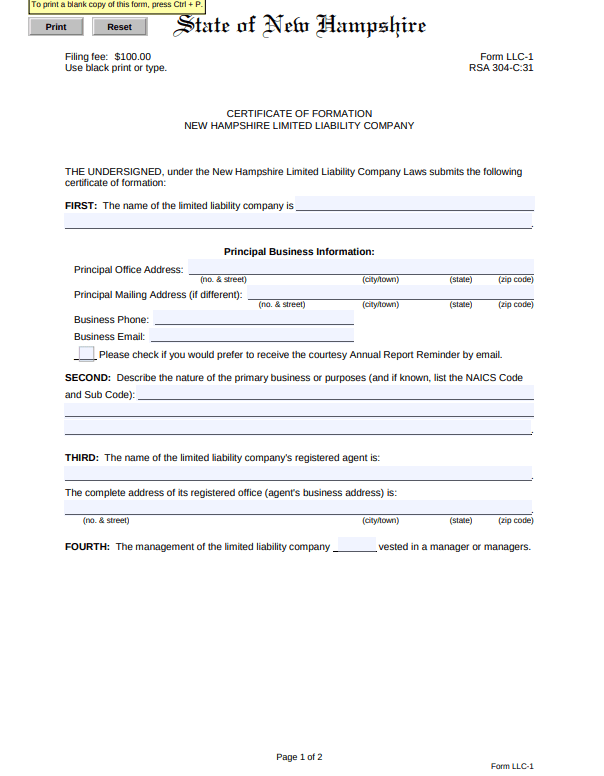
This filing officially creates your New Hampshire LLC. The filing fee is $100 by mail or $102 online through NH QuickStart, which includes a $2 electronic-filing surcharge.
Online: File Form LLC-1 Certificate of Formation online through NH QuickStart. The New Hampshire Secretary of State charges a $100 state filing fee, plus a $2 electronic filing handling charge, for a total of $102 when filed online.
Mail: Send your completed Form LLC-1 and $100 payment to the Corporation Division, NH Department of State, 107 N Main St, Room 204, Concord, NH 03301-4989.
In person: File at the State House Annex, 3rd Floor, Room 317, 25 Capitol St, Concord, NH. Walk-in filers can request expedited service for an additional $25.
Although New Hampshire does not require you to file an Operating Agreement with the Secretary of State, creating one is a smart step for your LLC. An Operating Agreement is an internal document that explains how your business will be owned, managed, and operated. It can help establish clear rules for members and reduce the risk of future disagreements.
Your New Hampshire LLC Operating Agreement can cover important details such as:
Ownership: Identify each member and their ownership percentage.
Management: Explain whether the LLC will be member-managed or manager-managed.
Member responsibilities: Define each member's duties, authority, and decision-making rights.
Profit and loss distribution: Specify how profits and losses will be allocated among members.
Voting rights: Establish how business decisions will be made and how much voting power each member has.
Capital contributions: Record how much each member contributes to the LLC and the process for making additional contributions.
Adding or removing members: Set rules for admitting new members or handling a member's departure.
Transfer of ownership: Explain when and how a member can transfer their ownership interest.
Dissolution: Establish what happens if the LLC decides to close its business.
If you don't want to create the document yourself, Swyft Filings can help you prepare a custom Operating Agreement as part of its NH LLC formation services, depending on the package you select. This can be a convenient option if you want to handle your New Hampshire LLC formation and essential business documents in one place.
Once you have formed your New Hampshire LLC, the next step is to determine whether you need an Employer Identification Number (EIN) from the IRS. When applying for an EIN, you should have your LLC's legal name, business address, responsible party information, and formation details available.
An EIN can help you:
Identify your business: The EIN serves as your LLC's federal tax identification number.
Open a business bank account: Many banks require an EIN to open a business bank account.
Hire employees: You generally need an EIN if your LLC has employees and must handle federal employment taxes.
File federal taxes: Your EIN may be used when filing federal tax returns and other tax documents.
Apply for business credit: Lenders and financial institutions may request your EIN when evaluating your business.
Keep business and personal finances separate: Using an EIN for business activities can make it easier to maintain separate business records and accounts.
If you choose one of Swyft Filings’ premium New Hampshire LLC formation packages, we can submit your EIN application as part of our package. This saves you the hassle of completing the IRS application yourself and makes it easier to take care of an important step in setting up your new business.
Once your New Hampshire LLC is formed, staying in good standing means filing your annual report on time, checking whether your business needs any additional licenses, and separating your business and personal finances.
Every New Hampshire LLC must file an Annual Report with the Secretary of State's Corporation Division each year by April 1, with a $100 filing fee by mail and $102 online. Unlike most states, New Hampshire uses a fixed calendar deadline rather than an anniversary date. Therefore, all active LLCs must file regardless of their business activity, revenue, or any changes during the year, and the only way to avoid the requirement is to formally dissolve.
Filing window: New Hampshire LLC annual reports must be filed between January 1 and April 1 each year.
Late fee: If you miss the April 1 deadline, a $50 late penalty may apply.
Good standing: Failing to file your annual report can cause your LLC to lose its good standing with the state.
Administrative dissolution: If your LLC fails to file required reports for two consecutive years, the state may administratively dissolve the business.
Choosing Swyft Filings to file an annual report on your behalf can help you stay on top of New Hampshire's filing requirements and avoid the hassle of tracking deadlines yourself.
New Hampshire doesn't have a state income tax or sales tax, but it does have two business-level taxes administered by the NH Department of Revenue Administration. The Business Enterprise Tax (BET) applies once your LLC's enterprise value tax base crosses a set threshold, and the Business Profits Tax (BPT) applies once gross receipts pass a set threshold.
Most very small or early-stage LLCs fall below both thresholds and owe nothing, but it's worth checking your numbers against the current thresholds each year, since they can change and revenue tends to grow.
New Hampshire does not have one general statewide business license that every LLC must obtain. However, depending on what you sell or do, you may still need a state tax license through the NH Department of Revenue Administration, a professional license through the Office of Professional Licensure and Certification, or a local permit from your city or town. Check the requirements that apply to your type of business to make sure you are legally authorized to operate.
If you are unsure which licenses apply to your LLC in NH, Swyft Filings' New Hampshire Business License Research service sorts out which of those actually apply to you and how you can file them.
Once your New Hampshire LLC is formed and you have obtained your EIN, consider opening a separate business bank account. Keeping your business and personal finances separate can make it easier to track income and expenses, manage cash flow, and maintain clear financial records for your LLC.
When choosing a bank, compare monthly maintenance fees, transaction limits, minimum balance requirements, online banking features, ATM access, and other account services. A dedicated business account can also help demonstrate that your LLC's finances are separate from your personal finances. If you need help getting started, check out our How to open a business bank account guide.
Here is what to budget for when you register a New Hampshire LLC and keep it current year over year.
| Item | Cost |
|---|---|
| Certificate of Formation | $100 by mail / $102 online |
| Name Reservation (optional) | $15, valid 120 days |
| EIN | $0 |
| DBA/Trade Name (if needed) | $50, valid 5 years |
| Annual Report | $100 ($102 online), due April 1 |
| Late filing penalty | $50 |
Forming a New Hampshire LLC yourself is doable, but you own every step: the Certificate of Formation, the registered agent requirement, and the annual report that comes due every April 1. Here is how DIY compares with working with Swyft Filings.
| Item | DIY | Swyft Filings |
|---|---|---|
| New Hampshire LLC Operating Agreement | Draft it yourself or use a free template | Custom Operating Agreement service available |
| New Hampshire Registered Agent | You need a qualifying New Hampshire street address and must remain available during business hours | Professional registered agent service available |
| Attorney access | Hire an attorney separately if needed | Personalized legal guidance may be available with eligible services |
| Domain Name + Website | Build and host everything yourself | Done-for-you website and domain available through partner UENI |
| New Hampshire Business License Research | Research state and local license requirements yourself | Business license research service available as an add-on |
| DBA / Trade Name Filing | Handle the applicable filing yourself | DBA Filing assistance available |
| Document Vault | Store and organize your own business documents | Secure online portal with document access |
| New Hampshire Compliance Management | Track annual reports, tax registrations, and deadlines yourself | Compliance support available through ComplianceGuard |
| Tax Consultation | Arrange and pay for a tax professional separately | Free 30-minute tax consultation available through partner 1-800Accountant |
| Support | No formation-service support | Lifetime customer support |
From choosing a name to filing your Certificate of Formation and getting your EIN, there is a lot to manage on your own. Choose Swyft Filings to handle your New Hampshire LLC formation. We will take care of the paperwork, including an EIN, an Operating Agreement, a DBA, and other supporting services.
$0 + State Filing Fees
Disclaimer: This guide provides general information about forming an LLC in New Hampshire and is not a substitute for legal, tax, or financial advice.
LLC rules, fees, and processing times vary by state. Select a state below to check its specific costs and filing requirements.