
Learn how to run a free Oregon Secretary of State business search, find assumed business names, and understand Oregon's unusually forgiving name availability standard.
Oregon's search has one feature almost nobody uses properly and one rule almost everybody gets wrong.
The feature is the Associated Name Search, which maps every assumed business name a company trades under, and every entity a registered agent represents. [3]
The rule is what counts as an available name. Oregon's own guidance says a name is distinguishable if it does not exactly copy one already on record, and that a single letter's difference is enough. [4] That is a far lower bar than most states have, and it changes what your search results actually mean. Let's read about this in detail.
Key Takeaways
Assumed business names are in the same search as entities. You do not need a separate tool to find an Oregon DBA. [3]
Assumed business names are filed by county. Which is why identical assumed names can legitimately coexist in Oregon. [4]
One letter is enough to distinguish a name. Oregon accepts anything that does not exactly copy a name on record. [4]
If you lapse your registration, your name becomes available to someone else. [4]
Leave the dash out of a registry number. The search will not find it otherwise. [5]
How to Perform an Oregon Business Entity Search Step-by-Step
Step 1. Open Find a Business
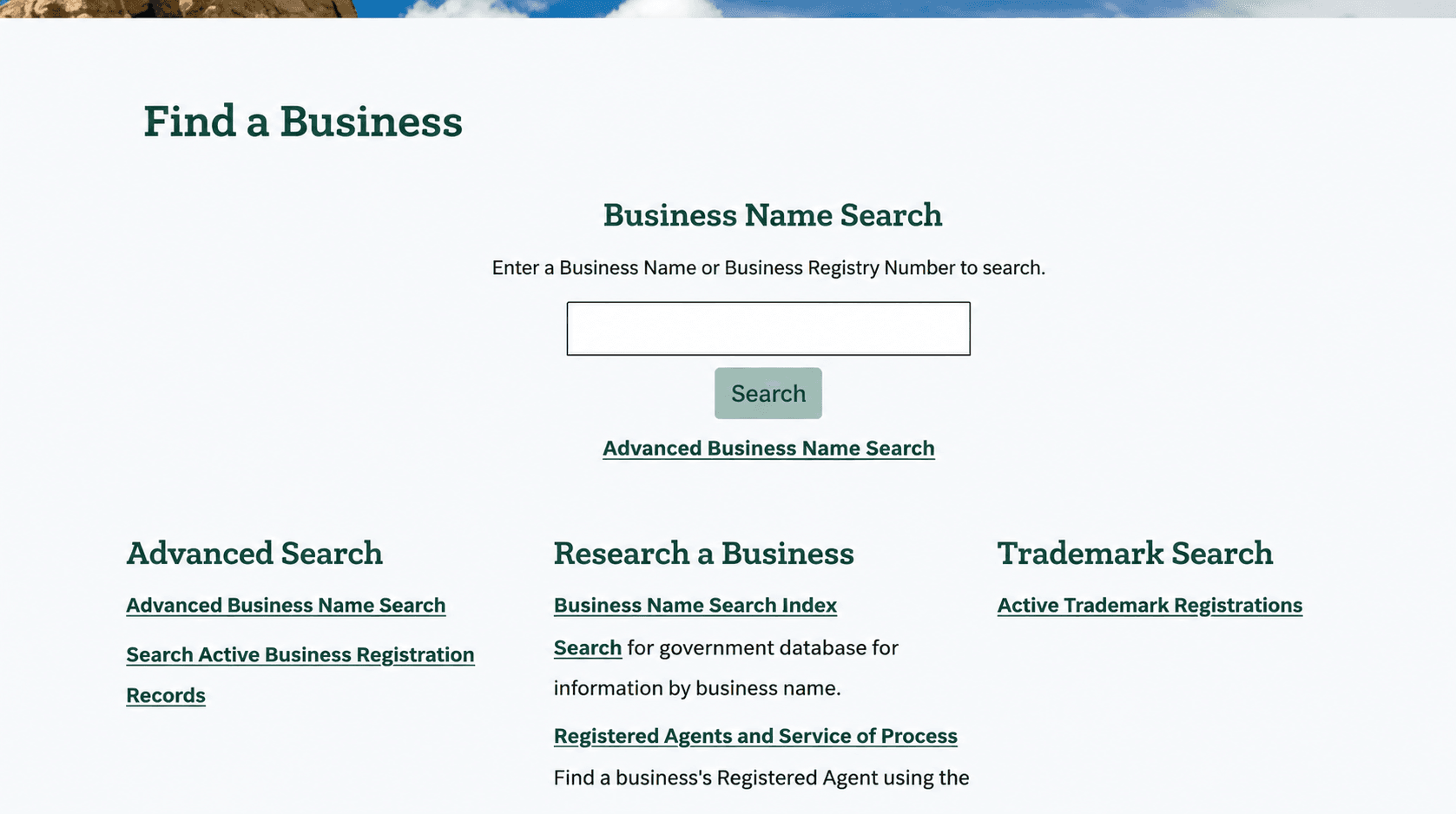
Go to the Secretary of State's Find a Business page. [1] The prompt reads "Enter a Business Name or Business Registry Number to search." Free, no login.
Step 2. Search By Name, or by Registry Number Without the Dash
One field takes both. If you have the registry number, use it. It returns one exact record.
Remember to leave the dash out. The Secretary of State's own search instructions say to enter the registry number without it. [5] That single formatting detail causes a lot of false "no results" reports. Registry number length varies by how old the entity is. Older registrations carry six digits; newer ones run longer. Do not assume a short number is wrong.
Step 3. Use the Name-Matching Methods When You Need Range
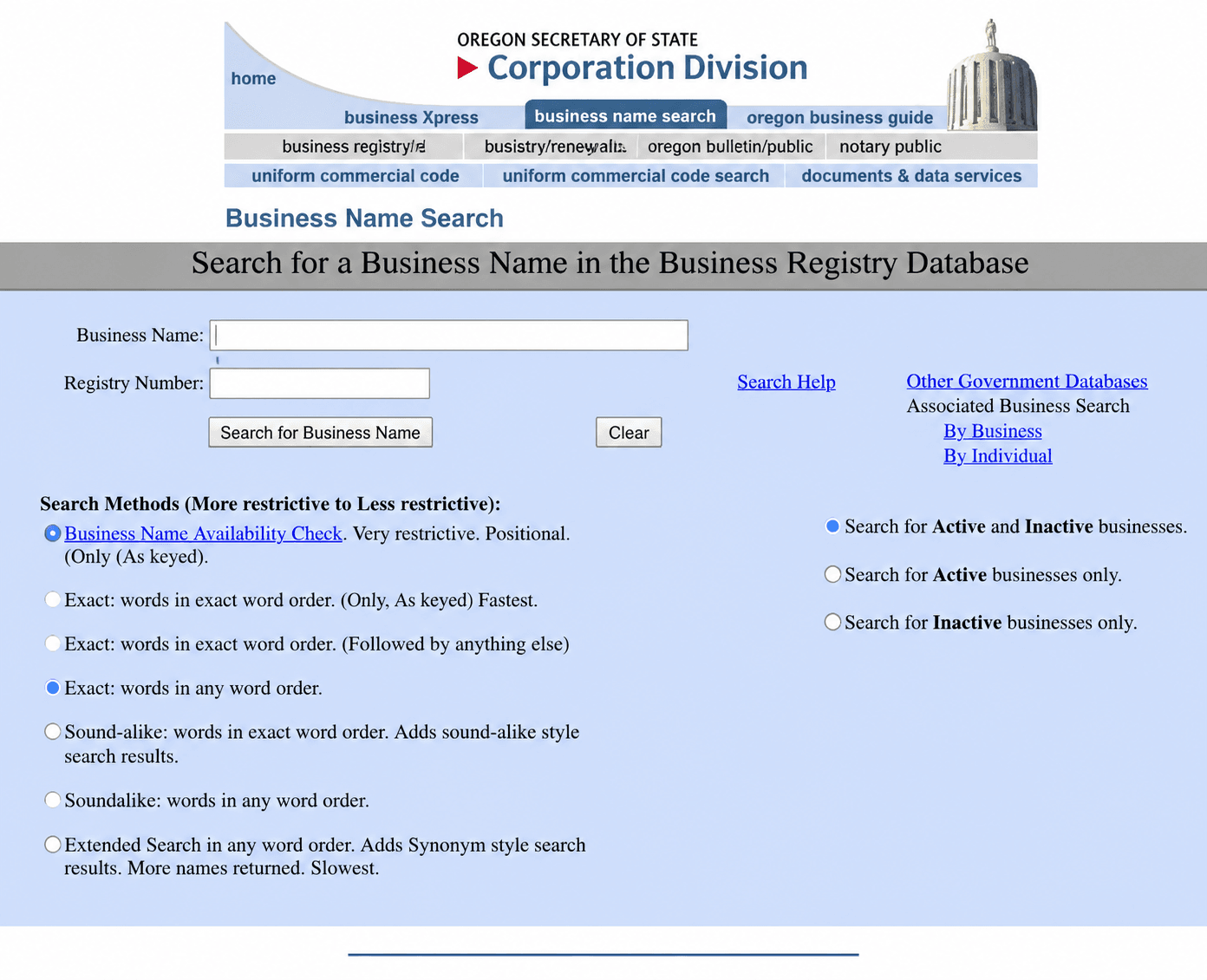
Oregon offers several word-matching methods rather than one match setting: [6]
Method | What It Returns |
Exact words in exact word order, as keyed | Names beginning with exactly what you typed, nothing after |
Exact words in exact word order, followed by anything else | Names beginning with your term, with more words after |
Exact words in any order | Names containing all your words, in any arrangement |
Sound-alike words in exact word order | Similar-sounding or similarly spelled names, same order |
Sound-alike words in any word order | Similar-sounding names, any order |
Extended search in any word order | The broadest option, including synonyms |
Sound-alike is the one to run before you file. It catches phonetic near-misses, and the extended search will surface synonyms you would never think to try.
Step 4. Open the Record and Read all Four Sections
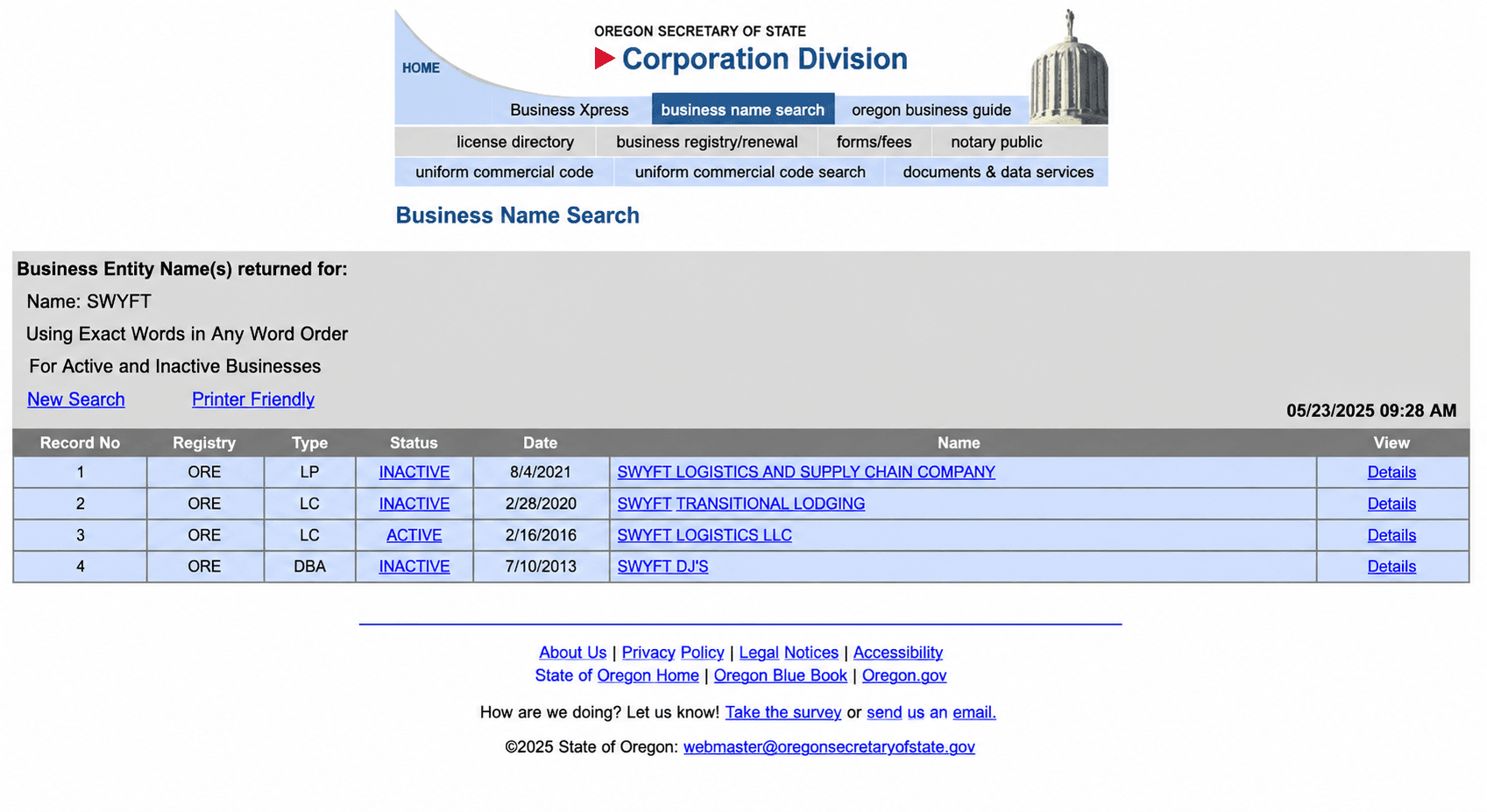
Click any result to open the full profile. It has four parts, and most people only read the first. [7]
Section | What It Gives You |
Entity data | Registry number, registry date, entity type, status, jurisdiction, renewal date |
Parties | The registered agent, plus other key personnel, each in its own block |
Name History | Every name the entity has ever used, in order |
Summary History | The full filing timeline, with a PDF link on each row |
The PDF column in Summary History is free. You can download the actual filing rather than trusting a summary of it.
Step 5. Run the Associated Name Search
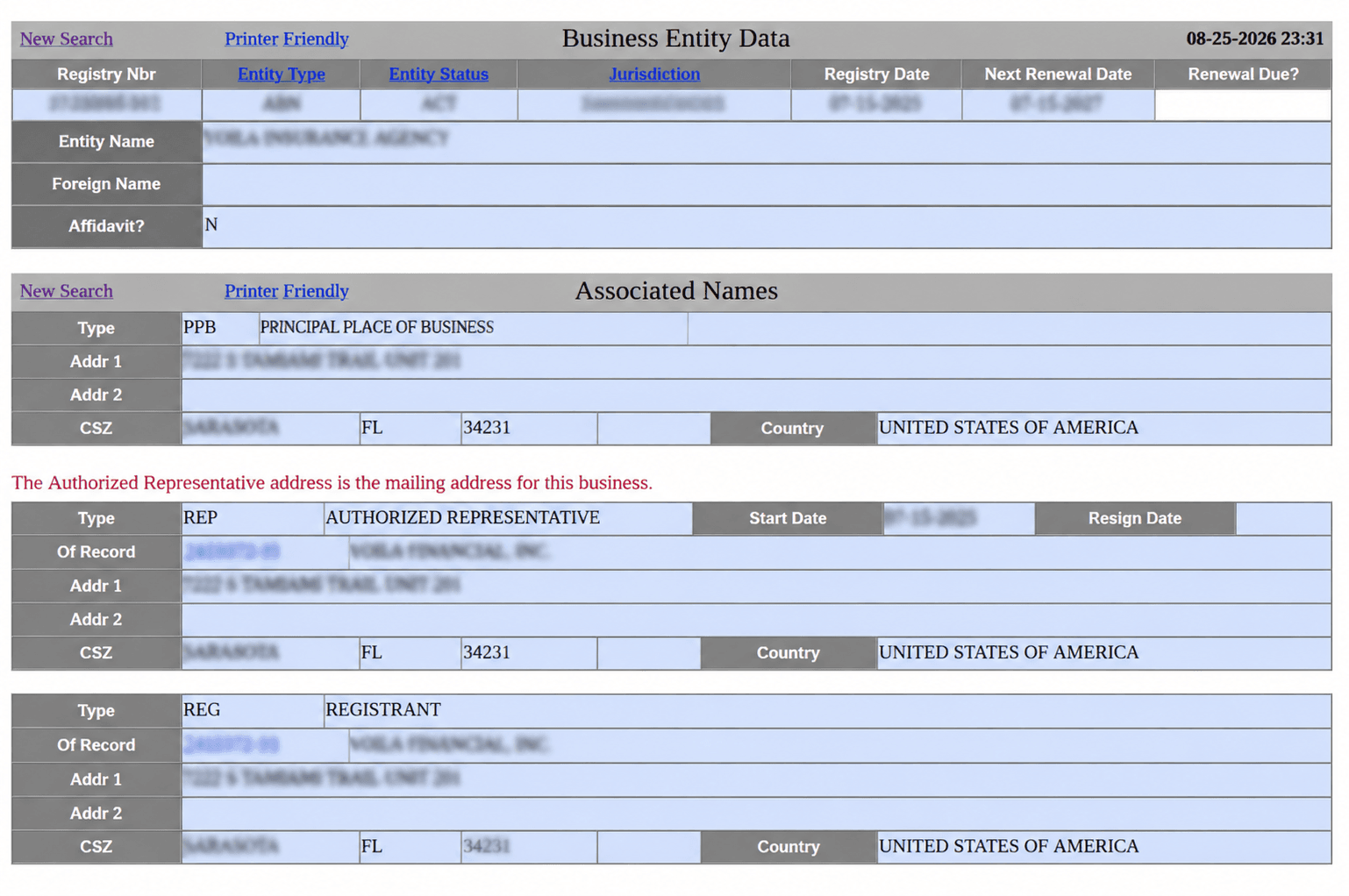
This is the tool that turns a name checker into a due diligence instrument, and almost nobody mentions it.
Enter a registry number, or look up a business by name and click the word "search" that appears after the business name. Oregon returns every entity associated with that business. [3]
You can filter by associated name type or choose All, and by Active only, Inactive only, or both. The default is All Associated Name Types and Active Businesses only, so widen it if you are researching history.
The state gives two use cases itself: finding every entity where a company is listed as the Registered Agent, and finding every assumed business name a company uses when you do not know them. [3]
How To Read Your Oregon Search Results
Field | What It Tells You | Why It Matters |
Entity name | The legal name on file | Confirms exactly what you are up against |
Entity type | DLLC, FLLC, DBC, FBC, NP, LP, LLP, ABN | The prefix tells you domestic or foreign at a glance |
Registry number | The unique permanent ID | Use it for precise lookups. Omit the dash [5] |
Status | Active, Inactive, Dissolved, and variants | Read this before anything else |
Registry date | When the entity was first approved | Shows how long the company has actually existed |
Renewal date | The anniversary the entity must renew by | Oregon renews on the anniversary, not a fixed date |
Parties | Registered agent and key personnel | A lapsed agent is a standard red flag |
Name History | Former names | Explains a mismatch with older paperwork |
The Entity Type Abbreviations
Oregon abbreviates aggressively in the results table. D means domestic, F means foreign.
Abbreviation | Entity Type |
DLLC | Domestic LLC |
FLLC | Foreign LLC |
DBC | Domestic business corporation |
FBC | Foreign business corporation |
NP | Nonprofit |
LP | Limited partnership |
LLP | Limited liability partnership |
ABN | Assumed business name |
Reading DBC as a domestic corporation and FBC as an out-of-state one saves you from drawing the wrong conclusion about who you are dealing with.
What Oregon Entity Statuses Mean
Status | What It Means | What To Do |
Active | Registered and current on filings | Proceed with normal due diligence |
Inactive | Not currently active, by choice or state action | Investigate the cause before relying on it |
Dissolved | Legally ceased and no longer recognized in Oregon | Cannot transact. Check for a successor |
Administratively Dissolved | The state dissolved it for missed filings | Reinstatement is required before it can operate |
Inactive, Withdrawn | A foreign entity voluntarily ended its Oregon registration | Confirm where it operates now |
Does an Inactive Name Become Available in Oregon?
If you do not renew your business registration, your name may become available for another business to register. [4]
A name is considered available when no other business with the exact same name has an active registration in the Oregon Corporation Division database.
However, availability does not automatically give someone exclusive rights to the name. Other legal protections, such as trademark rights, may still apply. A lapsed registration removes the name from Oregon’s active records, but the original owner may have options to reactivate the registration if eligible.
This means missing a renewal can create a real risk: your registered name may become available for someone else to claim, even though other legal rights may still affect who can use it.
How To Check Business Name Availability in Oregon
Oregon applies a distinguishable-upon-the-record standard, and it is more forgiving than nearly every other state.
The Secretary of State's own wording: A business name is distinguishable if it does not exactly copy a name already on record. Any of the following is enough: [4]
- One different word
- A different order of key words
- The addition of numbers
- Creative spelling
- Even a single letter's difference
What still will not work?
The designator itself, punctuation, spacing, and capitalization do not distinguish a name. Swapping LLC for Inc. on an otherwise identical name is not a change.
The important caveat is that Distinguishable is not the same as safe. Oregon will accept "Kwik Stop" alongside "Quick Stop." That is a legal green light and a branding disaster, and it offers no protection at all against a federal trademark claim.
So, the sequence to run is:
- Search your full proposed name using exact words in exact word order.
- Run sound-alike words in any word order to catch phonetic near-misses.
- Run the extended search for synonyms you would not have thought of.
- Check whether close matches are entities or ABNs, and for ABNs check the counties.
- Read the status of every close match, since inactive names may be free.
- Search the federal trademark register, which Oregon does not check.
Still deciding what to call the business? The free Swyft Filings business name generator is a sensible first stop.
What Are the Oregon Naming Rules
Entity Type | The Name Must Contain |
Limited liability company | "Limited Liability Company," LLC, or L.L.C. |
Corporation | "Incorporated," "Limited," "Corporation," or an accepted abbreviation |
Other limits include:
- No cross-type designators. An LLC name cannot contain Corporation, Incorporated, Inc., or Corp.
- No government implication. Nothing suggesting a connection to a government agency.
- No unlawful purpose. Nothing implying an activity that is illegal in Oregon.
- Restricted professional terms. Words such as bank, attorney, and engineer generally require additional paperwork or a licensed professional in the business.
How To Register an Assumed Business Name in Oregon
An ABN is what Oregon calls a DBA, and it is the filing most people searching this topic actually need. ABN is registered by Sole proprietors and general partnerships trading under anything other than the owners' own names. This is the only way they appear in the state registry at all. LLCs and corporations also file assumed names as a second name alongside their legal one.
What you need to decide before filing:
- The name of counties. You designate them, and that determines where your registration has effect. [4]
- Whether the name is clear in those counties. An identical ABN elsewhere in Oregon may not block you.
- The owner details. ABN registrations name the person or entity behind the business, which is why they are useful for due diligence.
What are the fee and term:
$50 to register, effective for two years, renewing at $50 every two years.If you miss the renewal, the name becomes available for someone else to register as per the Secretary of State. [4]
What an Assumed Business Name does not do:
An ABN does not create a legal entity and does not give you liability protection. A sole proprietor with an ABN carries the same personal liability as one without. It also gives you no exclusive rights beyond the registration itself.
Swyft Filings can handle your Oregon DBA registration, and for enforceable protection, we can help you file a federal trademark.
Name Reservation vs. Assumed Business Name
These are two different filings for two different situations, and they get conflated constantly.
Feature | Name Reservation | Assumed Business Name |
What it does | Holds a name while you prepare formation documents | Registers a trade name you actually use |
Fee | $100 | $50 |
Term | 120 days | Two years |
Renewal | Not a renewal; it simply expires | $50 every two years |
Scope | Statewide hold | Filed by the counties you designate [4] |
Can it be reserved in advance? | It is the reservation | No. ABNs cannot be reserved |
A reservation is optional. If your formation documents are ready, filing them claims the name at the same moment and saves you $100.
An ABN cannot be held in advance. If you want a trade name, you register it and start using it. When you are ready, you can form your Oregon LLC, or file as a C Corp or file as a Nonprofit.
Check Your Domain and Social Handles Before You Commit
Because Oregon's distinguishability bar is so low, clearing the registry proves less here than almost anywhere. It confirms the state will accept your filing. It does not confirm the name is yours to build on.
Run three more checks in the same sitting:
- The domain. Check the exact match and a fallback or two.
- The social handles. Check the platforms you will actually use.
- The federal trademark register. A mark held by a company that never registered in Oregon can still stop you, and "distinguishable upon the record" is no defense.
How To Verify an Oregon Business Before You Deal With It
- Search the exact legal name from the contract or invoice, not the brand name.
- Save the registry number, the status, and the date you checked.
- Confirm the status is Active, and read the specific label if it is not.
- Check the registry date against the track record being claimed.
- Read the Parties section for the registered agent and confirm it is current.
- Read Name History for rebrands nobody mentioned.
- Read Summary History for gaps, reinstatements, and amendments.
- Run the Associated Name Search to map every ABN the business trades under. [3]
- Run the same search on the registered agent to see the agent's full client list.
- Order a Certificate of Existence if the deal is significant.
What the registry will not tell you is that the Corporation Division confirms registration. It does not verify business licenses, permits, or regulatory compliance. Licensing runs through the Business Xpress License Directory and the relevant agency, not the Secretary of State.
Red Flags Worth a Second Look
- A company using LLC or Inc. in its name with no Oregon record at all.
- Any status other than Active behind a business presenting itself as fully operational.
- A lapsed or resigned registered agent. If an agent has resigned, the Secretary of State accepts legal service as a fallback, which is a sign of an abandoned entity.
- A brand name that appears nowhere as an ABN of the entity you were given.
- A pattern of dissolved entities associated with the same person or agent.
How To Get an Oregon Certificate of Existence
Oregon's certificate of good standing is called the Certificate of Existence. It is what banks, lenders, and other states' filing offices ask for.
- Order online through the Oregon Business Registry.
- Paper requests by fax or post take five to ten business days.
- Add a fee for authentication if you need an apostille for use outside the country.
- It depends on current filings. A lapsed annual renewal can void it, so file first, order second.
Swyft Filings can obtain a Certificate of Good Standing on your behalf.
Let Us File Your Oregon Business
Once your search confirms a name is clear across entities, assumed names, and the federal register, filing is the step that follows. Swyft Filings has helped more than 600,000 businesses get started since 2015. We handle Oregon LLC formation, C Corp and nonprofit filings, registered agent service, assumed business name registration, and business name changes.
Bibliography
- Oregon Secretary of State. Find a Business. Accessed on August 7, 2026.
- Oregon Secretary of State. Business Services. Accessed on August 7, 2026.
- Oregon Secretary of State. Associated Name Search Help. Accessed on August 7, 2026.
- Oregon Secretary of State. Assumed Business Name Publication. Accessed on August 7, 2026.
- Oregon Secretary of State. Search Active Business Registration Records. Accessed on August 7, 2026.
- Oregon Secretary of State. Business Name Search Help. Accessed on August 7, 2026.
- Oregon Secretary of State. Name Availability. Accessed on August 7, 2026.
Other Important Resources
FAQs
Yes. Oregon assumed business names (DBAs) are registered with the Secretary of State and appear in the same registry as business entities. The Associated Name Search can also show every assumed business name connected to a company.[3]
An assumed business name is Oregon's term for a DBA. It is a trade name used by a business instead of, or alongside, its legal name. Sole proprietors, partnerships, LLCs, and corporations may register assumed names for different business purposes.
Two Oregon businesses can have the same assumed name because assumed business names are filed by county. Identical names may exist in different counties, so you should check county information before treating a match as a conflict.[4]
You can check Oregon business name availability by searching the state registry using exact, sound-alike, and extended matching options. Oregon requires names to be distinguishable, and the Secretary of State makes the final decision when reviewing a filing.[4]
No. If an Oregon business registration has lapsed and is no longer active, the name may become available for another business to register. A name is available when no active business holds that exact registered name.[4]
An Oregon registry number is the unique permanent identifier assigned to a business registration. When searching by registry number, enter it without the dash because the Secretary of State's instructions require the number without formatting.[5]
No. The Oregon business registry only confirms that a business is registered with the state. It does not verify licenses, permits, or regulatory compliance, which are handled through other state resources and agencies.
No. An Oregon business name search only checks state registration records and does not provide federal trademark protection. A name may be accepted by Oregon but still conflict with an existing federal trademark, so a USPTO search is recommended.
Yes. Oregon's main business search includes active and inactive records, so dissolved and administratively dissolved entities remain visible with their status shown. The Active Business Registration Records search only displays active registrations.[5]