Learn how to run a free Ohio Secretary of State business search, use all seven search methods, and read the five statuses that decide whether a name is still protected.
Ohio's search is one of the better state tools in the country, and two things about it are worth knowing before you start.
First, it has seven search methods, including one that finds a company under a name it used to have. Second, its status field does something unusual: a canceled company can keep its name locked for a full year afterward under Hold status, so a name that looks free may not be. [1]
This guide covers the search, the five statuses, and Ohio's trade name versus fictitious name split, which is the single most consequential decision a DBA filer makes here.
Key Takeaways
Seven search methods. Business name, exact name, prior name, agent, organizer, number, and trademark. [1]
Hold status protects a name for a year. A canceled entity's name is not immediately up for grabs.
A trade name and a fictitious name are not the same filing. One gives exclusive rights; the other gives none. [4]
Your entity number has three possible names. Charter, Registration, or License, depending on entity type.
Filing images download for free. No login, no fee, from any entity record. [1]
Ohio Business Search vs Ohio Business Gateway
A quick clarification, because these get confused constantly and they are run by different agencies for different purposes.
Tool | What It Does |
Ohio Business Search | The Secretary of State's free public register of entities, trade names, and marks [1] |
Ohio Business Central | The Secretary of State's filing portal, where you submit forms and order certificates |
Ohio Business Gateway | The state's tax and licensing portal, run separately. Not a business register [3] |
If you are looking up a company, you want the Business Search. If you are filing, you want Business Central. The Gateway is where tax and licensing live, and the Secretary of State confirms it does not handle licensing at all. [3]
How To Perform an Ohio Business Entity Search Step by Step
Step 1. Open the Ohio Business Search
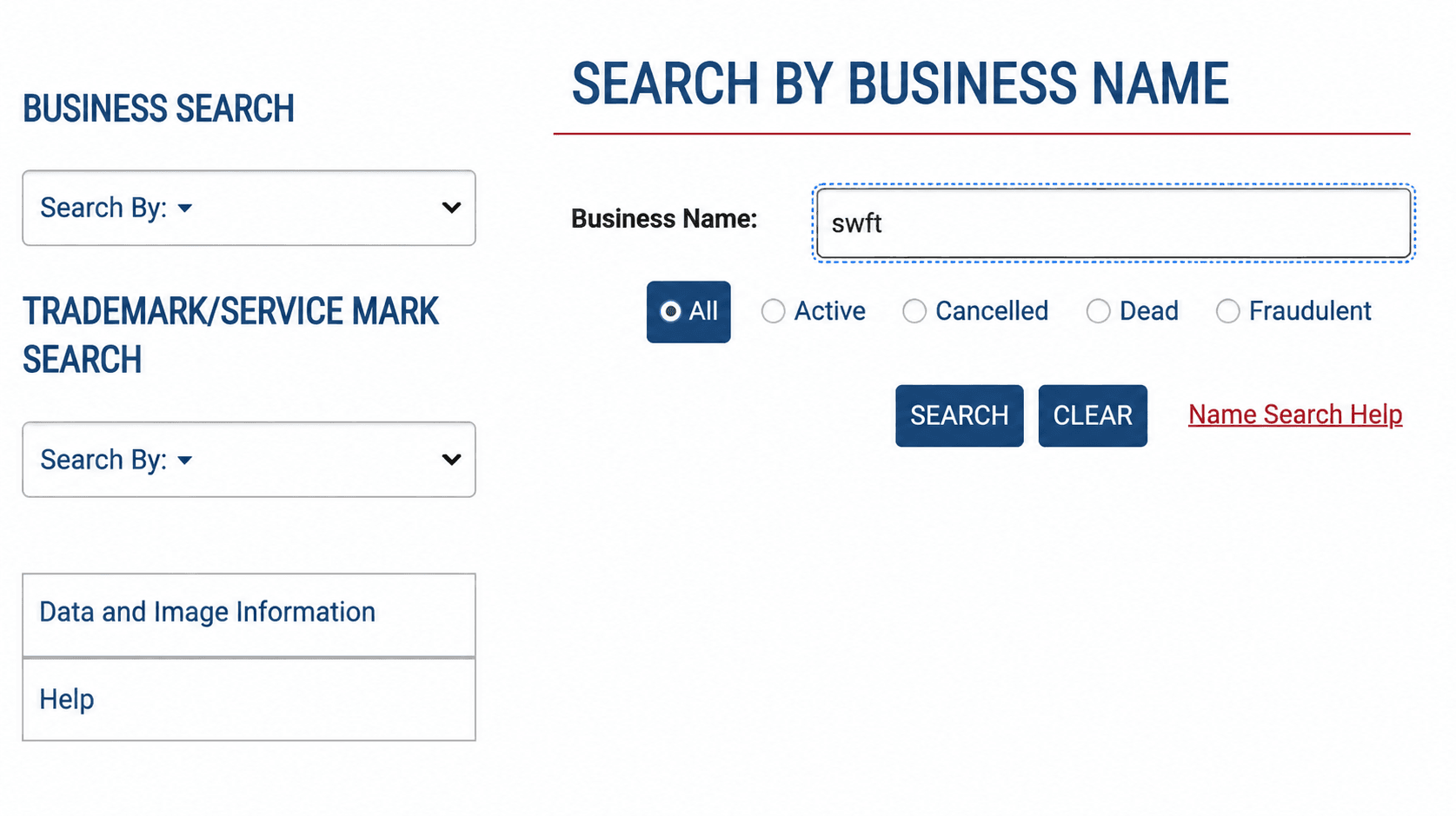
Go to businesssearch.ohiosos.gov, reached from the Businesses tab on the main Secretary of State site. [1] [2] No account, no login, no fee.
Step 2. Pick One of the Seven Search Methods
Ohio gives you seven search methods, and three of them have nothing to do with knowing the current name.
Search Method | Use It To |
Business Name | Run a partial or contains match on a name |
Exact Name | Match the precise registered name |
Prior Business Name | Find an entity under a name it no longer uses |
Agent or Registrant | Find every entity tied to a statutory agent |
Organizer or Incorporator | Find every entity tied to a founder |
Number | Pull one exact record by entity number |
Trademark or Service Mark | Search registered Ohio marks |
Prior Business Name is the one to remember. If a company rebranded, or if you are working from an old contract, this finds it when a current-name search will not. Very few state tools have it.
Step 3. Format Your Search Term the Way Ohio Expects
Ohio's system has specific formatting rules, and ignoring them produces false negatives.
- Remove special characters before searching: double quotes, apostrophes, commas, pound signs, parentheses, underscores, plus signs, forward slashes, and periods.
- Remove hyphens and concatenate. "World-Wide" becomes "worldwide."
- Treat consecutive single letters as one word. "C.R.S CONTRACTORS" should be searched as "CRS CONTRACTORS."
- Use the % wildcard for broader results. "CINCINNATI CONTRACT%" catches CONTRACTOR, CONTRACTORS, and CONTRACTING in one pass.
- Try it with and without the designator. Including or omitting LLC or Inc. changes what comes back.
Step 4. Set the Status Filter Deliberately
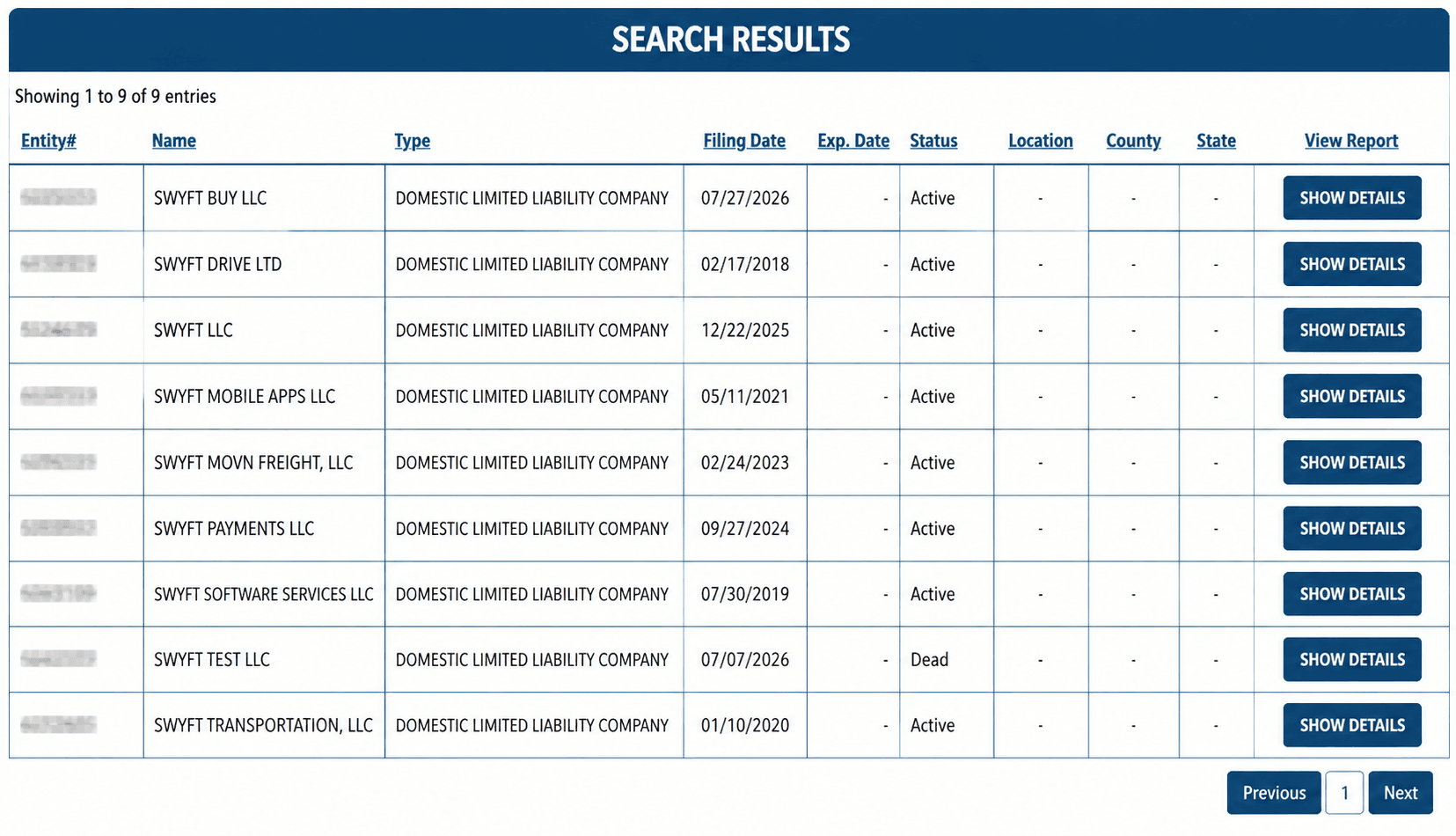
The filter offers All, Active, Canceled, Dead, and Fraudulent. Leave it on All when you are clearing a name, because a canceled entity may still be holding its name. Narrow to Active only when you are vetting a company you already know exists.
Step 5. Open Show Details and Download the Filings
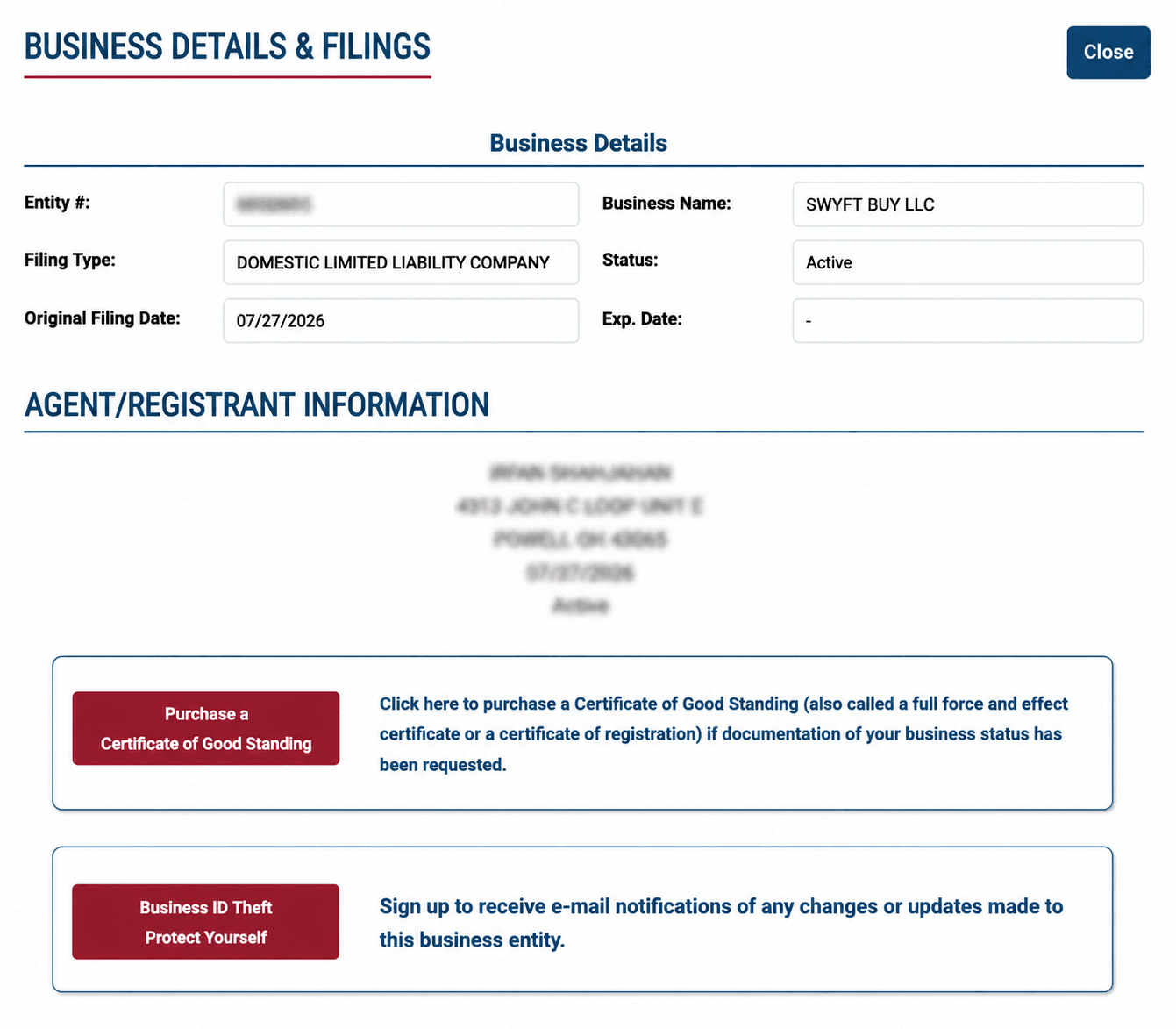
Click Show Details on any result for the full Business Details page. From there, you can view and download images of the entity's past filings for free, with no login. [1]
That is the most underused feature in the tool. You can read the actual Articles of Organization rather than a summary of them.
How To Read Your Ohio Entity Search Results
Field | What It Tells You | Why It Matters |
Entity name | The exact legal name, with spelling and punctuation | Compare against the name on any contract |
Name type | Legal name, trade name, fictitious name, or mark | Tells you whether a hit is a company or a brand filing |
Entity number | The state identifier, labeled by entity type | Save it. It is your fastest route back to the record |
Filing date | When the entity was filed with the SOS | Check it against the track record being claimed |
Expiration date | For names and marks that expire | Trade names and marks lapse; entities generally do not |
Status | Active, Hold, Canceled, Dead, or Fraudulent | The field that decides everything else |
Agent or registrant | Statutory agent name, address, effective date, and status | An agent whose own status is bad is a warning |
Location | City and county for domestic corporations | Useful for confirming you have the right company |
Filing images | Downloadable copies of past filings | Read the filing, not the summary |
Your Entity Number Has Three Different Names
This trips up anyone submitting information to another Ohio agency. The umbrella term is "entity number," but the official label depends on your entity type.
Entity Type | Official Term |
Domestic corporations | Charter Number |
Foreign corporations | License Number |
LLCs, partnerships, trusts, trade names, fictitious names, name reservations, trademarks, service marks | Registration Number |
Use the label that matches your entity type when filling in state forms. The Ohio Department of Taxation's own instructions ask for "charter number, registration number or license-to-conduct-business number," which is why getting it wrong causes processing delays.
What Ohio Entity Statuses Mean
Ohio has five statuses, and the second one is the one nobody expects.
Status | What It Means | Is the Name Available to Others? |
Active | On record as actively engaged in business and authorized to operate | No |
Hold | Canceled by the SOS for failing a legal requirement, but the name stays protected | No, not for one year after cancellation |
Cancelled | Canceled by the SOS, name no longer protected | Yes |
Dead | No longer in business after voluntary dissolution | Yes |
Fraudulent | A filing the Attorney General deemed fraudulent | The record is reverted or redacted |
Note:
Hold does not mean a filing is being processed. It means the entity was canceled, and its name remains protected for one year from cancellation under ORC § 1701.922.
For a name searcher, that changes the answer entirely. A Hold entity blocks your name today but may not in a few months. Canceled and Dead entities do not block it at all.
How To Check Business Name Availability in Ohio
Ohio requires a new name to be distinguishable upon the records of the Secretary of State under ORC § 1701.05. [6] And Ohio checks across every type at once: a corporation name is tested against LLCs, limited partnerships, reserved names, and trade names, not just other corporations.
So "Apples and Oranges Corp." will be refused if "Apples and Oranges LLC" already exists.
The Sequence That Works:
- Search with the status filter on All, so Hold entities appear.
- Search the distinctive word with the % wildcard.
- Search again with the special characters and hyphens stripped.
- Search trade names and fictitious names, since both count.
- Check the status of any close match against the table above.
- Search the federal trademark register, which the state does not check.
The Secretary of State alone decides distinguishability, and it decides at filing. A clear search is a strong signal, not a guarantee.
Still deciding what to call the business? The free Swyft Filings business name generator is a sensible first stop.
What Ohio Treats as the Same Name
These pairs are not distinguishable from each other:
This | Is the same as this |
Apple Company | Apple's Company |
Apple Orange LLC | Apple-Orange LLC |
Apple Junior | Apple Jr. |
We Are Oranges Ltd. | We're Oranges Ltd. |
Apple Inc. | A.P.P.L.E. Inc. |
Apples & Oranges | Apples and Oranges |
Apple and Orange | Apples and Oranges |
Apples or Oranges | Apples and Oranges |
An Apple and Orange Co. | The Apple and Orange Co. |
We Sell Oranges | We Sold Oranges |
Smith LLC | Smith, Inc. |
Punctuation, contractions, abbreviations, ampersands, articles, conjunctions, tense, singular versus plural, and the entity designator itself all fail to distinguish a name.
What Ohio Treats as a Different Name
These pairs are distinguishable:
This | Is different from this |
Two Apples, Three Oranges | 2 Apples, 3 Oranges |
Appples and Orranges | Apples and Oranges |
Oranges and Apples | Apples and Oranges |
Apfels | Apples |
Apple and Orangade | Apples and Oranges |
A Landscaping LLC | AA Landscaping LLC |
Quickie Laundromat | Kwikee Laundromat |
Numeral format, added letters, different word order, alternative or phonetic spelling, and a different word from the same root all work.
Ohio Naming Rules and Restricted Words
Your name must also carry the right designator and avoid reserved terminology.
Entity Type | The Name Must Contain |
Limited liability company | "Limited Liability Company," LLC, L.L.C., "Limited," LTD., or Ltd. |
Corporation | "Company," Co., "Corporation," Corp., "Incorporated," or Inc. |
Words That Need Approval or Are Reserved
- Bank, banking, banker, trust, or similar words in any language: require approval from the Superintendent of Financial Institutions, even if the business provides no banking or trust services.
- Insurance: reserved for insurance agencies.
- Cooperative wording: Company, Cooperative, Inc., Corp., Coop, Incorporated, Association, Co-Operative, Corporation, Assn., or Co-Op are reserved for cooperatives, which must use one of them.
- "A Legal Professional Association" or "Co., LPA": reserved for and required by legal organizations.
- "B-" or "Benefit": reserved for benefit corporations.
- Government wording: a name cannot imply affiliation with a government agency.
- Offensive language: refused outright.
Ohio otherwise permits any combination of letters, numbers including Roman numerals, and common symbols.
How To Reserve an Ohio Business Name
Detail | Information |
Filing | Name Reservation, Form 534B, online through Ohio Business Central or by mail |
Fee | $39 |
How long the hold lasts | 180 days |
Transfer or cancel | $25, filed on the same form |
Expedited | Additional fees apply for two-day, one-day, and four-hour service |
Ohio's 180 days is longer than most states' 120, which gives you real room to get formation documents together.
When you are ready, you can form your Ohio LLC, or file as a C Corp or file as a Nonprofit.
Ohio Trade Name vs. Fictitious Name
Ohio is one of the very few states that lets you register a DBA two different ways, on the same form, for the same fee, with completely different legal effect. Choosing wrong costs you your brand.
Item | Trade Name | Fictitious Name |
Must be distinguishable? | Yes | No |
Grants exclusive rights in Ohio? | Yes | No |
Can others register the same name? | No | Yes, any number of them |
Form | 534A | 534A |
Fee | $39 | $39 |
Term | Five years | Five years |
The Secretary of State's own example makes the difference concrete: if "Benny's Ice Cream" is registered as a fictitious name, a corporation may go ahead and register "Benny's Ice Cream, Incorporated." [3] That could not happen with a trade name.
A name is registered as a trade name if it is distinguishable from everything on file. If it is not distinguishable, it can only be reported as a fictitious name, or registered as a trade name with a Consent to Use form from the existing holder. So if the brand matters, check distinguishability first because a fictitious name is not protected.
Registration is Not Optional in Ohio
Another thing to know is that Ohio requires you to register. If a business intends to operate under a name other than its legal name, that name must be filed with the Secretary of State. [4]
The Five-Year Clock, and the Reminder
Trade name and fictitious name registrations are effective for five years from the date of registration under ORC § 1329.04. [5] Renewal must be filed in the six-month window before expiry. Failure to renew results in cancellation of the name.
Here is the part almost no state offers: the Secretary of State is required to notify you. Under ORC § 1329.04, the SOS must notify registrants within the six months before expiry, by ordinary or electronic mail to the last known address on file. [5]
That only works if your address on file is current. Ohio also requires you to update a statutory agent or address change within 30 days, and failure to do so may result in cancellation of the business. [7]
Ohio trademarks and service marks run ten years, with the same six-month renewal window. [7] Swyft Filings can handle your Ohio DBA registration, and for nationwide protection, we can help you with the federal trademark registration.
How To Get an Ohio Certificate of Good Standing
The search shows a status for free. A certificate is the signed proof of it, and it is a paid document ordered through Ohio Business Central. The name varies by entity type. Ohio may issue it as a Certificate of Full Force and Effect or, for nonprofits, a Certificate of Continued Existence. Banks, lenders, other states' foreign qualification filings, and M&A closings all ask for one.
Free filing images downloaded from the search are convenient but not certified. When a bank, court, or investor needs a certified copy, order it through Business Central rather than downloading it. If you don’t want to juggle the paperwork, Swyft Filings can obtain a Certificate of Good Standing on your behalf.
Looking Up an Ohio Nonprofit
Nonprofit corporations are formed under ORC Chapter 1702 and appear in the same search. Two Ohio-specific points:
- Read the entity type field to confirm you have a nonprofit corporation rather than a for-profit one.
- Nonprofits file a Statement or Certificate of Continued Existence rather than the filings a for-profit makes, so the filing history looks different. [3]
Registration with the Secretary of State is not the same as federal tax-exempt status, which comes from the IRS.
Ohio Business Search vs UCC Filing Search
These answer different questions and live in different systems.
Question | Where the Answer Is |
Does this company exist, and is it active? | Ohio Business Search [1] |
Does a creditor have a security interest in its assets? | Ohio UCC search, a separate Secretary of State system |
Is it current on taxes? | Ohio Department of Taxation |
Is it licensed for its work? | Ohio Business Gateway and the relevant regulator [3] |
For legal research or lending due diligence, the entity search establishes existence and standing. The UCC search establishes whether the assets are already pledged. Run both.
How To Use the Ohio Search for Due Diligence
- Search the exact legal name from the contract or invoice, not the brand name.
- Save the entity number, the status, and the date you checked.
- Confirm the status reads Active, and read the specific label if it does not.
- Run a Prior Business Name search to see whether the company has rebranded.
- Read the statutory agent, including the agent's own status field.
- Run an Agent or Registrant search to see the agent's full client list.
- Run an Organizer or Incorporator search on the founder to find their other companies.
- Download the filing images and read the actual documents.
- Order a certificate through Business Central if the transaction warrants certified proof.
What the Search Will Not Tell You
- Ownership. Ohio records organizers, incorporators, and agents, not a verified members or shareholders list.
- Financials. No revenue, assets, or credit information.
- Tax standing. That sits with the Department of Taxation.
- Licensing. The Secretary of State does not handle it. [3]
Red Flags Worth a Second Look
- A company using LLC or Inc. in its name with no Ohio record at all.
- A Hold, Canceled, or Dead status behind a business presenting itself as fully operational.
- A Fraudulent status, which means the Attorney General has been involved.
- A recent prior-name change nobody mentioned to you.
- A statutory agent whose own status field is not clean.
Let Us File Your Ohio Business
Once your search confirms a name is clear across entities, trade names, and the federal register, filing is the step that follows. Swyft Filings has helped more than 600,000 businesses get started since 2015. We handle Ohio LLC formation, C Corp and nonprofit filings, statutory agent service, DBA registration, and business name changes.
Bibliography
- Ohio Secretary of State. Ohio Business Search. Accessed on August 7, 2026.
- Ohio Secretary of State. Businesses. Accessed on August 7, 2026.
- Ohio Secretary of State. Business Frequently Asked Questions. Accessed on August 7, 2026.
- Ohio Laws and Administrative Rules. Ohio Revised Code Section 1329.01, Trade Name and Fictitious Name Registration. Accessed on August 7, 2026.
- Ohio Laws and Administrative Rules. Ohio Revised Code Section 1329.04, Term and Renewal. Accessed on August 7, 2026.
- Ohio Laws and Administrative Rules. Ohio Revised Code Section 1701.05, Corporate Name. Accessed on August 7, 2026.
- Ohio Secretary of State. Maintain Active Business and Trade Name Status. Accessed on August 7, 2026.
Other Important Resources
FAQs
Yes. The Ohio Business Search is free with no account or login, and filing images can be downloaded free from any record.[1] Certified copies and certificates are paid documents ordered through Ohio Business Central. Private lookalike sites charging for the search are not the state.
Open businesssearch.ohiosos.gov, set the status filter to All, and search the distinctive part of the name with the % wildcard. Strip out punctuation first. Click Show Details for the entity number, statutory agent, filing dates, and downloadable filings.[1]
It is the entity number the Secretary of State assigns at registration, and "charter number" is the label used for domestic corporations. Foreign corporations get a License Number, and LLCs, partnerships, trade names, and marks get a Registration Number. All three are the same field in the search.
Yes. The Agent or Registrant method returns every entity tied to a named statutory agent, and there is a separate Organizer or Incorporator method for founders. Both are among the seven search methods, and neither requires an account.[1]
It means the Secretary of State canceled the entity for failing a legal requirement, but its name remains protected for one year from cancellation. It is not a pending review. For a name searcher, a Hold entity blocks your name now and may not later.
A status added by Senate Bill 98, effective 24 October 2024, applied when the Attorney General has deemed a filing fraudulent. The record is reverted or redacted. It is a serious signal if you encounter it on a company you were about to deal with.
Search with the status filter on All, use the % wildcard on your distinctive word, and search trade and fictitious names as well as entities. Ohio checks a proposed name against every type at once, so an existing LLC blocks a corporation using the same name. The Secretary of State decides distinguishability at filing.[6]
Five years from registration, renewable for $25 in the six-month window before expiry. The Secretary of State is required to notify you within those six months, by post or email to the address on file, so keep your contact details current.[5]
No. An EIN is a federal number issued by the IRS and is not published in any Ohio state database. Apply for your own free one on the IRS website. To get a vendor's EIN, request a completed Form W-9 from them directly. Ohio's entity number is a different identifier entirely.
Order it through Ohio Business Central. Depending on entity type, it is issued as a Certificate of Full Force and Effect or, for nonprofits, a Certificate of Continued Existence. The free status shown in the search is not a substitute when a bank or another state asks for certified proof.
Filing images downloaded from the search are free but uncertified. Certified copies are ordered through Ohio Business Central, with mail requests using Form 500, and carry a fee. Check the current fee schedule before ordering.[1]
No. The Business Gateway is the state's tax and licensing portal. The Secretary of State's business search is the entity register, and the Secretary of State confirms it does not handle licensing.[3]