Learn how to run a free Indiana Secretary of State business search, understand what each status on the record means, and check whether a business name is available.
The Indiana Secretary of State keeps a free public record of every business registered in the state. Running an Indiana business search takes about a minute. Reading it correctly takes a little longer.
Indiana files reports every two years rather than every year, which makes plenty of healthy records look neglected to anyone used to an annual cycle. It also administratively dissolves businesses that fall behind, and a dissolved company can quietly release its name to whoever wants it next. This guide covers the search, the record, and both of those quirks.
Key Takeaways
- The search is free and needs no account. An INBiz login is only required to file something, not to look a company up. [1]
- Indiana reports are biennial, not annual. The Business Entity Report is due every two years, in the anniversary month of formation. [4]
- Admin Dissolved is common and fixable. Indiana dissolves a business that misses its report, and reinstatement is possible for up to five years. [3]
- A dissolved name may be up for grabs. Check whether their own name is still available first. [6]
- A clear search is not an approval. The state decides on your name when it reviews the filing or the reservation.
Indiana Business Entity Search at a Glance
Detail | Information |
Official tool | Indiana SOS Business Entity Search, also called the Indiana business search, INBiz business search, Indiana SOS business search, or Indiana entity lookup [1] |
Operated by | Indiana Secretary of State, Business Services Division |
Portal | INBiz, the state one-stop business portal, run with the Department of Revenue and the Department of Workforce Development [2] |
Cost | Free, and no account is needed to search [1] |
Search by | Business name, business ID, filing number, registered agent, or incorporator and governing person [1] |
Match types | Starts With, Contains, or Exact Match [1] |
Advanced filters | Entity type, status, address, and city [1] |
Covers | Corporations, LLCs, series and master LLCs, nonprofits, LPs, LLPs, benefit corporations, and business trusts |
Business Services Division | 302 West Washington Street, Room E018, Indianapolis, IN 46204, (317) 234-9768 [4] |
What the Indiana Business Database Covers
What You Will Find:
- Limited liability companies: Domestic and foreign LLCs, plus master LLCs and series LLCs.
- Corporations: For-profit, professional, benefit, and nonprofit corporations.
- Partnerships: Limited partnerships and limited liability partnerships.
- Other entity types: Business trusts and agricultural cooperatives.
- Name reservations: Reserved names appear as their own record type, so a name can be held without an entity existing yet.
What is Not in The Database
- Sole proprietorships: They do not register with the Secretary of State, so they leave no state record.
- County-level assumed names: A sole proprietor or general partnership files an assumed business name with the county recorder, not the state, so those names can be invisible here. [5]
- EINs and tax numbers: A federal Employer Identification Number comes from the IRS and appears in no state database.
- Business licenses: Indiana has no single statewide general business license, and local permits sit with cities and counties.
A real Indiana business trading under a registered name can be entirely absent from the state database because its name was filed at the county courthouse. [5]
How To Perform an Indiana Business Entity Search Step-by-Step
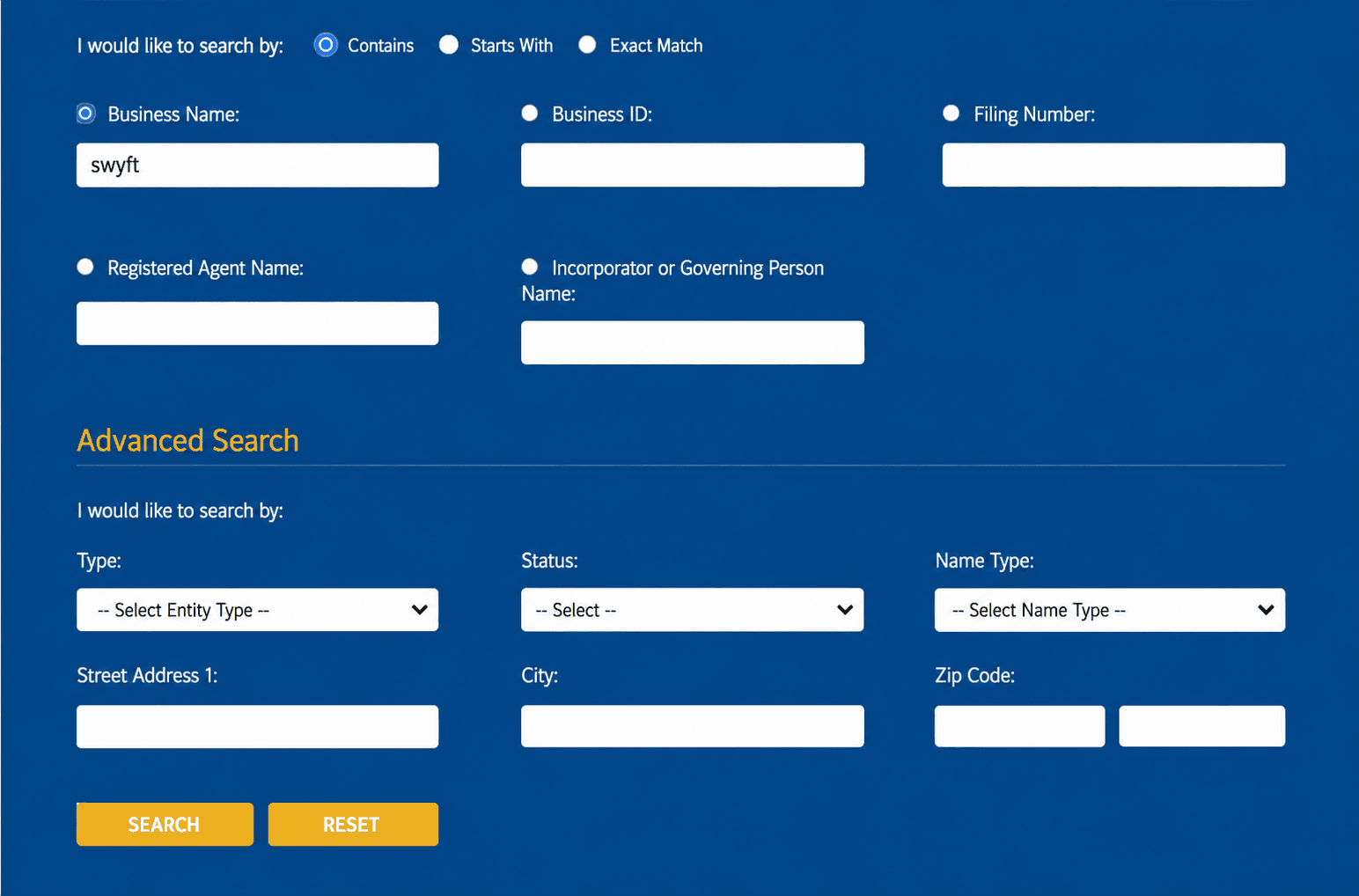
Step 1. Open the Indiana Secretary of State Business Search on INBiz
Go to the public business search run by the Business Services Division. [1] No account, no login, no fee. You only need an INBiz account to file documents or manage an entity you own.
Step 2. Choose What You Are Searching By
Search By | When To Use It |
Business name | The default, when you know or can guess the company name |
Business ID | Exact and instant, when you have the state-assigned ID |
Filing number | When you are tracing a specific document rather than a company |
Registered agent | Reverse lookup to find every entity tied to one agent |
Incorporator or governing person | To find companies connected to a named individual |
Step 3. Pick the Right Match Type
Indiana gives you Starts With, Contains, and Exact Match. Start with Contains, because Starts With will hide look-alikes that carry a filler word in front, and Exact Match will miss the near misses that can still block your filing. [1]
- Drop the designator: Search "Wabash Roofing," not "Wabash Roofing LLC." Business identifiers do not distinguish a name in Indiana.
- Drop the punctuation: Hyphens, apostrophes, and commas are not treated as differences.
- Try singular and plural: Plurals and possessives do not distinguish a name either.
- Search the distinctive word alone: One strong keyword surfaces more conflicts than a full legal name.
Step 4. Use the Advanced Filters Once You Can See the Field
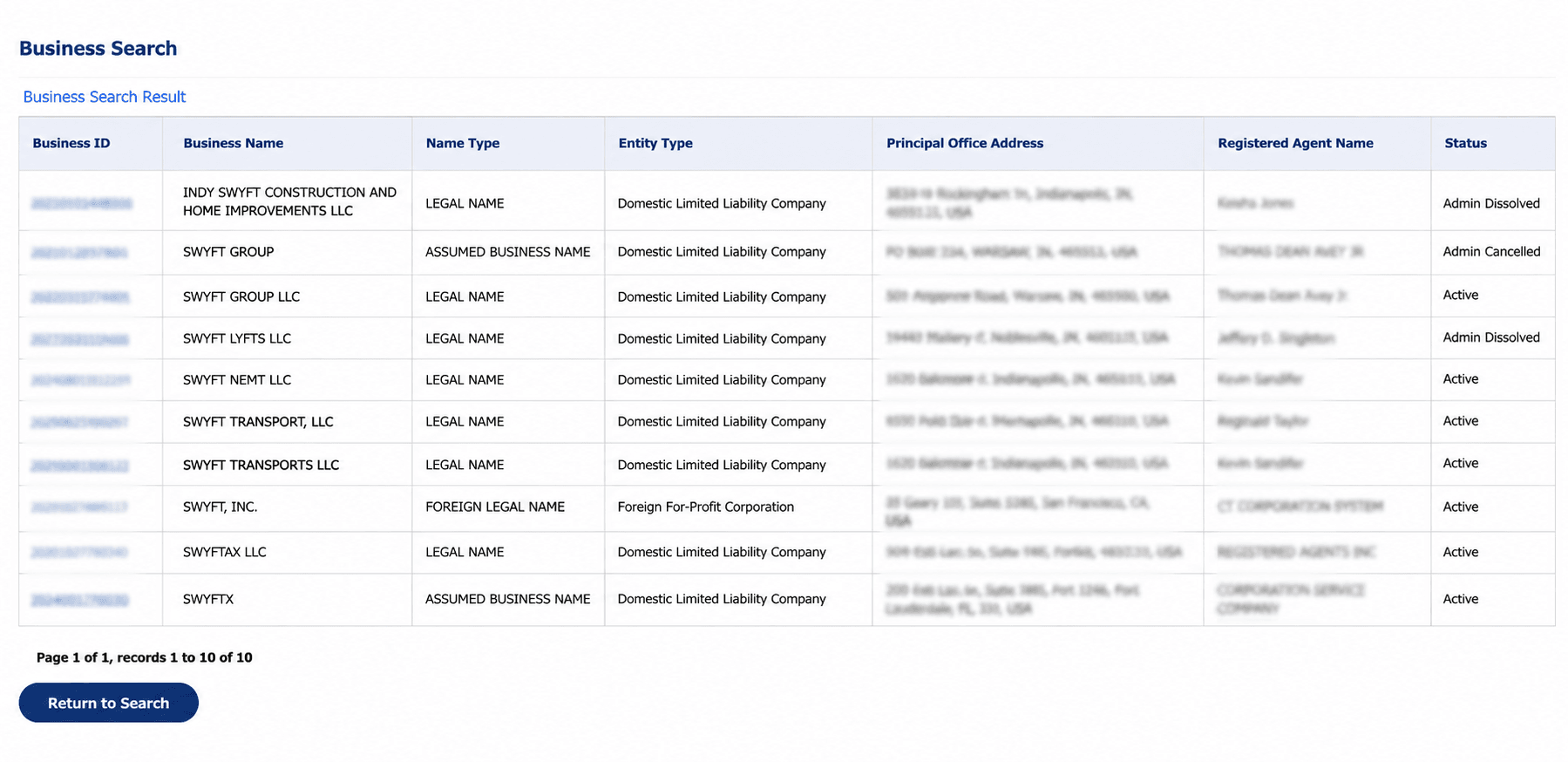
The advanced section lets you narrow by entity type, status, address, and city. [1] Filter by status only after a broad search, because excluding dissolved records hides exactly the entities you need to assess when clearing a name.
Step 5. Open the Entity Record and its Documents
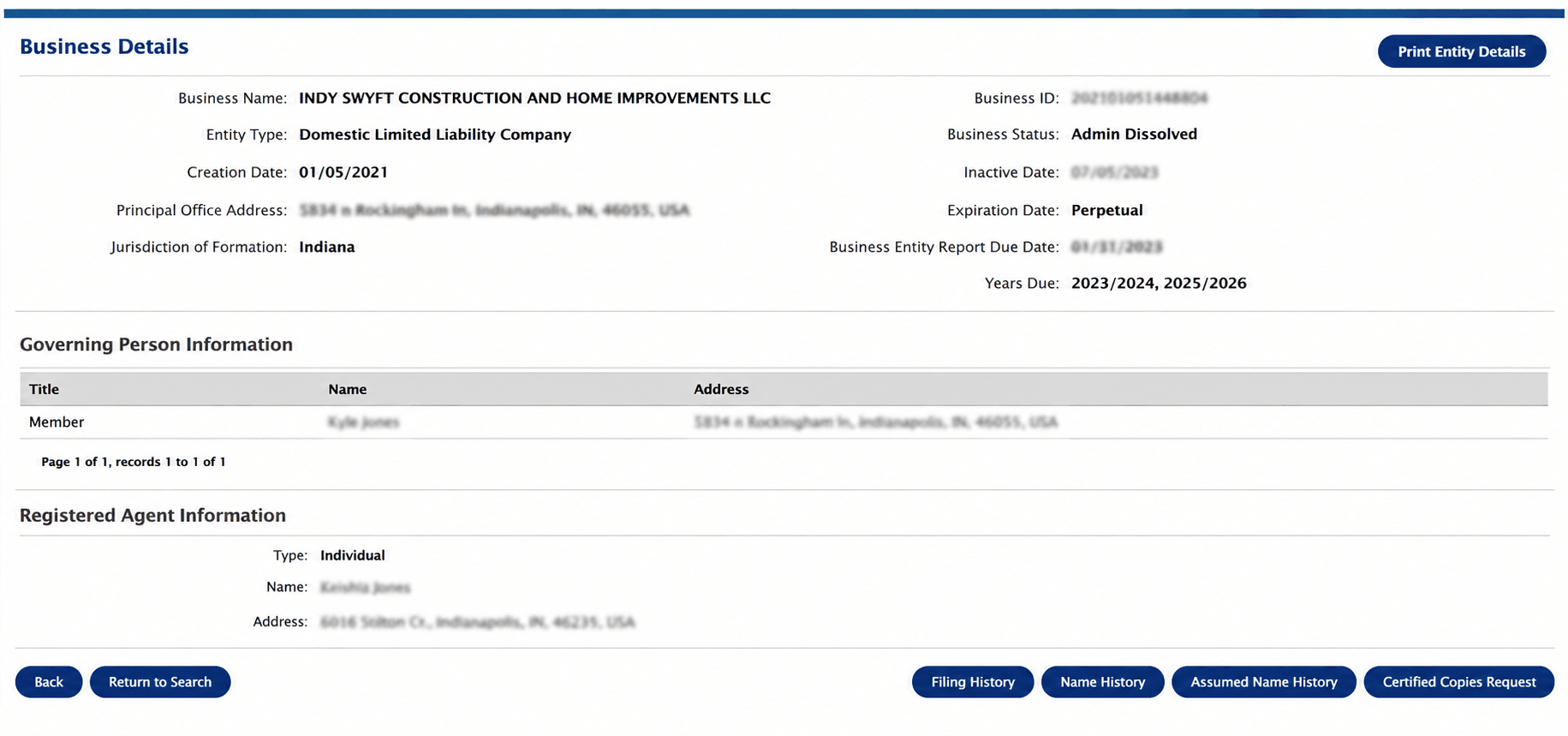
Click through from the results table to the full record. From there you can view filed PDFs, including business entity reports and articles of incorporation or organization, without an account. [1]
How To Read Your Indiana Entity Search Results
Field | What It Tells You | Why It Matters |
Entity name | The exact registered legal name | It should match the name on any contract or invoice |
Business ID | The unique state identifier | Use it for repeat lookups; it never returns the wrong record |
Entity type | LLC, corporation, nonprofit, LP, LLP, or trust | Sets which filings and naming rules apply |
Entity status | Whether the business is active with the state | The most important field on the page |
Creation or formation date | When it registered in Indiana | Check it against the experience the business claims |
Principal office address | Where the business says it operates | A mail drop or out-of-state address is worth noting |
Registered agent | Who accepts legal service, with an Indiana address | A missing agent is itself grounds for dissolution [3] |
Principals and governing persons | Officers, members, or managers on record | The closest thing Indiana publishes to leadership |
Business Entity Report due date | When the next biennial report is due | The fastest way to tell whether a record is genuinely current |
Years due | Which report years are outstanding | Two or more years owed is a real warning sign |
Filed documents | Reports and formation documents as PDFs | Read the actual filing rather than a summary |
Read the report due date and the years due together. Because Indiana runs a two-year cycle, a record that looks stale to someone used to annual reports may be perfectly current. [4]
What Indiana Entity Statuses Mean
Active is the status you want. The rest are questions to ask before you sign anything, and one of them matters a great deal if you are clearing a name.
Status | What It Means | What To Do |
Active | Registered and current with the Secretary of State | Proceed with normal due diligence |
Pending Administrative Dissolution or Revocation | A report is overdue, and the state has issued a warning letter | The business can still cure it by filing before the deadline on the letter [3] |
Admin Dissolved | The state terminated a domestic entity for non-compliance | It cannot legally conduct business in Indiana until reinstated [3] |
Revoked | The state withdrew a foreign entity's registration | Same effect as dissolution for an out-of-state company [3] |
Dissolved | The owners closed it voluntarily | Do not contract with it |
Withdrawn | A foreign entity ended its Indiana registration | Confirm where it is registered now |
Merged | Absorbed into another entity | Identify and vet the surviving entity instead |
Why Indiana Statuses Change: The Business Entity Report
Indiana entities file a Business Entity Report every two years, due in the anniversary month of formation. [4] Two things trigger administrative dissolution or revocation: failing to file and pay that report, and failing to maintain a registered agent. [3] Indiana dissolves a business when the report is not filed within 120 days of its due date.
Series LLCs are an exception worth knowing. A series does not file its own Business Entity Report. [4] If you want the deadline off your plate entirely, Swyft Filings can handle your business entity report filing.
Can You Use a Name That Shows as Admin Dissolved in Indiana?
An administratively dissolved Indiana business cannot legally conduct business in the state until it reinstates. [3] But it does not lose its name at the moment of dissolution, and it does not keep it forever either. The state's own reinstatement form tells a business applying to reinstate to check on INBiz whether its own name is still available, and to file Articles of Amendment to change the name if it is not. [6]
In other words, Indiana will let someone else take the name of a dissolved company, and the dissolved company has to rename itself when it comes back. What that means:
- You may be able to take the name: The entity is not protecting it the way an active entity does.
- The original owner may come back: Reinstatement is available for up to five years from the effective date of dissolution. [6] [8]
- After five years, the door closes: A business dissolved for five years or more cannot reinstate and must register as a new entity. [3]
- Reinstatement is slow: It requires a Certificate of Clearance from the Department of Revenue, which takes around four weeks, plus every outstanding Business Entity Report. [6]
- Confirm before you commit: Run the name through the search immediately before you file, not weeks ahead.
The safest route, if a dissolved company is holding the name you want, is to reserve the name rather than assume it is free.
How To Check if a Business Name Is Available in Indiana
- Search your full name using Contains, and read every near miss.
- Search the single most distinctive word in the name.
- Search again without the entity designator and without punctuation.
- Clear the status filter so dissolved and revoked records appear in the results.
- Check the status of any close match against the section above.
- Search the federal trademark register separately, since Indiana does not cover it.
A no-match result is preliminary. Indiana reviews every name reservation and registration request and reserves the right to deny a name that is too similar to one already on file.
Still deciding what to call the business? The free Swyft Filings business name generator is a sensible first stop before you pay a reservation fee.
Indiana LLC Naming Requirements and Restricted Words
Two rules apply at once. Your name has to carry the right designator, and it has to be distinguishable from names already on file.
Entity Type | The Name Must Contain |
Limited liability company | "Limited Liability Company," or the abbreviation LLC or L.L.C. |
For-profit corporation | "Corporation," "Incorporated," "Company," or "Limited," or Corp., Inc., Co., or Ltd. |
Nonprofit corporation | A corporate designator, per the requirements for its entity type |
Limited partnership | "Limited Partnership" or an accepted abbreviation |
Limited liability partnership | "Limited Liability Partnership" or an accepted abbreviation |
What Does Not Make an Indiana Business Name Distinguishable
- Punctuation: Hyphens, commas, apostrophes, and periods.
- Capitalization: Upper or lower case makes no difference.
- The business identifier: Swapping LLC for Inc. on an otherwise identical name.
- Plurals and possessives: Adding an s or an apostrophe s.
- Hyphenation: Joining or splitting words with a hyphen.
Words That Need Extra Paperwork or Are Off Limits
- Government implication: A name cannot suggest the business is a government agency.
- Regulated professions and industries: Words such as attorney, university, and bank require additional paperwork or approval before the filing will clear.
- Profanity and restricted phrases: The Secretary of State will reject them outright.
- Misleading purpose: A name cannot imply an activity the entity is not authorized to conduct.
How To Reserve an Indiana Business Name Without Registering Yet
Reserving is optional, cheap, and the only step that actually holds a name. A clear search does not.
Detail | Information |
Fee | $10.00, paid by card |
How long the hold lasts | 120 days |
Renewable? | Yes, the reservation can be renewed |
How to file | Online through INBiz only. Indiana does not accept a paper name reservation [2] |
Where in the portal | Secretary of State Business Service Division, then Name Reservation [2] |
What it does not do | A reservation does not form your business or authorize you to trade |
If your formation documents are ready, you can skip the reservation entirely and file, which claims the name at the same moment. When you are ready, you can form your Indiana LLC, or file as a C Corp or nonprofit.
Indiana Assumed Business Name Search
Indiana calls a DBA an assumed business name, and where it gets filed depends on what kind of business you run.
Assumed Business Name Versus Legal Entity Name
Your legal entity name is what appears on your Articles of Organization or Incorporation and in the state search. An assumed business name is a second name you trade under. It creates no new legal entity and changes nothing about your tax position.
Where You File, By Business Type
Your Business | Where the Assumed Name Is Filed |
Registered entity such as an LLC or corporation | Certification of Assumed Business Name with the Secretary of State [5] |
Sole proprietor or general partnership | The county recorder in the county where the business operates. The state form cannot be used for a county filing [5] |
What This Means For Your Search
- Search both levels: A name held by a sole proprietor at the county level will not appear in the state search.
- An assumed name is not protection: It records the name publicly but does not give you exclusive rights against a trademark holder.
Swyft Filings can handle your Indiana DBA registration, and for genuine brand protection, we can help you with the federal trademark registration.
Searching for Out-of-State Companies Registered in Indiana
A company formed elsewhere that transacts business in Indiana must register with the Secretary of State, and it then appears in the same search alongside domestic entities.
- Run a normal name search: There is no separate foreign entity database.
- Read the entity type: Foreign versions of most domestic types are listed separately, so the type field tells you where the company was formed.
- Revoked means it lost authority: For a foreign entity, revocation of registration is the equivalent of administrative dissolution. [3]
- Reinstatement needs a home-state certificate: A foreign entity reinstating in Indiana must supply a certificate of existence issued in the last 60 days by its home state. [6]
- No record is meaningful: An out-of-state company doing real business in Indiana with no record may not have registered as required.
How To Request an Indiana Certificate of Existence
Indiana calls its good standing document a Certificate of Existence. The free search shows you a status. The certificate is the signed proof of it, and banks, lenders, and other states routinely ask for one.
- Order it through INBiz: From the entity record on the state portal. [2]
- Two versions exist: A standard certificate and a long-form certificate, with the long form requested through the Information Request Form. [7]
- The entity must be current: An administratively dissolved or revoked entity cannot get one until it reinstates. [3]
- Historic records take longer: Certified copies of older microfilm-era records are processed on a longer timeline than current filings. [7]
Swyft Filings can help you get a Certificate of Good Standing if you don’t want to deal with the portal yourself.
Indiana Business Entity Search Costs
Searching is free. These are the costs attached to searching, holding a name, and registering an assumed name. [5] [7] Confirm current amounts on INBiz before you pay, since fees change.
Service | Fee | Notes |
Indiana business entity search | Free | No INBiz account needed [1] |
Registered agent and governing person search | Free | Reverse lookup in the same tool [1] |
Viewing filed documents | Free | Reports and formation PDFs from the entity record [1] |
Name reservation, 120 days | $10.00 | Online only, renewable [2] |
Assumed business name, online | $20.00 per name | $10.00 for nonprofit corporations |
Assumed business name, paper | $30.00 per name | $26.00 for nonprofit corporations [5] |
Certificate of Existence | See INBiz | Standard and long-form versions available [7] |
How To Verify an Indiana Company Before You Deal With It
- Search the exact legal name from the contract or invoice, not the brand name.
- Confirm the status reads Active, and not Admin Dissolved, Revoked, or Pending.
- Read the Business Entity Report due date and the years due together.
- Check the creation date against the experience the business claims.
- Confirm the registered agent is current, since a missing agent alone can trigger dissolution. [3]
- Run a registered agent search to see how many entities share that agent.
- Open the filed documents and read the actual reports rather than the summary.
- Ask for a Certificate of Existence if the deal is significant.
Red flags Worth a Second Look
- A company using LLC or Inc. in its name with no state record at all.
- An Admin Dissolved or Revoked status behind a business presenting itself as fully operational.
- Two or more report years showing as due.
- A very recent creation date behind a claim of long experience.
- A legal name on the record that does not match the paperwork you were sent.
Let Us File Your Indiana Business
Once your search confirms a name is clear, filing is the step that follows. Swyft Filings has helped more than 600,000 businesses get started since 2015. We handle Indiana LLC formation, C Corp and nonprofit filings, registered agent service, DBA registration, business entity report filing, and business name changes, so no deadline is yours to track.
Bibliography
- Indiana Secretary of State. Business Entity Search. Accessed on August 6, 2026.
- INBiz. Indiana Business Portal. Accessed on August 6, 2026.
- INBiz. Administrative Dissolution and Revocation. Accessed on August 6, 2026.
- Indiana Secretary of State. Indiana Business Entity Report, State Form 48725. Accessed on August 6, 2026.
- Indiana Secretary of State. Certification of Assumed Business Name, State Form 30353. Accessed on August 6, 2026.
- Indiana Secretary of State. Application for Reinstatement, State Form 4160. Accessed on August 6, 2026.
- Indiana Secretary of State.Application for Reinstatement, State Form 4160. Accessed on August 6, 2026.
- Indiana General Assembly. Indiana Code Title 23, Business and Other Associations. Accessed on August 6, 2026.
Other Important Resources
FAQs
Active means the entity is registered and current with the Secretary of State. Dissolved means it has ended, either voluntarily by its owners or administratively by the state. An administratively dissolved business cannot legally conduct business in Indiana until it reinstates.[ [3] ]
Often, yes. Indiana does not permanently hold a name for a dissolved entity, and the state's own reinstatement form instructs a returning business to check whether its name is still available and to change it if not.[ [6] ] Reserve the name rather than assume it, and search again immediately before you file.
Search the state database first, because your chosen name still cannot conflict with a registered entity. Then check the county recorder in your county, since that is where sole proprietor assumed business names are filed.[ [5] ]
Yes. Dissolved, revoked, and withdrawn entities stay in the database with their status shown, and their filed documents remain viewable. Just clear the status filter, because narrowing to active records hides exactly the entities you need to see when clearing a name.