

A decade of search-behavior data (2015–2025) reveals a permanent shift in how SMB/SME owners think about business financing, and what that means for entrepreneurs today.
Key Findings
- +78%: Grant search interest growth post-COVID
- 100/100: Peak grant score in April 2020 (Google Trends)
- 2.5x: Post-COVID vs pre-COVID SMB grant search volume
- +3.8%: Loan interest change pre vs. post-COVID
"Small business owners aren't just looking for money. In fact, they're looking for
money they don't have to pay back. A decade of data shows COVID-19 didn't
just trigger a short-term spike in grant searches; it permanently rewired
how entrepreneurs think about funding their businesses."
Compiled by Swyft Filings Research using Google Trends data across global, U.S., and U.K. markets, spanning 2015 to 2025.
New Research Finds Small Business Owners Have Permanently Abandoned Loans in Favor of Grants
COVID-19 didn't just reshape public health; it reshaped small business finance. New data from Swyft Filings, compiled from nearly a decade of global search behavior, reveals that the pandemic triggered a fundamental and lasting shift in how small and medium-sized business (SMB/SME) owners approach funding. Grant-related searches surged by 78% on average in the post-pandemic era compared to pre-2020 baselines, while loan interest grew by just 3.8% over the same period.
The findings challenge a long-held assumption in the financial services sector: that business loans are the default financing tool for growing companies. The data tell a different story, one where entrepreneurs, battered by economic uncertainty and inspired by unprecedented government stimulus programs, have permanently recalibrated their funding instincts toward free, non-repayable capital.
HOUSTON, TX — Swyft Filings, a leading U.S. business formation platform, today released findings from a comprehensive analysis of SMB funding search behavior spanning 2015 to 2025. The study tracked 2,500 distinct grant and loan-related search queries across global, U.S., and U.K. markets, revealing a seismic and sustained shift in entrepreneur financing preferences.
Summary
This study analyzes relative search interest data for small business funding queries from January 2015 through Dec 2025, covering global trends with specific attention to the United States and the United Kingdom. The dataset comprises 2,500 keywords and query series spanning grant-specific, loan-specific, and general funding regarding small and medium-sized businesses.
Metric | Pre-COVID (2015–2019) | COVID Peak (Mar–Apr 2020) | Post-COVID (2021–2025) | Change |
Grant Search Index | 16.4 | 87.5 | 29.3 | +78.2% |
Loan Search Index | 32.1 | 76.0 | 33.3 | +3.8% |
"Small Business Grants" | 11.0 | 100 (peak) | 27.0 | +145% |
"Govt Grants for SMB" | 17.3 | 100 (peak) | 27.4 | +58% |
"Small Business Loans" | 54.4 | 100 (Apr 2020) | 56.4 | +4% |
Table 1: Summary of key funding-search metrics across periods. Index values are relative (0–100 Google Trends scale); averages computed across respective date ranges.
Background & Methodology
Access to capital is the lifeblood of small business growth. For decades, business loans, whether from banks, credit unions, or the U.S. Small Business Administration (SBA), served as the primary external financing mechanism for SMBs. Grants, by contrast, were considered niche, limited, and difficult to obtain.
This study uses Google Trends data as a proxy for SMB owner intent and preference. Search behavior is one of the most reliable real-time indicators of consumer and entrepreneur psychology: when owners search for grants rather than loans, they are signaling both awareness of and preference for non-repayable funding.
Data Sources & Parameters
- Platform: Google Trends (relative search interest, 0–100 scale).
- Period: January 2015 – Dec 2025 (132 monthly data points).
- Geographies: Global, United States, United Kingdom.
- Query Categories: 1600 grant-related terms, 500 loan-related terms, 400 general funding terms — 2,500 total keyword series.
- Methodology: Monthly relative interest scores averaged across thematic clusters; period averages computed for pre-COVID (2015–19), COVID year (2020), and post-COVID (2021–25).
Note: Google Trends scores are normalized to the peak value in each series (peak = 100). This methodology measures relative changes in search preference rather than absolute search volumes, making it ideal for tracking shifts in entrepreneur mindset over time.
The Long View: A Decade of Shifting Preferences
The most striking finding from the data is not the COVID spike itself, which was expected given unprecedented government relief programs, but rather what came after. Grant search interest did not return to pre-2020 levels. Instead, it settled at a permanently elevated plateau, creating a structural shift in the grant/loan search ratio.
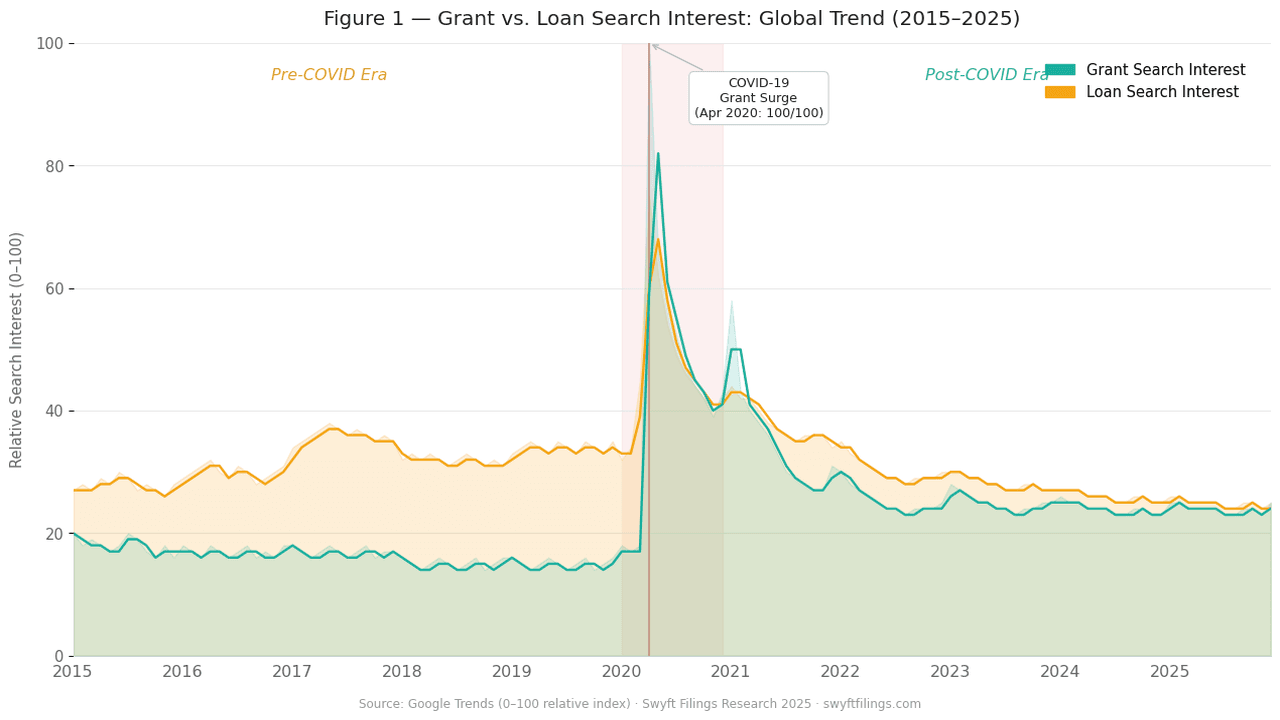
Before COVID-19, the landscape was clear: loan-related search terms, particularly "small business loans" and "startup loans," dominated over equivalent grant terms. The average pre-COVID loan search index stood at 32.1, compared to 16.4 for grants; a near-2:1 ratio in favor of debt-based financing interest.
Then came March 2020. Within a single month, multiple grant-related search terms hit their absolute peak (100/100) on Google Trends simultaneously; a phenomenon unprecedented in the prior five years of data. By April 2020, 'small business grants,' 'grants for small business,' 'business grants,' 'small business grant,' and 'government business grants' all peaked at 100, the theoretical maximum. What followed was not a return to baseline.
Core Finding 1: The 78% Grant Surge That Stuck
When comparing the pre-COVID era (2015–2019) to the post-COVID era (2021–2025), the data reveals a dramatic and permanent realignment:
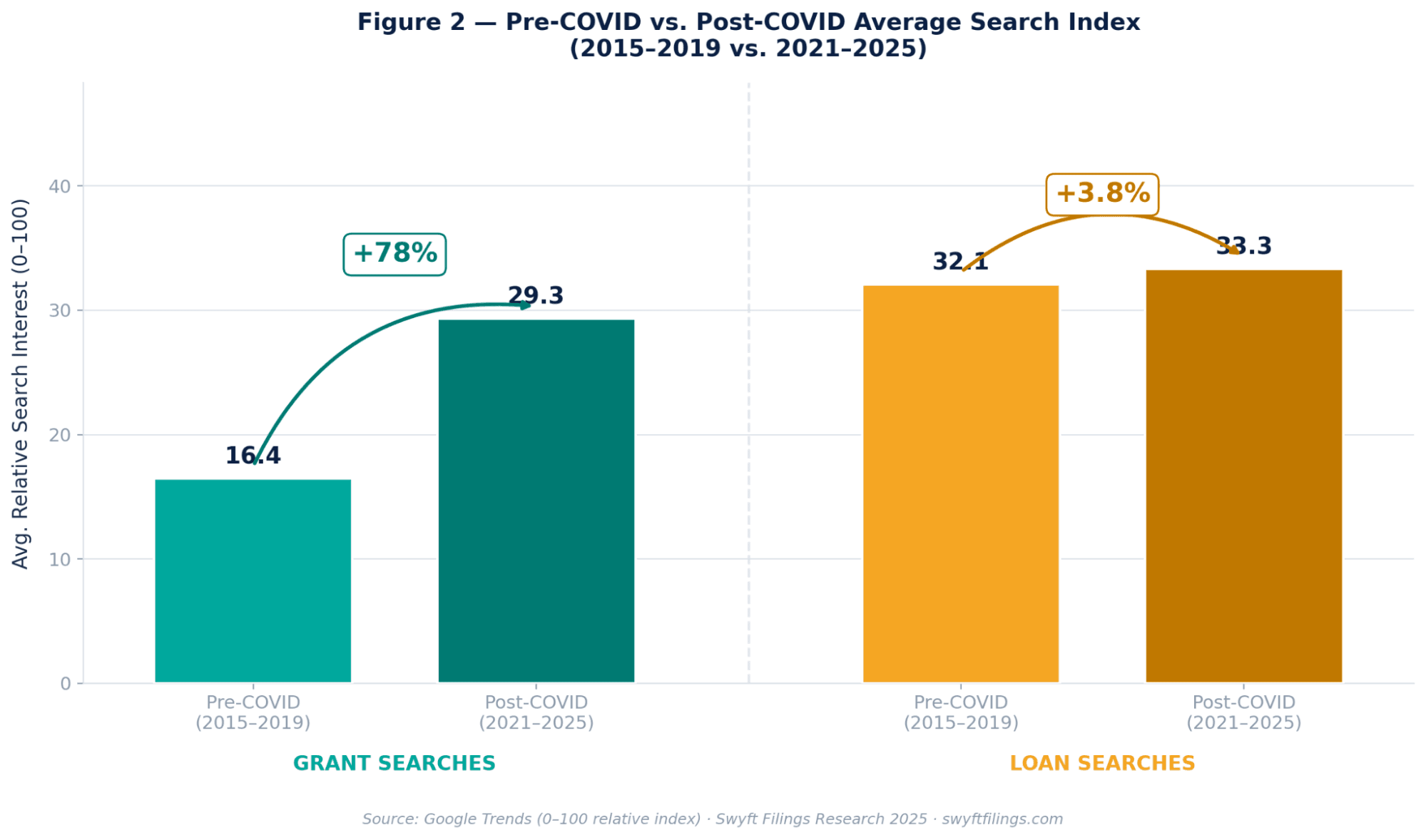
The grant search index rose from an average of 16.4 (2015–2019) to 29.3 (2021–2025); an increase of +78.2%. The loan search index, meanwhile, moved from 32.1 to 33.3, a statistically negligible +3.8%. The gap between grant and loan interest has closed dramatically. For the first time in the data's history, grant searches are approaching parity with loan searches.
More specifically, the term 'small business grants' recorded an average search score of just 11.0 across 2015–2019. By 2021–2025, that average had reached 27.0, a 145% increase. This is not noise. This is a structural change in small business owner psychology.
Core Finding 2: COVID Acted as a Catalyst, Not a Cause
A critical distinction in the data: the preference for grants was not invented by COVID-19; in fact, it was accelerated and permanently amplified. Even in the pre-2020 data, grant search queries were growing gradually from 2015 to 2019, particularly around "government grants for small business" and "business grants." The pandemic acted as an accelerant, compressing a decade's worth of attitudinal shift into a single year.
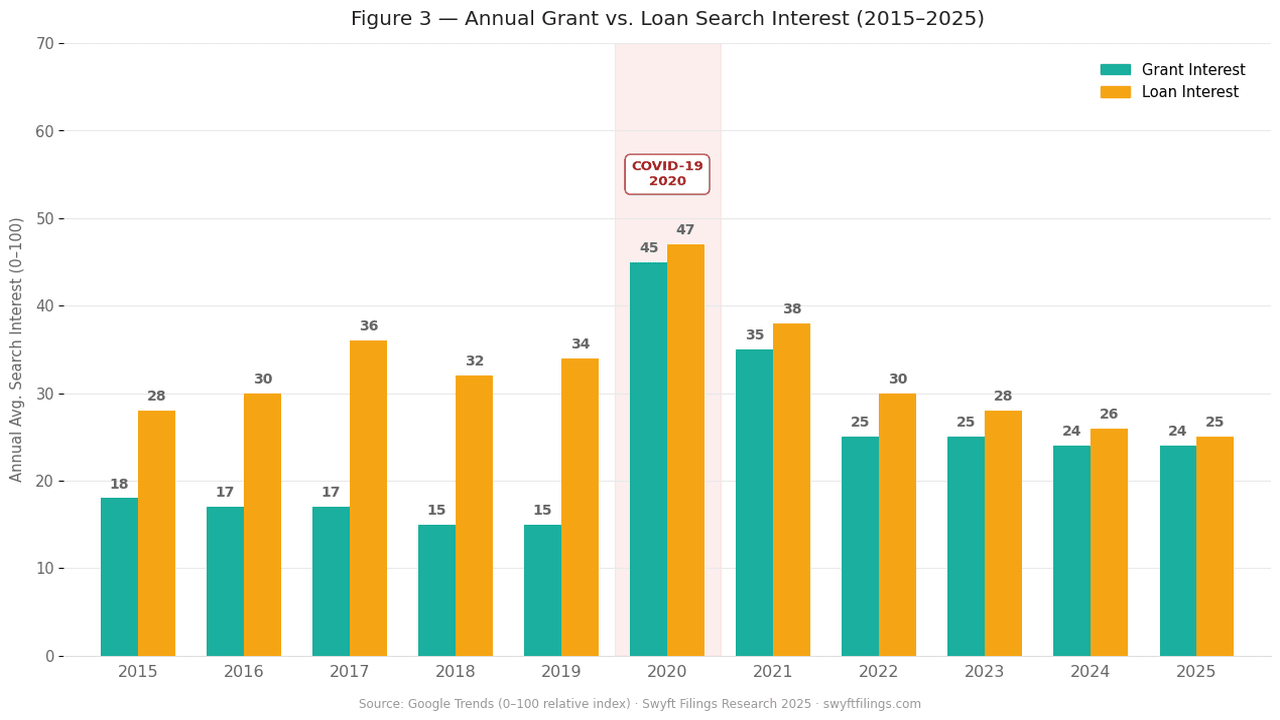
The 2020 spike reached staggering levels. In March 2020 alone, 'government grants for small business' hit 100/100; it's the all-time peak. The following month, 'small business grants,' 'grants for small business,' 'business grants,' and 'small business grant' all simultaneously hit 100/100. The stimulus effect was extraordinary.
Crucially, this also coincided with loan searches peaking; 'small business loans' hit 100 in April 2020, and 'business loans' hit 100 — evidence that entrepreneurs explored all funding avenues simultaneously. But in the years that followed, loan interest reverted much closer to pre-COVID norms while grant interest did not.
Core Finding 3: The Grant-to-Loan Ratio Reversal
Perhaps the most commercially significant finding is the keyword-level comparison between equivalent grant and loan terms. Before COVID-19, loan-related terms were consistently more searched. After COVID-19, that relationship inverted for several key keyword pairs.
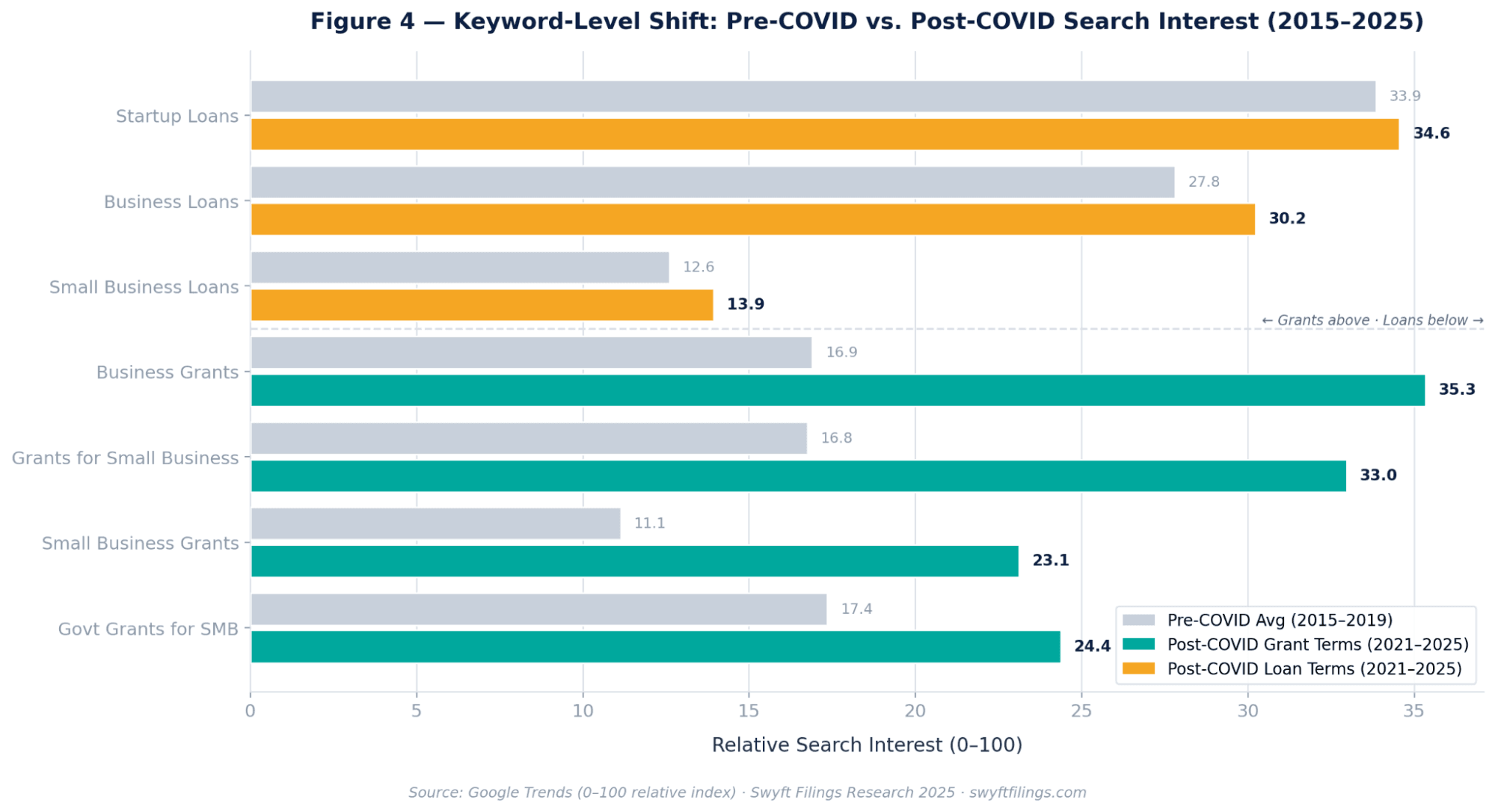
The chart above reveals a striking pattern: every grant-related keyword saw a substantial increase post-COVID, while loan-related keywords remained relatively flat. 'Grants for small business' grew from 18.5 to 31.0 post-COVID. 'Government grants for small business' grew from 17.3 to 27.4, which is a 58% increase. Meanwhile, 'small business loans' moved only marginally.
Core Finding 4: New Demographics Enter the Grant Landscape
One of the most revealing signals in the data is the emergence of 'grants for women in business' as a meaningful search term from 2020 onwards. This term recorded near-zero search volume in 2015–2019 for many months, but from 2020 began appearing consistently with readings of 18–27. This suggests the pandemic-era grant awareness campaign reached new entrepreneurial demographics, particularly women-owned small businesses, who had not previously engaged with grant-seeking behavior.
This diversification of the grant-seeking population represents a structural market expansion. The grant landscape is no longer the preserve of charities, academic institutions, or large-scale innovators. It has been democratized.
Regional Context: U.S. & U.K. Patterns
While the dataset's global aggregate reveals the macro trend, the U.S. and U.K. contexts add important regional texture. Both markets experienced the same fundamental shift, but with distinct characteristics reflecting differences in their small business financing ecosystems.
United States
The U.S. grant surge was closely tied to federal COVID relief programs, particularly the Paycheck Protection Program (PPP), Economic Injury Disaster Loans (EIDL), and targeted SBA grant schemes. Though the PPP was technically a loan (with forgiveness provisions), it introduced millions of small business owners to government-facilitated funding for the first time, and normalized the idea of 'free money from government.'
The data shows U.S. SMB owners' grant interest remained elevated well beyond the initial stimulus period. Terms like 'government grants for small business' and 'small business grants' sustained elevated search scores through 2021 and 2022, suggesting that the PPP experience didn't just provide emergency relief — it fundamentally changed how American entrepreneurs think about federal funding. Many owners, having successfully navigated a government program for the first time, began actively searching for additional grant opportunities.
The U.S. small business sector employs approximately 46% of private-sector workers and accounts for 43.5% of GDP. A permanent shift in how these businesses seek capital has macroeconomic implications beyond just individual company finance. When entrepreneurs seek grants over loans, they reduce their exposure to interest-rate risk, which is a particularly important shift given the Federal Reserve's rate-hiking cycle of 2022–2023.
United Kingdom
In the U.K., the grant surge was driven by a different but equally powerful cocktail of factors: the Coronavirus Job Retention Scheme (furlough), the Small Business Grant Fund, the Retail, Hospitality and Leisure Grant Fund, and later the Restart Grant program. For many U.K. SME owners, 2020 was the first time they had ever interacted with a government grant program.
U.K.-specific search patterns reveal a strong and sustained interest in government grants that persisted through the post-pandemic recovery. Post-Brexit trade uncertainty added an additional dimension: as U.K. businesses lost access to certain EU funding streams (including Horizon Europe and ERDF regional funds), domestic grant searches intensified — owners seeking alternative non-repayable capital to offset the funding gaps created by departure from EU programs.
The U.K. government's recognition of this demand is evidenced by subsequent programs, including the Help to Grow scheme, Innovate UK grants, and various UK Shared Prosperity Fund components, all of which kept grant awareness elevated in the post-2021 period.
Why Are Small Business Owners Choosing Grants Over Loans?
The search data documents the 'what', but the 'why' requires contextual analysis. Multiple converging factors explain why the grant preference has persisted:
- The Debt Aversion Effect: Post-pandemic SMB owners carry significantly higher debt loads than their pre-2020 counterparts. Many took on emergency loans or credit facilities during COVID and are now debt-servicing averse. The appeal of non-repayable funding has never been stronger.
- Interest Rate Shock: The Federal Reserve raised rates from near-zero to over 5% between 2022 and 2023. For small businesses operating on thin margins, the cost of loan capital rose dramatically, making grants comparatively more attractive on a risk-adjusted basis. The data shows no corresponding decline in grant searches during the rate cycle.
- Government-Normalized Mindset: The pandemic proved that government money was obtainable, navigable, and potentially life-saving for small businesses. This changed the perceived accessibility of grants. Where once SMB owners assumed grants were only for nonprofits or R&D companies, millions now know from direct experience that grants can flow to any viable business.
- Digital Discovery & Visibility: Grant aggregator platforms, consultant networks, and social media communities dedicated to SMB grants have proliferated since 2020. Awareness of available grants has increased substantially, directly fueling search intent.
- Equity Preservation: As venture capital and angel investment became harder to access in the 2022 funding downturn, grant funding emerged as a mechanism to finance growth without diluting equity, particularly valuable for founders who had already considered and rejected VC terms.
- Women & Minority-Owned Business Programs: Dedicated grant programs for underserved founders, including BIPOC entrepreneurs and women-owned businesses, gained significant visibility post-2020. The data captures this through the emergence of 'grants for women in business' as a standalone, meaningful search category.
Implications for Small Business Owners
The data presents both an opportunity and a warning. The grant-preference shift means more entrepreneurs are competing for the same pool of non-repayable capital. At the same time, awareness and infrastructure improvements mean more grants are being made available and more successfully accessed. Here is what the data means in practice:
Implication | What It Means for You | Action |
Grant competition has intensified | More businesses searching = more applicants per grant pool. Quality of application matters more than ever. | Invest in professional grant writing or formation services before applying. |
Non-repayable capital is now mainstream | Grants are no longer niche. They are a primary tool in every serious entrepreneur's funding toolkit. | Build a grant calendar and apply systematically, not opportunistically. |
Formal business structure increases eligibility | Most grants require an LLC, corporation, or registered entity. Sole proprietors miss most opportunities. | Formalize your business structure early. LLC formation is fast and affordable with services like Swyft Filings. |
Loans still have a critical role | Grants fund projects; loans fund operations. The two are complementary, not mutually exclusive. | Build a blended capital strategy: grants for growth initiatives, SBA loans for working capital needs. |
Women & minority grants are underutilized | Despite rising awareness, dedicated demographic programs remain undersubscribed relative to their funding pools. | Research WBENC, NMSDC, and SBA 8(a) programs proactively if you qualify. |
Table 2: Practical implications of the grant preference shift for SMB/SME owners.
Commentary: What This Means for Business Formation
The surge in grant-seeking behavior has a direct implication for business formation that is often overlooked: most grant programs require applicants to operate as a formally registered business entity. Sole proprietors, freelancers, and informal operators are typically ineligible for government and foundation grants.
The single most impactful step an entrepreneur can take to maximize their access to grant funding is to formalize their business structure. An LLC or corporation is not just a liability shield; it is a key to unlocking the funding landscape that data now shows entrepreneurs are actively seeking.
Swyft Filings has helped over 600,000 entrepreneurs formalize their businesses across all 50 U.S. states. The company's research division compiled this study to help existing and aspiring small business owners understand the macro financing landscape and make more informed decisions about capital strategy.
The trend data suggest that entrepreneurs who formalize their business structure early and position themselves to access non-repayable capital will have a structural advantage over competitors who rely solely on debt financing in a high-interest-rate environment. As the data shows, this is not a fringe strategy: it is the dominant instinct of the modern small business owner.
Looking Ahead: The Grant Economy Through 2025 and Beyond
The data collected through Dec 2025 shows grant interest stabilizing at a structurally higher level than pre-COVID. Several macro forces suggest this trajectory is likely to continue rather than reverse:
- AI and technology grants: Federal and state programs targeting AI adoption by small businesses have proliferated since 2025, creating new grant categories that simply did not exist in the pre-2020 data.
- Climate and sustainability funding: The Inflation Reduction Act and equivalent U.K. green economy programs have injected billions in grant funding accessible to qualifying SMBs, expanding the grant pool substantially.
- Continued rate environment: Even with Federal Reserve cuts in 2024–2025, borrowing costs for small businesses remain elevated historically. Grant capital continues to represent a compelling cost-of-capital relative to commercial loans.
- State-level program expansion: Individual U.S. states have dramatically expanded their own SMB grant programs since 2020, creating a decentralized grant landscape with thousands of available opportunities beyond federal programs.
- Global development of grant infrastructure: Both the U.S. and U.K. have invested in digital portals and grant discovery platforms (grants.gov, ukri.org) that reduce the friction of grant discovery, thus ensuring search intent translates to application rates at higher frequencies.
Based on all observable trends in the data, Swyft Filings research projects that grant-related search interest will continue to outpace loan-related search growth through at least 2025. The post-pandemic entrepreneur has been permanently introduced to the concept of non-repayable business capital, and that introduction cannot be undone.
Conclusions
This study set out to answer a single question: Do small business owners prefer grants over loans? The data provides a clear and data-backed answer: yes, and increasingly so.
- Grant search interest grew by 78% from pre-COVID to post-COVID baselines, while loan interest grew by just 3.8%.
- The COVID-19 pandemic was not the origin of grant preference; it was an inflection point that accelerated a pre-existing trend and permanently elevated the baseline.
- The grant-to-loan search ratio has permanently shifted. What was a near-2:1 advantage for loans pre-COVID is now approaching parity.
- New demographics, particularly women-owned businesses, have entered the grant-seeking landscape, expanding the total addressable population of grant applicants.
- The structural drivers of grant preference (debt aversion, high rates, program normalization, digital discoverability) remain intact and show no signs of reversal.
- Business formalization remains the critical gating factor for grant eligibility, making LLC and corporation formation not just a legal step, but a strategic financial decision.
The modern small business owner isn't afraid of ambition. They're allergic to unnecessary debt. The decade's data doesn't lie: grants aren't a backup plan. They're the first call.
Disclaimer: This study uses Google Trends relative search interest data as a proxy for SMB funding intent. Scores are normalized (0–100) and represent relative interest within each series, not absolute search volumes. All data covers January 2015 through Dec 2025. Regional data for the U.S. and U.K. is incorporated into the analysis. This report is for informational purposes only and does not constitute financial or legal advice. Swyft Filings is a document filing service and not a law firm.
