
Initial Setup
Compliance
Changes & Filings
Resolve
Protect & Legal
Learn
Excellent
7,984 reviews

Starting a Delaware C Corporation involves several important steps, including choosing a compliant corporate name, appointing a registered agent, establishing your stock structure, filing the Certificate of Incorporation, adopting bylaws, organizing the corporation, and obtaining an EIN.
Let’s have a detailed look at what each step to start a C Corp in Delaware actually involves.
Your Delaware C Corporation needs a name that meets the requirements of the Delaware General Corporation Law (TITLE 8 Corporations). Delaware requires a corporate name to contain an appropriate corporate designator and to be distinguishable from certain names already on state records.
Here are the top naming rules to follow for Delaware C Corporations:
Must Be Distinguishable: Your corporation’s name must be distinguishable from names already reserved or registered in Delaware for corporations and other business entities, including LLCs, partnerships, limited partnerships, and statutory trusts.
Include an Approved Designator: Your Delaware C Corporation must contain a corporate designator, such as Corporation, Company, Incorporated, Limited, Association, Club, Foundation, Fund, Institute, Society, Union, or Syndicate, or an approved abbreviation of these terms.
Avoid the Word “Trust”: Delaware generally prohibits corporations from using the word “Trust” in their names, except where permitted under applicable law.
Use “Bank” Only When Permitted: The name generally cannot include “Bank” or a variation of the word unless the corporation falls within the specific banking-related exceptions provided under Delaware law. The word may also be permitted when used in a context that clearly does not refer to a banking business and is not misleading.
Search the Delaware Division of Corporations' entity search database before committing to your preferred Delaware C Corporation name. It is also sensible to review federal and state trademark records because state name availability does not establish trademark rights.
Keep a few backup names available in case your first choice cannot be registered. If you need ideas, Swyft Filings' free business name generator can help you develop alternatives.
Yes, you can reserve a corporate name in Delaware either online or by mail before you incorporate. For online, file through the Delaware Name Reservation Portal, or mail the paper Application for Reservation of a Corporate Name at the address:
Delaware Division of Corporations
401 Federal Street – Suite 4
Dover, DE 19901
Phone: 302-739-3073
The state filing fee is \$75, and a successful reservation holds your Delaware C corporation name for 120 days. A name reservation is optional. You can proceed directly with incorporation if your preferred name is available.
Yes. A Delaware C Corporation can operate under a different name by registering a Doing Business As (DBA) or trade name. To register a trade name, you can file through Delaware One Stop, which is managed by the Delaware Division of Revenue.
Your corporation must have a valid Delaware Business License or a Trade Name-Only License to register the trade name. The state registration fee is \$25 as a one-time fee. Looking for a professional to file a DBA on your behalf? Choose Swyft Filings' DBA registration service.
A Delaware corporation must maintain a registered agent and registered office in Delaware. The registered agent receives service of process and other official communications for the corporation.
Your registered agent generally must:
Have a Delaware address: The Delaware registered agent must maintain a physical office in the state where official documents can be received.
Remain available: The registered agent must be generally present at the designated location often enough to receive service of process and other communications.
Be eligible to serve: Delaware permits an individual resident or qualifying domestic or foreign entity to serve as a registered agent.
Maintain current information: Your corporation must keep its registered agent information up to date.
If you do not live in Delaware or do not maintain a Delaware office, a professional registered agent service from Swyft Filings can satisfy this requirement.
Delaware does not charge a standard state fee for registered agent services. If you meet the state’s requirements, you can serve as your own registered agent and avoid the cost of hiring a professional service. Commercial registered agents set their own prices based on the services they provide.
For example, Swyft Filings offers registered agent services for \$149 per quarter, or less than \$50 per month. The service includes:
A dedicated registered office address in your state of formation for receiving official mail and legal notices.
Secure document uploads, with legal service of process documents typically available within 2–3 hours. Mail-based notices may take longer depending on processing volume.
A safe online dashboard where you can view, store, and download documents received on your behalf.
Nationwide availability if you expand your business into additional states.
Before filing your Certificate of Incorporation, determine how many shares your Delaware corporation will be authorized to issue and whether those shares will have par value or no par value. These decisions can affect your initial Delaware filing fee and future franchise tax calculations.
Consider the following:
Total shares authorized: You don't have to issue every share you authorize. Keeping shares unissued gives you room to bring on employees or investors later without amending your Certificate.
Par value vs. no par value: This is one of the biggest cost levers in Delaware. Authorizing shares with a small par value (commonly a fraction of a cent) keeps your filing fee low. Choosing no-par-value stock instead triggers a dramatically higher fee, a mistake that can turn a filing that should cost around \$109 into a much higher bill.
Stock classes: A single class of common stock is usually sufficient for straightforward businesses. If you're planning to raise outside capital, you'll likely need to think through preferred stock down the line.
Voting rights: Different share classes can carry different voting weight, so decide early how control will be distributed among founders and future investors.
Dilution: Every future funding round dilutes existing shareholders, so keep your long-term ownership goals in mind when you're setting the initial structure.
Future financing: Leave appropriate flexibility for future employees, investors, or financing rounds.
Because the par value decision directly affects your filing costs, this is one step where it pays to get it right the first time rather than amend later.
You create a corporation by filing a Certificate of Incorporation with the Delaware Secretary of State. Delaware does not create separate entity types called "C Corporations" or "S Corporations." These terms describe how a corporation is taxed under federal law. A Delaware corporation is taxed as a C Corporation by default unless it elects a different tax treatment, such as S Corporation status with the IRS.
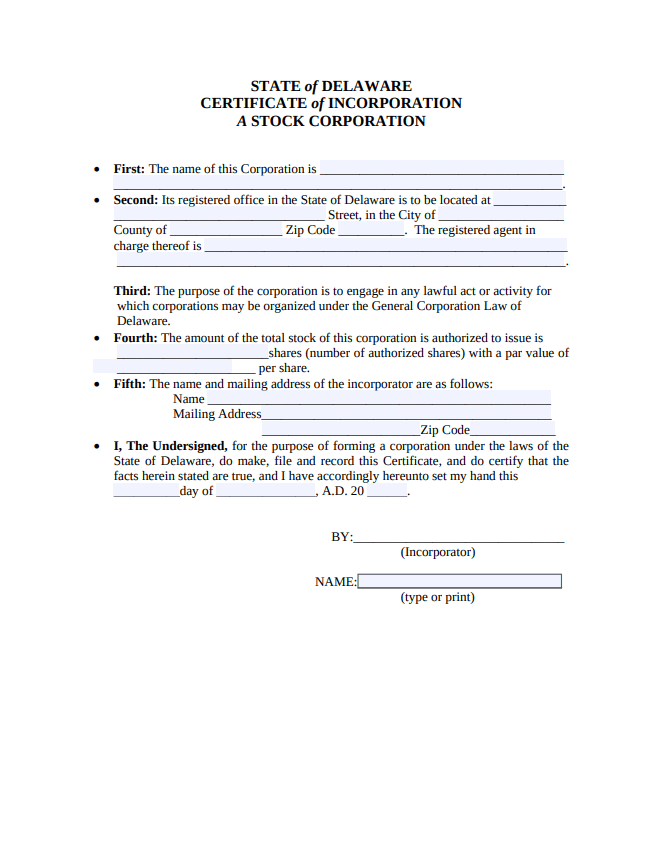
Your Delaware Certificate of Incorporation generally establishes details such as:
Delaware's minimum filing fee for a Certificate of Incorporation is \$109, which varies depending on the authorized stock and other filing factors. You can file a Delaware Certificate of Incorporation through online electronic submission or by postal mail.
Online Filing: Completed Certificate of Incorporation applications can be submitted on the Delaware eCorp Business Services website. This is the quickest filing option and allows you to pay the required fees by credit card.
Mail Filing: Complete the Certificate of Incorporation, sign it, and mail it along with a Filing Cover Memo and a check payable to the “Delaware Secretary of State” by mail.
By law, the information you put on your Certificate of Incorporation becomes part of the public record. However, Delaware only requires a few pieces of information on the form itself: corporation name, registered agent, authorized shares, and the incorporator's name and signature. It doesn't ask for your directors, officers, or shareholders, so those names stay off the public filing by default.
Two things help you keep even the required information private:
Use a registered agent service. Your provider's Delaware address appears on the public filing as your registered agent address, so your home or office address doesn’t appear in the public record.
Let a professional formation service sign as your incorporator. A service like Swyft Filings can act as the incorporator on your Certificate of Incorporation, so their name appears on the public document instead of yours.
Corporate bylaws are the internal rulebook that governs how your Delaware C Corp runs day-to-day. You do not file your bylaws with the state like the Certificate of Incorporation. You only form the bylaws and keep them safe with other internal records.
Your bylaws should cover the practical rules of running the company, including:
Once your bylaws are drafted, your initial directors or incorporator should formally adopt them, usually at your organizational meeting, and keep the adopted copy with your corporate records. If you need help drafting your Corporate bylaws, Swyft Filings can prepare and draft customized Corporate Bylaws for your organization.
After Delaware approves your Certificate of Incorporation, hold an initial organizational meeting where your incorporator or initial directors formally get the corporation running. At this meeting, you'll typically:
Keep formal minutes of this meeting and store them with your corporate records. Delaware doesn't file these minutes, but they're some of the clearest evidence that your corporation is following proper formalities if that protection is ever challenged in court.
An EIN is a federal tax ID that identifies your corporation for tax purposes, separate from your own Social Security number. You need to apply for an Employer Identification Number, or EIN, with the IRS once your corporation filing is approved by the state. You will need the following details to apply for an EIN:
You can do it through the IRS website in about 15 minutes. Swyft Filings can also handle it as part of your Delaware C Corp formation package.
Filing your Certificate of Incorporation creates your Delaware corporation, but there are a few ongoing requirements to keep it in good standing.
Every Delaware corporation, regardless of whether it does business in the state, has to file an annual franchise tax report and pay franchise tax by March 1 each year. This isn't an income tax. It's the fee Delaware charges for the right to exist as a Delaware corporation.
You'll pay a \$50 filing fee plus the franchise tax itself. Delaware calculates your tax two ways, and you can pick whichever costs less:
Authorized Shares Method: This is the default way Delaware uses on your notice. The tax runs from a \$175 minimum up to a \$200,000 maximum, based on how many shares you've authorized. This method can result in a surprise bill if you authorized a large number of no-par-value shares.
Assumed Par Value Capital Method: This method factors in your total assets, authorized shares, and par value, and it often yields a lower figure for corporations with modest assets but a high share count.
Missing the March 1 deadline incurs penalties and interest, and letting it go unresolved for more than a year can eventually result in your charter being voided.
If your corporation actually does business in Delaware, generating income there rather than just being incorporated there, you'll owe Delaware corporate income tax on the portion of your income apportioned to the state. Many corporations that incorporate in Delaware but operate elsewhere do not owe this tax, since it applies only to income earned within Delaware.
If your corporation actually conducts business in Delaware, you generally need a Delaware business license from the Division of Revenue, separate from your Certificate of Incorporation. Corporations incorporated only in Delaware but operating entirely in other states typically don't need this license, though they may need one in the state where they actually do business.
Bring your Certificate of Incorporation, your adopted bylaws, and your EIN confirmation letter to the bank. Keeping business money separate from personal funds is one of the clearest ways to protect your liability shield.
Many founders incorporate in Delaware but run their actual business from another state. If that's your situation, you'll likely need to register as a foreign corporation in the state you're physically operating in, in addition to staying current on your Delaware obligations.
| Item | Cost |
|---|---|
| Certificate of Incorporation | \$109 (including minimum state fees; additional fees may apply based on filing details) |
| Name Reservation (optional) | \$75 |
| Registered Agent (professional service) | Swyft offers this at \$149 per quarter |
| Annual Franchise Tax Report Filing Fee | \$50 |
| Annual Franchise Tax | \$175 to \$200,000, based on your share structure |
| EIN (IRS) | \$0 |
Starting a Delaware C Corp involves paperwork and ongoing requirements that can quickly become complicated, from setting up your share structure to keeping up with state filings. Swyft Filings has helped businesses with corporation formation in Delaware and compliance since 2015. Our team understands Delaware Division of Corporations requirements and can help you prepare and file your C Corp paperwork accurately and efficiently for free.
\$0 + State Filing Fees
*Disclaimer: This guide provides general information about forming a C Corp in Delaware and is not a substitute for any kind of legal, tax, or financial advice*.
C Corp rules, filing costs, and corporate tax structures vary by jurisdiction. Select any state below to view its specific C Corp laws.