

You want your business to have a real name. A name people can find, trust, and pay. But the paperwork seems confusing. That is where a DBA comes in.
A DBA (short for "doing business as") lets you operate your business under a name that is different from your legal name. It is one of the simplest steps in building a business identity, and it costs far less than most entrepreneurs expect. This guide covers everything you need to know about DBAs.
What Does DBA Stand For?
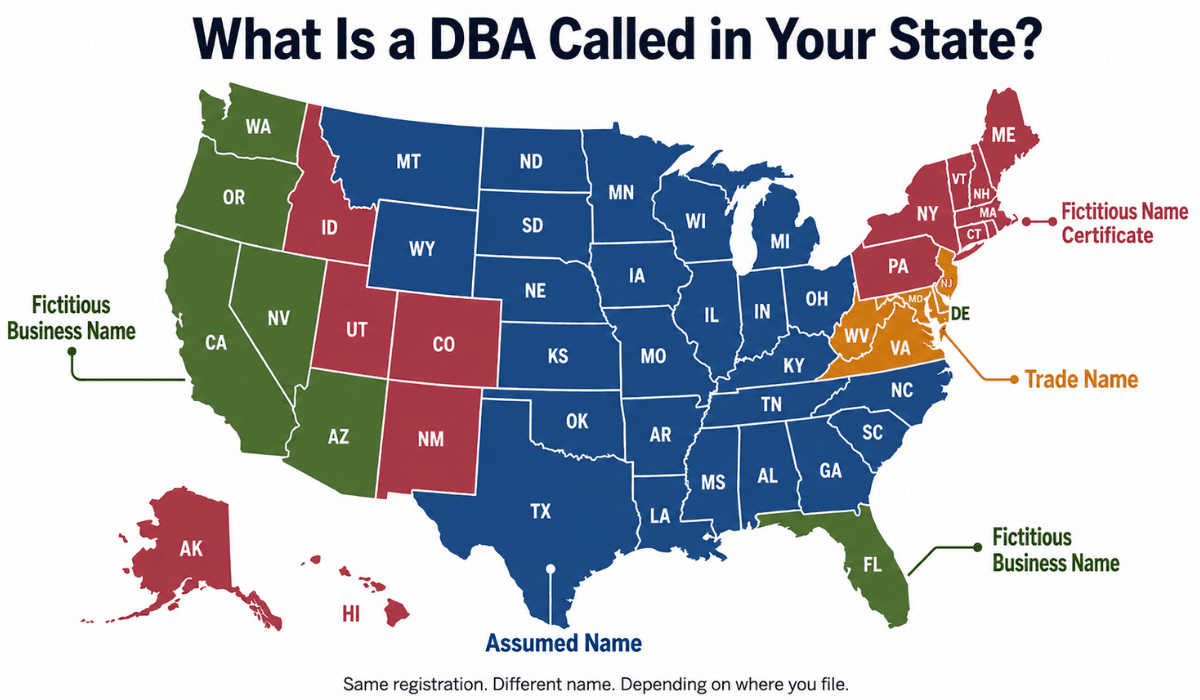
DBA stands for "doing business as." It is a registered name that allows a person or business to operate under a name different from their legal name.
Your business has a legal name. For a sole proprietorship, that legal name is your personal name. For an LLC or corporation, it is the name on your formation documents. A DBA lets you conduct business publicly under a different, more memorable name, without creating a new legal entity.
For example, if Freya Williams runs a bakery as a sole proprietor, her legal business name is Freya Williams. She cannot legally promote herself as "Baked by Freya" without first registering a DBA for that name. Once she files, she is officially Freya Williams, doing business as Baked by Freya.
The term appears on legal documents written as "d/b/a".
For example, "RRL Corporation d/b/a Lexus of Westminster."
The U.S. Small Business Administration describes a DBA as a trade name, fictitious name, or assumed name that lets you conduct business under a name other than your personal name or formal entity name.
Read more: What Is a “Doing Business As” (DBA)?
Who Needs a DBA?
Not every business needs a DBA. Whether you need one depends on your business structure and how you want to operate.
Sole Proprietors and General Partnerships
Sole proprietors and general partnerships need DBAs the most. Under U.S. law, if you operate as a sole proprietor, your legal business name is your personal legal name. If you want to use any other name, you must first file a DBA.
Operating under an unregistered name is illegal in most states and may result in financial penalties. In Virginia, for instance, using a fictitious name without registering it can result in a fine of up to $2,500 or jail time or both. [1]
LLCs and Corporations
LLCs and corporations already have their own legal business names. They are not required to file a DBA unless they want to operate under a different name.
Many formal business entities use DBAs to launch new product lines, expand into new markets, or run multiple brands under one legal entity. An LLC called Apex Holdings LLC might register a DBA to open a coffee shop under the name Apex Café, keeping everything under one legal structure without forming a new company.
Franchisees
Franchisees often form an LLC or corporation to purchase their franchise. They then file a DBA to operate legally under the franchisor's brand name. If you buy a franchise through your business entity, the DBA connects your legal entity to the public-facing brand.
What Are the Benefits of a DBA?
Filing a DBA gives your business several practical advantages.
Open a Business Bank Account
Banks require sole proprietors and general partnerships to have a registered DBA before they can open a business checking account under a trade name. Without one, a sole proprietor can only open personal accounts. A DBA allows you to accept checks and payments made out to your business name.
Build a Professional Brand Identity
A strong business name builds credibility. "Smith's Sweet Treats" sounds more professional and memorable than "Emily Smith" in the context of a bakery. A DBA gives sole proprietors the ability to present a polished business identity to customers, vendors, and partners without the cost of forming an LLC.
Protect Your Privacy
When you operate as a sole proprietor without a DBA, your personal legal name is your business name. That information is public. A DBA lets you separate your personal name from your business identity, which limits how easily strangers can connect your business activities to your personal life.
Run Multiple Brands Under One Entity
A single LLC or corporation can hold multiple DBAs. Each DBA can represent a separate product line, service category, or geographic market, all under the same legal entity. This saves the cost and administrative burden of forming a new business for each brand. There is no legal limit on how many DBAs one business can hold, as long as each name is not misleading to consumers.
Expand Into New States
If your business wants to operate in a new state where your existing name is already taken by another company, you can register a DBA in that state under a different name. Your legal entity stays intact; only the operating name changes for that market.
Enter Contracts and Get Licenses Under Your Business Name
Once your DBA is registered, you can sign contracts, apply for business licenses, and enter into agreements using your trade name. This makes operations cleaner and more professional.
What a DBA Does Not Do
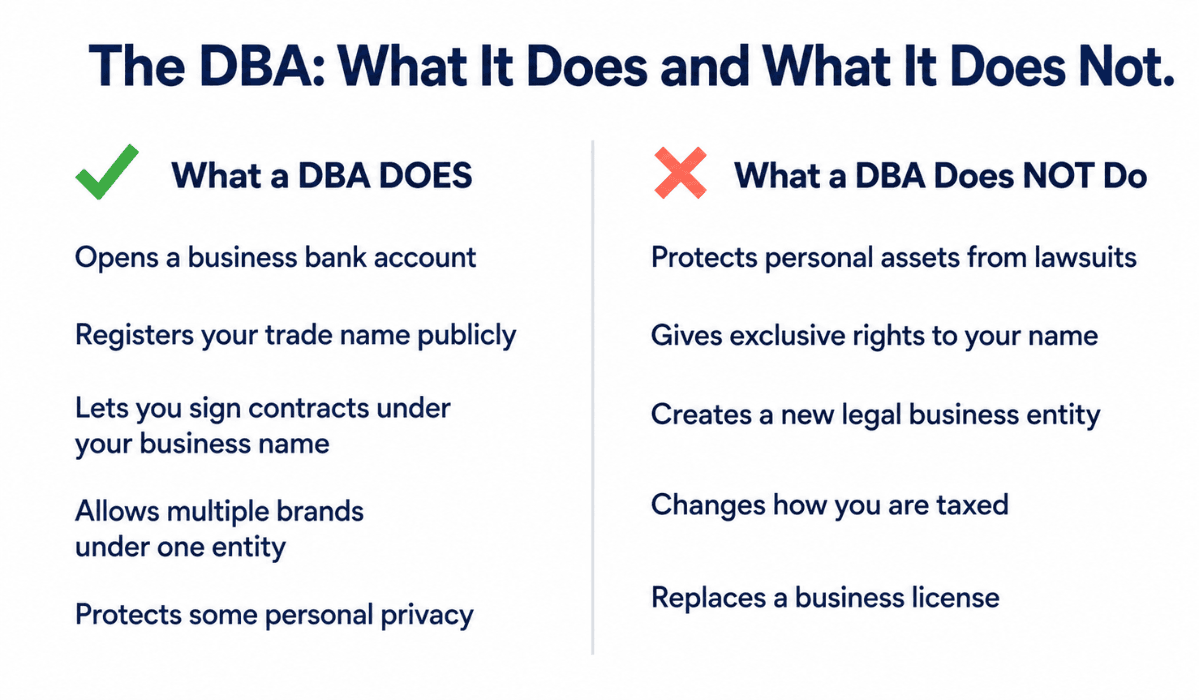
- A DBA does not provide personal liability protection: This is the most common misconception. If someone sues your sole proprietorship or general partnership, they can pursue your personal assets regardless of whether you have a DBA. A DBA is a name, not a legal shield.
- A DBA does not give you exclusive rights to the name: In most states, registering a DBA does not prevent another business from using the same name. To protect your name exclusively, you need to register a trademark with the U.S. Patent and Trademark Office. [2]
- A DBA does not create a new business entity: You remain a sole proprietor, partnership, LLC, or corporation. The DBA is attached to your existing structure. Nothing changes about how your business is legally organized.
- A DBA does not change how you are taxed: Your tax filing status stays exactly the same after a DBA registration.
Is a DBA or LLC Better?
This is one of the most common questions small business owners ask, and the honest answer is: they serve different purposes.
A DBA is a business name. An LLC is a legal business structure. Comparing the two is a bit like comparing a nickname to a legal contract; they are not substitutes for each other.
Here is the comparison:
Feature | DBA | LLC |
Personal liability protection | No | Yes |
Creates a separate legal entity | No | Yes |
Tax flexibility | No | Yes |
Cost to set up | $10–$150 in most states | $50–$800 in most states |
Ongoing compliance | Minimal | Annual reports, fees |
Name exclusivity | No | Often yes (varies by state) |
When a DBA makes sense
- You are a sole proprietor testing a business idea with minimal risk
- You want to create a trade name quickly and affordably
- You are an LLC that wants to operate a new brand under your existing entity
- Your business is low-risk, and you do not need liability protection
When an LLC makes more sense
- You want to protect your personal assets from business debts or lawsuits
- You want tax flexibility, including the option to elect S Corp status
- You plan to hire employees or bring on investors
- You want credibility with banks, lenders, and commercial landlords
Many business owners use both. They form an LLC for liability protection and then file a DBA registration to operate under their preferred brand name.
Does a DBA Affect Taxes?
A DBA has no effect on your taxes.
When you register a DBA, your tax filing obligations stay exactly the same as before. A sole proprietor with a DBA still reports all business income on Schedule C of their personal Form 1040 and pays self-employment tax (currently 15.3%) on all net business profits.
A DBA does not give you the ability to change your tax classification. Only forming an LLC or corporation, and in some cases electing S Corp status, opens up tax flexibility. An LLC can choose to be taxed as a sole proprietorship, a partnership, an S corporation, or a C corporation. A DBA cannot make any of those elections.
If you are a sole proprietor and want to reduce your self-employment tax burden, the right path is to form an LLC and explore S Corp status, not to file a DBA. [3]
Is a DBA the Same as an EIN?
No. A DBA and an EIN are two different things, and it is important not to confuse them.
A DBA (doing business as) is a registered business name. An EIN (Employer Identification Number) is a nine-digit federal tax identification number issued by the IRS.
Here is the key difference: a DBA identifies your business name publicly. An EIN identifies your business to the federal government for tax purposes.
Do you need an EIN if you have a DBA?
You may not be legally required to have one, but it is strongly recommended. An EIN lets you:
- Open a business bank account without using your Social Security number
- Hire employees
- File taxes as a business rather than an individual
- Keep your Social Security number off contracts and W-9 forms
Sole proprietors can apply for a free EIN directly at the IRS.
Can you use your EIN for your DBA?
Yes. Once you have an EIN, you can list it under your DBA name on bank applications and W-9 forms. Your EIN is tied to your Social Security number behind the scenes, so the IRS can still connect your business income to your personal return.
How to Register a DBA: Step-by-Step
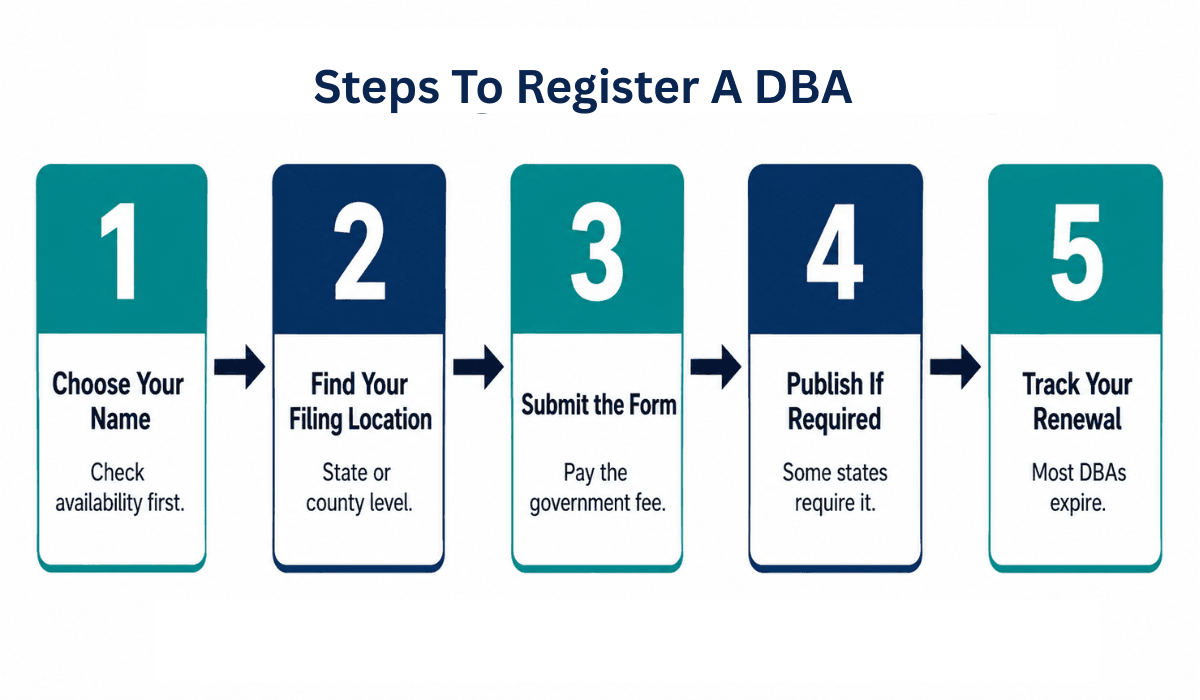
The process for registering a DBA varies by state and sometimes by county. Here is a general overview of how it works.
Step 1: Choose Your DBA Name
Pick a name that reflects your business and that customers will remember. Before committing to a name, check that it is available. You can use the Swyft Filings business name checker to search your state's database.
A few naming rules to keep in mind:
- Your DBA name cannot imply a legal structure that your business does not have. A sole proprietor cannot include "LLC" or "Inc." in a DBA name.
- Most states prohibit DBA names that suggest government affiliation or use banking or insurance terms.
- Your name should be distinguishable from other registered names in your area.
Step 2: Determine Where to File
Some states require DBA registration at the state level. Others require it at the county level. A few require both. Check with your state's Secretary of State office or county clerk's office to find the correct filing location.
Examples of how this works in practice:
- California: Filed at the county level with the county clerk. [4]
- Florida: Filed at the state level with the Division of Corporations through Sunbiz. [5]
- Pennsylvania: Filed with the Pennsylvania Department of State using Form DSCB:54-311. [6]
- Virginia: Filed with the State Corporation Commission.
Step 3: Complete and Submit the Registration Form
The registration form typically asks for:
- Your DBA name
- Your legal name (or your entity's legal name if you have an LLC or corporation)
- Your business address
- The nature of your business
- Your signature
Government fees range from $10 to $150 depending on your state and county.
Step 4: Publish If Required
Some states require you to publish a notice of your DBA in a local newspaper before or after filing. California, Florida, and New York all have publication requirements. Failing to publish can invalidate your DBA registration in states where it is mandatory.
Step 5: Renew Before It Expires
DBA registrations do not last forever in most states. Renewal timelines vary:
- California and Florida: every 5 years
- Texas: every 10 years
- Virginia: no expiration (until you cancel it)
Missing a renewal can cause you to lose the right to use your business name and may prevent you from enforcing contracts signed under that name. Set a reminder well in advance of your renewal date.
DBA Scenarios: Real-Life Situations
Understanding how a DBA works is easier when you see it in action. Here are five situations where a DBA is the right move.
Situation 1: The Freelance Designer Who Wants to Look Professional
Maria Rivera is a freelance graphic designer. She operates as a sole proprietor under her own name. Her clients are fine with paying "Maria Rivera," but she wants to build a brand, something like "Rivera Creative Studio."
Maria files a DBA for Rivera Creative Studio in her county. Now she can accept payments made out to Rivera Creative Studio, open a business checking account under that name, and present herself professionally on contracts and invoices. Her legal structure stays the same. She just has a name that matches her brand.
Situation 2: The LLC That Wants to Launch a New Product Line
Carlos runs a successful cleaning supply company called GreenClean Solutions, LLC. He wants to launch a separate line of home air fresheners under the brand name "AirBright."
Rather than forming a brand-new LLC for AirBright, Carlos files a DBA. GreenClean Solutions, LLC, doing business as AirBright, is now on file with the state. He keeps one legal entity, one set of taxes, and one set of annual report obligations, while operating two distinct brands.
Situation 3: The Sole Proprietor Who Needs a Bank Account
David Kim runs a small food truck. He has been accepting only cash because he cannot open a business account; banks require a business name registration to issue one. David's legal name alone is not enough.
David files a DBA for "Seoul Food Truck." With that registration in hand, he walks into the bank and opens a business checking account. Now, customers can pay by card, checks get deposited under his business name, and his personal and business finances stay separate.
Situation 4: The Established Business Expanding Into a New State
Lena owns a regional landscaping LLC called Green Horizons Landscaping, LLC, registered in Ohio. She wants to expand into Indiana. But when she searches Indiana's business name database, she finds that "Green Horizons Landscaping" is already taken by another company.
Lena registers a DBA, "Green Horizons Outdoor Services," in Indiana. Her Ohio LLC remains unchanged. The Indiana DBA lets her operate in the new state under a distinguishable name without creating a new legal entity. She links to the foreign qualification process to make sure her Ohio LLC is properly registered to do business in Indiana.
Situation 5: The Sole Proprietor Who Wants Privacy
Tom Mueller runs a consulting firm as a sole proprietor. His legal business name is Tom Mueller. He does not want clients to immediately know his full name from his business materials and marketing.
Tom files a DBA for "Clarity Strategy Group." His full name is no longer the face of his business in public documents. Clients see a professional brand. Tom keeps his privacy while staying fully compliant with state law.
Should You File a DBA or Form an LLC?
If your only goal is a business name, a DBA is sufficient and affordable. But if you are building something serious, consider whether an LLC makes more sense.
The average cost to defend a small business lawsuit exceeds $50,000. A DBA gives you none of that protection. An LLC does. The cost difference between a DBA and an LLC is usually a few hundred dollars at most.
If you are unsure which path is right for your situation, our guide on how to determine if you need a DBA breaks down the decision clearly.
Swyft Filings can help you register a DBA quickly and accurately. Our business formation specialists handle the paperwork while you focus on your business.
Need Help Registering Your DBA?
Choosing a business name is exciting. The registration paperwork, less so.
Swyft Filings has helped 600,000+ businesses get their formations right since 2015. Our business formation specialists know the online DBA registration requirements across all 50 states and handle every step of the filing accurately and on time.
Tell us the name you want to use, and we will handle the DBA paperwork for you.
Bibliography
- Virginia State Corporation Commission. Fictitious Names. Accessed on May 18, 2026.
- USPTO.Trademark Basics. Accessed on May 18, 2026.
- IRS. Self-Employed Individuals Tax Center. Accessed on May 18, 2026.
- California Secretary of State. Name reservations. Accessed on May 18, 2026.
- Florida Division of Corporations. Fictitious Name Registration. Accessed on May 18, 2026.
- Pennsylvania Department of State. Fictitious Names. Accessed on May 18, 2026.