

An artist should consider forming an LLC once their creative work moves beyond casual sales and involves real business risk. But how do you know when you've reached that tipping point?
It's simple! It is time to consider an LLC when your business involves recurring clients, studio visitors, gallery contracts, licensing deals, product sales, or employees.
While a sole proprietorship is a fine starting point for low-risk hobbies, a formal entity helps you organize your brand more professionally once income and expenses grow.
It is important to remember that an LLC does not replace insurance or automatically slash your taxes. However, it does create a distinct legal entity, helps separate your personal and business finances, and provides a stronger foundation for your art career. Let’s discuss this in more detail.
Key Takeaways
Artists don't legally need an LLC to sell work, but operating without one means personal assets are exposed to business disputes.
An LLC creates a legal separation between you and your business; a sole proprietorship does not.
Most single-member artist LLCs are taxed the same as sole proprietors. The benefit is protection and structure, not automatic tax savings.
Artists who teach, work on-site, sell physical goods, or have collaborators have the most to gain from forming an LLC.
State filing fees and annual report costs differ from state to state.
LLC for Artists: Quick Decision Table
Your situation | LLC worth it? | Why it matters |
Selling a few prints as a hobby | Not yet | Sole proprietorship is enough while testing |
Taking regular freelance commissions | Yes | Contracts, revisions, and payment disputes add risk |
Painting murals or installing art on-site | Strongly yes | Client property, assistants, and equipment create exposure |
Selling ceramics, candles, or handmade goods | Consider it | Product liability and returns can escalate |
Teaching workshops or hosting studio visitors | Strongly yes | Injuries, permits, and rented space add risk |
Music artist with royalties or collaborators | Yes | Contracts, brand ownership, and shared income need structure |
Selling digital art or NFTs | Depends | LLC becomes useful as licensing income and contracts grow |
Running an artist collective or shared studio | Yes | Shared ownership and shared money need clear documentation |
What Is an LLC for Artists?
An LLC, or limited liability company, is a business structure created under state law. For artists, an LLC can turn a creative business into a separate legal entity from the individual artist.
That matters because many artists start informally. You make a few sales, get commissioned by a client, open an Etsy shop, sell at a craft fair, or invoice a gallery. At first, it may feel like a side project. Over time, the project can become a business with income, expenses, clients, contracts, and tax responsibilities.
An artist LLC can help organize that business. It gives you a formal business name, a state-recognized entity, and a structure for opening business accounts, signing contracts, and separating business records from personal records.
LLC rules vary by state, so filing fees, reports, renewal deadlines, and exact formation documents depend on where you form your business. That is why artists should treat LLC formation as both a legal structure decision and an administrative decision.
Do Artists Legally Need an LLC to Sell Art?
Most artists do not legally need an LLC just to sell art, accept commissions, or get paid for creative work. If you sell under your own legal name without forming another business structure, you may be operating as a sole proprietor by default.
That does not mean there are no rules. Depending on your location and what you sell, you may still need a local business license, sales tax registration, vendor permit, studio permit, or craft fair documentation. These requirements are separate from forming an LLC.
While an LLC isn't a legal requirement for sales, it becomes critical when you consider liability. Many artists don't think about lawsuits until a mural client blames them for property damage, a workshop student trips over equipment, or a licensing dispute turns ugly. Without an LLC, a creditor or plaintiff can go after your personal savings, car, or home to settle those claims.
As a sole proprietor, there is no legal separation between you and your business. You are held personally responsible for all financial and civil liabilities. This is why the real reason to form an LLC isn't just for the prestige or the paperwork; it’s for the legal "firewall" it builds around your personal life.
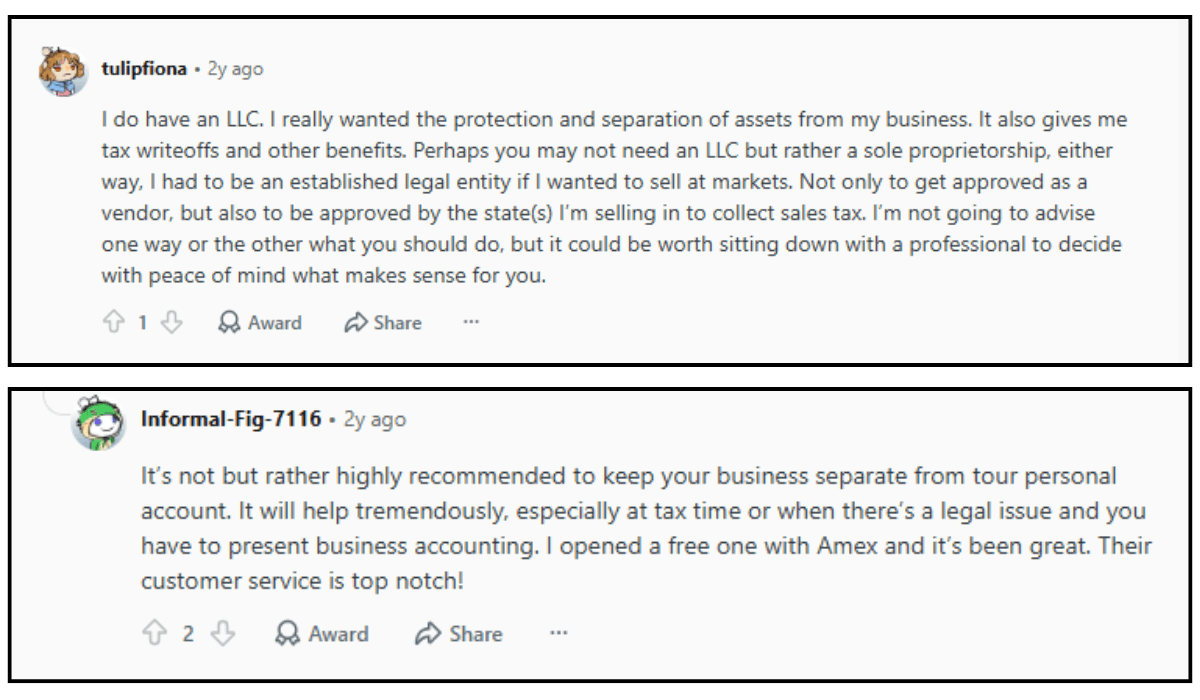
Here is a Reddit conversation on the same. A user named ‘FluffinChibiMu’ asked a question on r/artbusiness: Is getting an LLC for your art brand worth it?, and the best commenters replied as:
LLC vs. Sole Proprietorship for Artists
Feature | Sole Proprietorship | LLC |
Setup | Starts automatically with business activity | Filed with the state |
Cost | Usually none to start | State filing fee required |
Liability separation | No separate entity | Separate legal business entity |
Business name | Your legal name or a DBA | LLC name (optional DBA) |
Tax filing | Schedule C on personal return | Same for single-member LLCs, unless you elect otherwise |
Banking | Personal or DBA account | Dedicated business account in the LLC name |
Best for | Testing low-risk art sales | Growing business with income, contracts, or risk |
Also Read: Should I Form A Sole Proprietorship or A Single-Member LLC in 2026?
Pros and Cons of an LLC for Artists
An LLC can be a practical move for many artists, but it is not the right answer for every situation. The best decision depends on your income, risk level, location, expenses, and long-term plans.
Pros of Forming an Artist LLC
- Personal and business separation: An LLC can help separate your business obligations from your personal life. This is one of the main reasons artists consider forming one.
- More professional presentation: Clients, galleries, vendors, venues, and collaborators may take a formal business name more seriously. An LLC can make invoices, contracts, and proposals feel more established.
- Cleaner business banking: An LLC can make it easier to open a business bank account in your business name. That helps keep art income, supplies, software, studio rent, and marketing expenses organized.
- Better structure for contracts: Commissions, licensing deals, murals, music work, and gallery relationships often involve written agreements. An LLC gives you a business name to use on those documents.
- Room to grow: An LLC can support a solo artist, a studio, a music project, an artist collective, or a creative services business. It can also work with a DBA if your public-facing brand differs from your LLC name.
Cons of Forming an Artist LLC
- State filing costs: Every state has its own formation fee. Some states also require annual reports, renewal fees, or franchise taxes.
- More admin: You may need to maintain a registered agent, file state reports, keep records, and update business documents.
- Separate finances matter: If you form an LLC but keep mixing personal and business money, the structure may not help as much as you expect. A separate bank account is important.
- Taxes are not automatically lower: A single-member LLC is often treated similarly to a sole proprietorship for federal income tax unless it elects a different tax classification.
- Insurance may still be needed: An LLC does not pay covered claims the way insurance can. Artists with studio visitors, events, products, or physical work may need both.
When an Artist Should Consider Starting an LLC
An LLC starts to make more sense when your art creates business obligations beyond occasional sales. Here are common situations where artists should consider forming one.
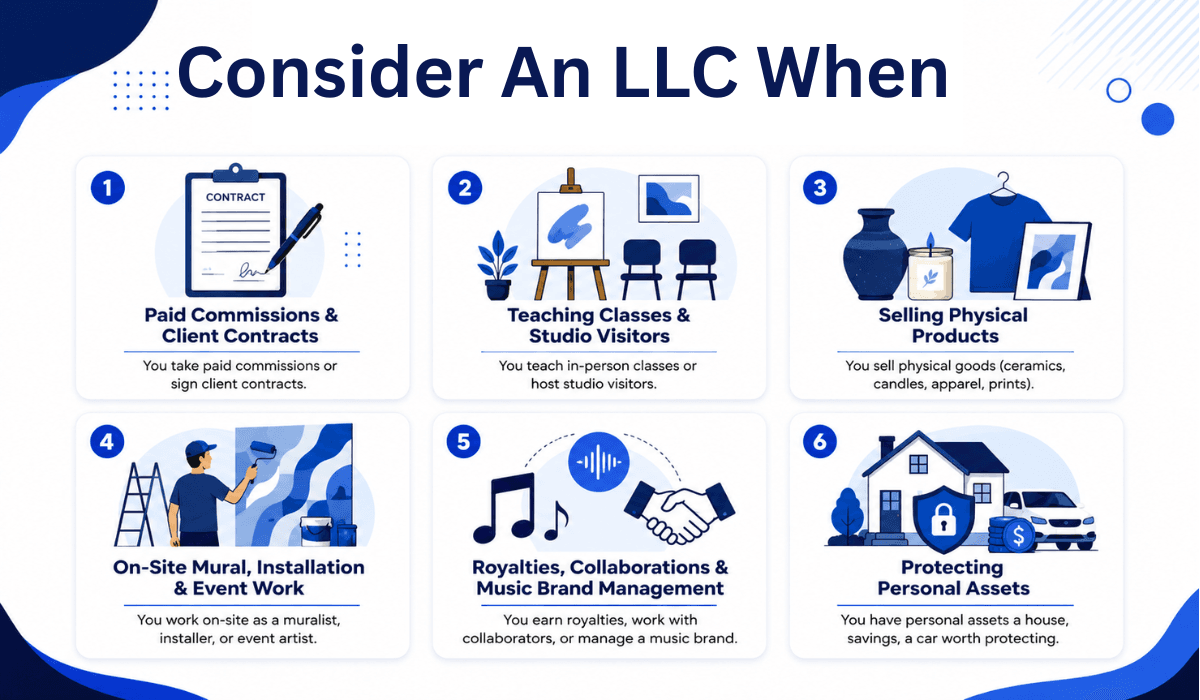
You Take Paid Commissions or Client Contracts
Commissions can create clear business responsibilities. A client may expect a certain size, style, delivery date, revision process, usage rights, or refund policy.
A freelance illustrator, portrait artist, designer, photographer, or digital artist may face questions like:
- Who owns the final artwork?
- Can the client use it commercially?
- What happens if the client asks for extra revisions?
- What happens if the project is canceled?
- Who pays for materials or shipping?
- What happens if the client refuses to pay?
An LLC will not solve every contract issue, but it can give your business a formal structure for signing agreements, invoicing clients, and separating business income.
You Sell Physical Products
Artists who sell physical goods have different risks from artists who only sell digital files. Prints, ceramics, apparel, candles, handmade jewelry, stickers, zines, and home goods can involve shipping, returns, defects, customer complaints, or product-related concerns.
An LLC may be worth considering if you sell physical products through:
- Etsy
- Shopify
- Craft fairs
- Galleries
- Markets
- Wholesale accounts
- Local shops
- Pop-up events
Product sellers should also consider insurance, sales tax registration, and clear refund policies. The LLC is one part of a larger business setup.
You Teach Classes, Host Workshops, or Run a Studio
Teaching can be rewarding, but in-person activity adds practical risk. Students may visit your studio, use supplies, move around equipment, or attend events in rented spaces.
An LLC can help organize the business side of workshops, classes, retreats, private lessons, and studio memberships. You may also need local permits, insurance, liability waivers, or venue-specific paperwork.
This is especially relevant for artists who teach:
- Painting classes
- Pottery workshops
- Tattoo apprenticeships
- Music lessons
- Dance or performance sessions
- Photography workshops
- Children’s art classes
You Work On-Site as a Muralist, Installer, or Event Artist
Muralists and installation artists often work on client property. That can involve ladders, lifts, walls, floors, paint, tools, assistants, public spaces, and tight deadlines.
An LLC can help formalize how your business handles contracts, deposits, project scope, materials, change orders, and subcontractors. It may also make your business look more prepared when working with commercial clients, schools, municipalities, restaurants, and event venues.
On-site artists should also consider insurance because the physical setting can create risks that an LLC alone may not cover.
You Are a Music Artist, Performer, or Independent Label
A music artist may start with casual gigs, then grow into a business with streaming income, merchandise, licensing, session work, collaborators, producers, and brand deals.
An LLC for music artists can help organize:
- Performance income
- Royalty payments
- Merchandise sales
- Recording expenses
- Collaborator agreements
- Licensing deals
- Management or booking payments
- Independent label activity
A solo performer may form a single-member LLC. A band, producer group, or independent label may need a more detailed operating agreement because multiple people may share ownership, income, and responsibilities.
You Are Building a Recognizable Artist Brand
If your art has a studio name, shop name, or music brand that's separate from your legal name, an LLC gives that brand formal backing.
Larger institutional clients and corporate buyers often prefer working with a registered business entity over an individual, and forming an LLC can open those doors.
For example:
Public brand | Possible structure |
Maya Lee Art | Sole proprietorship, LLC, or DBA, depending on goals |
Blue Wall Studio | LLC or DBA |
Northside Murals | LLC with a brand-focused name |
Velvet Static Records | LLC, possibly with DBA if needed |
Clay & Current | LLC or DBA for product sales |
A business name should work across your website, invoices, social profiles, contracts, business bank account, and future growth plans.
Also Read: How To Start An LLC Online
When an Artist May Not Need an LLC Yet
Not every artist needs to form an LLC immediately. A low-risk artist who is testing the market may choose to wait.
You may not need an LLC yet if:
- You sell art only occasionally
- Your income is small and irregular
- You are not signing client contracts
- You do not teach in person
- You do not sell physical products at scale
- You do not hire assistants or collaborators
- You are not renting studio space
- You are not using a public business name
- You are not ready for state fees or ongoing filings
This does not mean you should ignore the business side. You can still track income, save receipts, open a separate account, create basic contracts, research local license rules, and learn what your state requires.
An LLC may become the next step when your art income becomes consistent, your clients become more formal, or your business activity starts to feel bigger than a hobby.
How Much Does It Cost to Start an Artist LLC?
The cost to start an LLC for artists depends on the state where the LLC is formed and the services needed to maintain it. LLCs are created under state law, so filing fees, annual reports, franchise taxes, and renewal rules vary.
Here are the common cost categories to plan for:
Cost Type | What it Covers | Average Cost |
State Filing Fee | Articles of Organization fee | $100 – $130 (One-time) |
Annual Report | Ongoing state filing fee | $50 – $100 (Yearly)(biennial) |
Registered Agent | A person/service to receive legal and state mail. | $0 (Self) or $50/ month (Service) |
DBA Registration | Public business name registration | $99 (One-time) |
EIN (Tax ID) | A social security number for your business. | $0 (Free via IRS) |
Operating Agreement | Internal LLC rule document | $0 (DIY) –$35+ |
Business License | Local permit to operate in your specific city/county. | $50 – $100 (Varies by location) |
Also Read: LLC Costs by State Comparison (2026)
What Are the Tax Benefits of an LLC for Self-Employed Artists
An LLC doesn't automatically cut your tax bill. For federal income tax, a single-member LLC is usually treated the same as a sole proprietorship. It means our income still flows through to your personal return on Schedule C.
The real benefit is organization. A dedicated LLC bank account makes it much easier to track deductible art expenses:
- Supplies (paint, canvas, clay, paper, digital tools)
- Software subscriptions and platform fees
- Studio rent and equipment
- Shipping materials and booth fees
- Website hosting and marketing
- Business mileage and professional services
Clean records mean cleaner deductions and a stronger position if the IRS ever asks questions.
Also Read: LLC Tax Benefits Explained
Liability Insurance vs LLC for Artists
An LLC and liability insurance solve different problems.
An LLC can help create a legal separation between your art business and your personal assets. Insurance can help pay for certain covered claims, depending on the policy.
That distinction matters for artists with physical products, studio visitors, workshops, events, installations, or on-site projects.
Issue | LLC may help with | Insurance may help with |
Separating personal and business assets | Yes | No |
Paying covered claims | No | Yes, depending on policy |
Client injury at a workshop | Structure may help | Coverage may help |
Damaged property during a mural project | Structure may help | Coverage may help |
Product-related complaint | Structure may help | Coverage may help |
Professional credibility | Yes | Sometimes |
Contract requirements | Sometimes | Often |
Some artists need both. A studio artist who teaches classes, a muralist who works on client property, or a product seller shipping handmade goods may want the structure of an LLC plus the practical coverage of insurance.
Also Read: 15 Common LLC Mistakes to Avoid in 2026 (And How to Avoid Them)
Do Artists Need a DBA?
A DBA ("doing business as") lets you operate under a name that differs from your legal name or your LLC name.
An artist named Jordan Rivera might want to operate as Riverline Murals or Clay & Current, both of which are DBA situations.
- A sole proprietor can file a DBA to use a brand name
- An LLC can file a DBA if the public brand name differs from the formal LLC name
- A DBA doesn't create liability protection the way an LLC does
If you've built a recognizable brand name and want it registered officially, a DBA is the tool. If you want liability separation, an LLC is the tool. Many artists end up using both.
Also Read: How to Change From DBA to LLC in 5 Steps
Summing Up:
Art businesses grow in stages. A few commissions become regular clients. A weekend market becomes an Etsy shop. A solo music project becomes royalties, merchandise, and a management deal.
Swyft Filings helps artists handle the LLC formation paperwork that comes with that growth. Since 2015, Swyft has helped over 600,000 businesses across all 50 states get started.
If your creative work is ready for a more formal structure, you can start the process in minutes. Start your LLC now!