

Changing from an S Corp to an LLC gives owners more control. Whether you are curious if you can change an S Corp to an LLC or you are ready to start the S Corp to LLC conversion process today, follow
If you’ve decided to convert your S Corp to an LLC, understanding all the details of such a conversion is crucial. For many small business owners, changing an S Corp to an LLC offers a path to simpler management and significant tax flexibility.
This guide will walk you through how to convert an S Corp to an LLC step by step. It’ll also explain why this might be an excellent move for your business, in case you have any doubts. Let’s begin.
Key Takeaways
If you have a C Corp with S Corp status, you can convert to an LLC by statutory conversion, statutory merger, or non-statutory conversion based on state laws.
If you have an LLC taxed as an S Corp, it can be converted back to its original tax status by just revoking its status and filing Form 8832.
Converting an S Corp into an LLC offers numerous benefits, including management and tax advantages, specifically for small business owners.
Why Change an S Corp to LLC?
Before presenting a step-by-step guide on changing an S Corp to an LLC, let’s see why you should consider this move. Remember that an S Corp is only a tax classification, not a business structure. So, you aren’t changing the business entity, but its tax treatment.
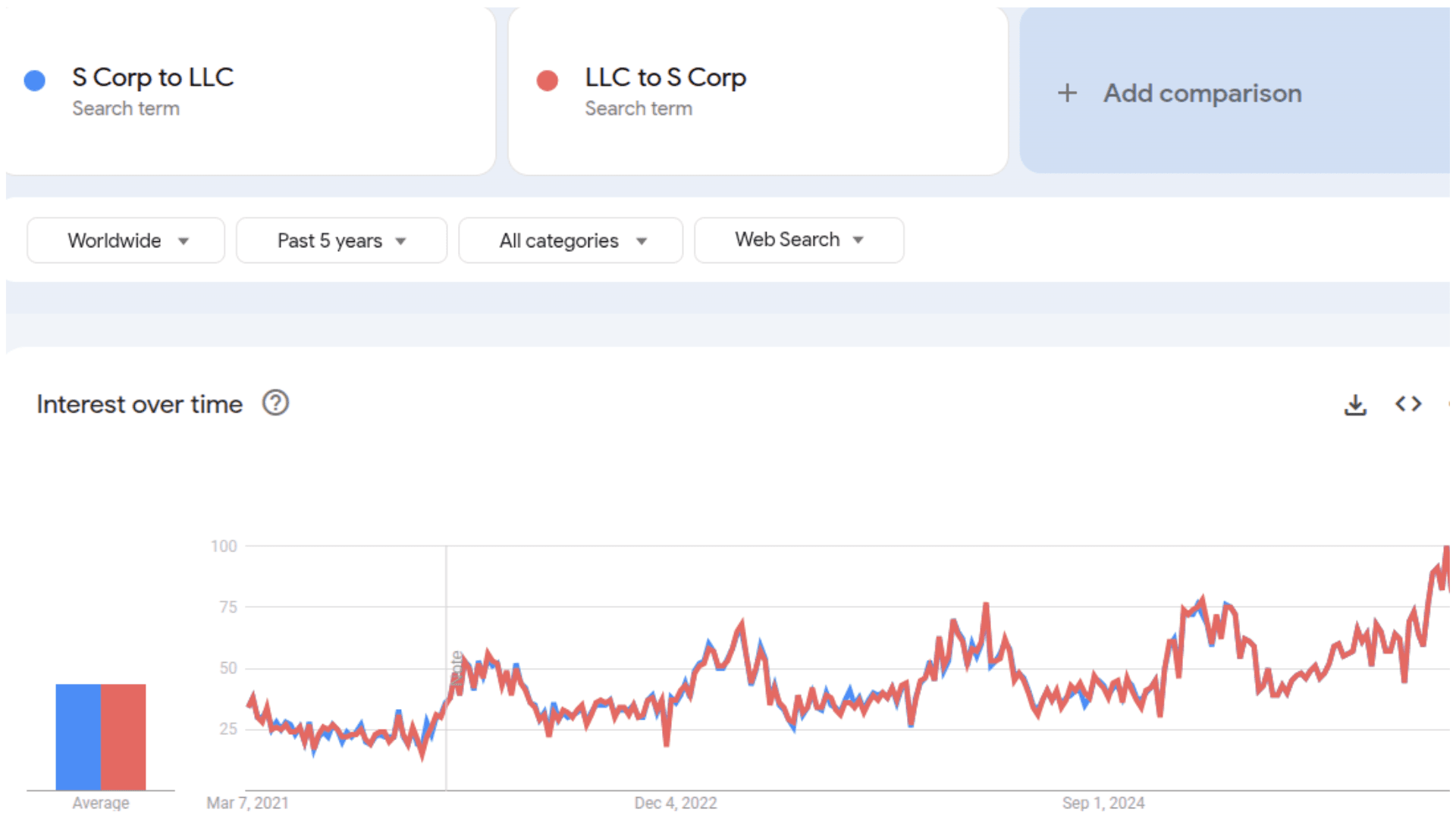
The Google Trends graph for the past 5 years shows search interest for "S Corp to LLC" (blue) and "LLC to S Corp" (red) staying very close and competitive. The lines often cross each other, with no clear overall winner.
This balance happens because both options have strong main points that pull owners in opposite directions as their business changes:
- S Corp edge: It gives major self-employment tax savings (15.3%), allows you to pay a reasonable salary (taxed), and take the rest as distributions (often tax-free).
- LLC edge: On the other hand, LLC offers superior flexibility with unlimited owners (vs. S Corp’s 100 cap), minimal meetings/rules.
Real business owners are facing similar decisions right now. In a recent r/tax discussion (from mid-2025), a New Jersey owner with four single-member LLCs taxed as S Corps asked about revoking the election for 2026 to cut complexity and $1,500 in annual state fees (CBT-100S filings). They worried about getting stuck with C Corp double taxation instead of reverting to simple Schedule C reporting.
The consensus from tax pros: Yes, you can revoke and return to default LLC taxation (disregarded entity/Schedule C for single-member LLCs), but it often requires two steps:
- File Form 8832 to re-elect default classification (not just C Corp).
Many owners start with an LLC for simplicity, switch to an S Corp (or elect S tax on LLC) for tax wins when profits grow, then go back to a pure LLC if they need more owners, less paperwork, or face S Corp limits.
See if this fits your 2026 goals below.
LLC No Longer Meets the S Corp Requirements
The Internal Revenue Service (IRS) requires businesses to meet specific requirements to qualify as an S Corp.[1] This includes the following:
- Must have no more than 100 shareholders.
- Can not have partnerships, corporations, or non-resident aliens as shareholders
- Can only have one class of stock
Let’s say your business has expanded and now has over 100 shareholders. Or, perhaps shareholders the IRS deems not “allowable” are set to join your S Corp. In this case, you have no choice but to abandon your S Corp status.
Remember: If your business owns real estate or valuable patents, converting to an LLC can trigger a 'Taxable Liquidation.' Essentially, the IRS treats it like you sold your assets to yourself at a profit. Check your asset values before you sign anything!
Greater Management Flexibility
An LLC imposes no limit on how many owners or members there can be. It allows you to completely customize your business entity’s structure to fit your business needs. This includes drafting an LLC Operating Agreement that defines unique voting rights and management roles, which is often more flexible than corporate bylaws.
Fewer Formalities
Many formalities are associated with running an S Corp. These concern virtually every part of the entity’s operation. S Corps requires:
- Annual meetings and recorded minutes.
- Board of Directors oversight.
- Strict record-keeping for corporate resolutions.
In contrast, LLCs tend to have significantly fewer formalities, thus providing a more flexible operational framework. For instance, getting a specific activity approved only requires the approval of the LLC members and not the entire board of directors.
Better Profit Distribution
With everything LLC-related, “flexibility” is the keyword. Profit distribution is no different.
In an S Corp, shares are used to distribute profit, with every share being worth equally. So, naturally, shareholders with more shares receive more profit.
The same can apply to an LLC; profits can be shared based on ownership interest. However, they can also be shared based on initial contributions, as outlined in the LLC’s operating agreement. In other words, members contributing more cash will receive a higher profit share.
Tax Advantages
Though an S-Corp designation can help businesses save money on taxes, so can reverting the business entity to an LLC. It all depends on your specific circumstances.
For instance, if your LLC’s taxable income decreases, reverting to your default tax election might be more cost-effective than running an S Corp.
Plus, as an LLC, you don’t have to pay capital gains tax on passive income. If your business starts generating substantial passive income (e.g., from investments or rental properties), then reverting to an LLC status is the way to go.
Of course, with an LLC, you can also choose to be taxed as a partnership (for multi-member LLCs) or a sole proprietorship (for single-member LLCs), which is on par with the flexibility of this business type.
Also read, Top 10 Ways to Start Your Business and Form an LLC
S Corp vs. LLC: Pros and Cons for Small Business
Let’s briefly review how S Corps compare to LLCs so you can solidify your decision to change your business entity’s tax designation.[2]
Feature | S Corp | LLC |
Entity Type | Taxation Status | Legal Entity |
Taxation Style | Pass-through taxation | Pass-through taxation |
Federal Taxes | No federal taxes | No federal taxes |
Ownership Limits | Up to 100 shareholders | No management/owner limits |
Paperwork | Abundant requirements | Minimal requirements |
Liability | Limited liability | Limited liability |
Stock | One class of stock | No stock |
How to Convert an S Corp to an LLC
The exact conversion process primarily depends on whether you already own an LLC taxed as an S Corp or you own a C Corp with an S Corp status, which you want to convert into an LLC.
Here's an at-a-glance checklist:
- Revoke S Corp status (IRS letter).
- File Form 8832 for LLC classification.
- For C Corps: Choose statutory conversion, merger, or non-statutory.
LLCs Taxed as an S Corp: How to Convert Back
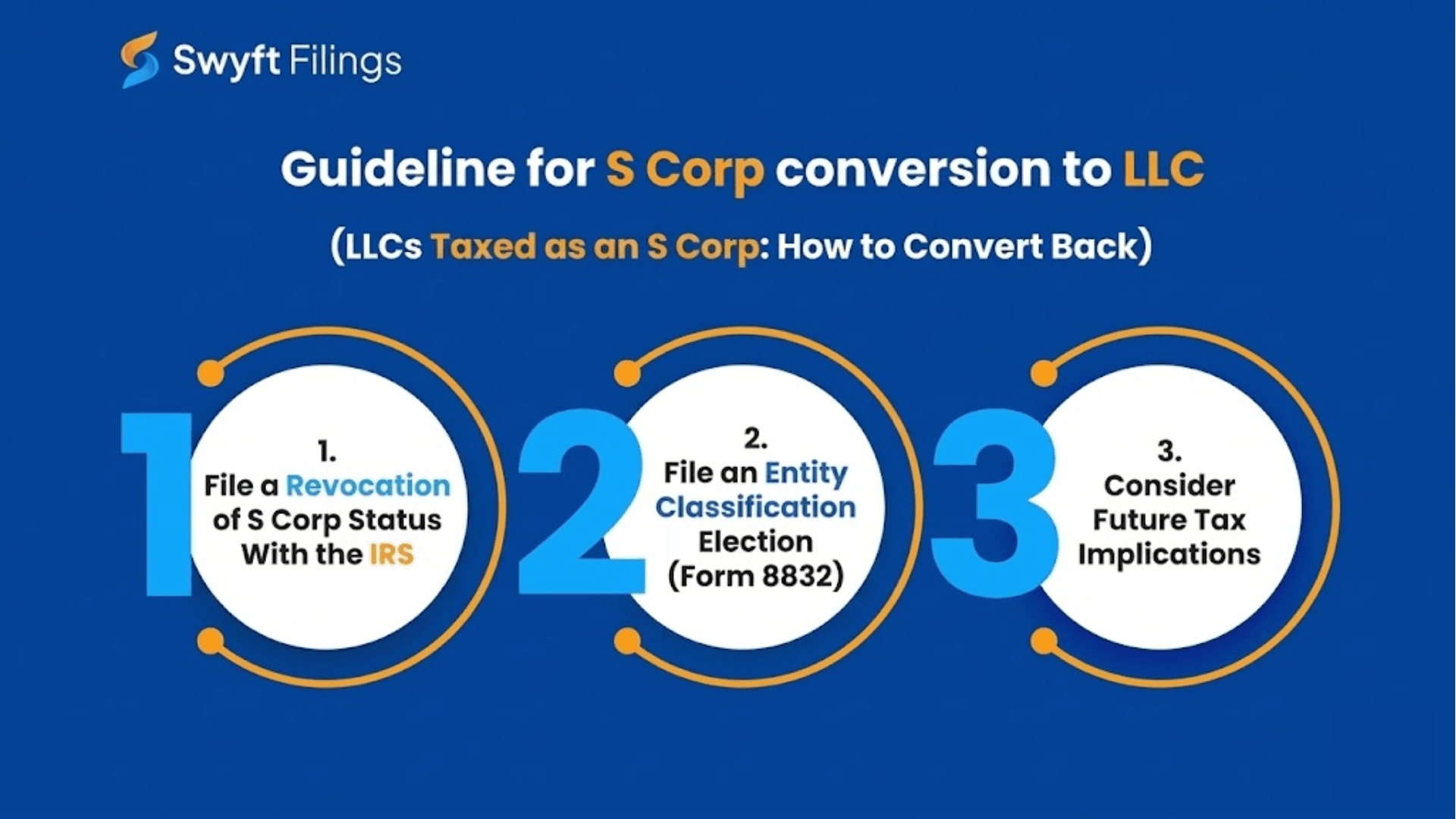
Let’s start with the simpler option first. While some details might vary from state to state, the following step-by-step guide provides a general outline for the conversion process.
1. File a Revocation of S Corp Status With the IRS
If you already own an LLC with S Corp status, all you have to do is have this status revoked by the IRS. To do so, you must compose a document called a statement of revocation.
The IRS’s official website offers guidelines on what to include in your statement of revocation, as this is not an “official” form. Note that the agency uses the word “shareholders” to refer to the owners of the S Corp. Since you’re reverting to an LLC, this term refers to your LLC members.
Your statement of revocation must start by declaring that your organization revokes the selection made under Section 1362(a) of federal law. From there, you should include all the basic information about your business as instructed by the IRS, including members’ information, your S Corp’s EIN (Employer Identification Number), and the date of revocation.
Your deadline to submit this form to the IRS is the 15th day of the third month of the tax year if you want the revocation to be effective on the first day of the same year. In other words, if you want your revocation to be effective on January 1, you must file the form by March 15.
If you miss this deadline, you can still choose a specific future date within the current year for the revocation to begin; otherwise, the IRS will default the change to the first day of your next tax year.
2. File an Entity Classification Election (Form 8832)
As its name suggests, the statement of revocation revokes your business entity’s status as an S Corp. Now, it’s time to re-classify how your LLC will be taxed. For this, you must file Form 8832, aka the Entity Classification Election.[3]
Generally speaking, you need to file this form at the same address as your tax return.
Form 8832 doesn’t have a deadline per se. However, it can’t be filed more than 75 days before the desired effective election date. At the same time, this date can’t be more than 12 months before the election date is filed.
3. Consider Future Tax Implications
Once you convert from an S Corp to an LLC, your business will likely experience certain tax consequences. Here are some important considerations to keep in mind:
- Self-Employment Tax: Single-member LLCs can be subject to more complicated taxation, as members may now pay self-employment tax on all draws, not just a salary.
- State Fees: Your business might be subject to additional taxes, depending on your state. For instance, Tennessee and California impose a franchise tax on LLCs.
- Single-Member Shift: Your financial projections and budget may change due to the new tax structure. Owners of single-member businesses report all business profits directly on their personal Form 1040.
If any of these consequences deter you, think twice before going through the revocation process. Once your S Corp status is revoked, you can only get it back after at least five years have passed, unless you obtain consent from the IRS to re-elect earlier.
C Corporations With S Corp Status: Conversion Options
Suppose you own a C Corporation with S Corp status. In that case, you can convert it into an LLC in three ways: statutory conversion, statutory merger, and non-statutory conversion. Your chosen method will primarily depend on applicable state laws.
1. Statutory Conversion
Statutory conversion (domestic conversion) is the simplest of these three methods. This process allows you to convert your S Corp directly into an LLC without dissolving the original corporation. To achieve this, you must do the following:
- Get authorization from all shareholders.
- Prepare a corporate resolution or a plan of conversion.
- File the resolution with a Certificate of Conversion with the Secretary of State.
2. Statutory Merger
A statutory merger calls for merging the existing S Corp into the LLC, effectively dissolving the original S Corp. The S Corporation’s assets and liabilities will be vested in the new LLC, and its owners (shareholders) will become the new LLC’s owners (members).
This process involves filing a Certificate of Merger with the Secretary of State. Depending on your state, you’ll likely need to submit more documents to complete this process.
3. Non-Statutory Conversion
Non-statutory conversion is the most complex of these three methods. It involves transferring assets from the S Corp to an LLC before dissolving the former entity. This process is quite time-consuming, as it essentially involves going through the entire formation and dissolution process.
Here’s what it generally entails:
- Notify the IRS about the S Corp dissolution and liquidation
- Inform all creditors, clients, shareholders, and employees of the change
- File a Certificate of Dissolution with the Secretary of State’s office
- Create a new LLC
- Transfer your existing S Corps’ assets, liabilities, and ownership over to the new business.
Cost and Maintenance After Conversion
The total cost to convert an S Corp to an LLC depends on your state’s specific requirements and your current entity structure. Generally, you should budget for the following:
- State Fees: Expect to pay the Secretary of State between $50 and $500 for your Certificate of Conversion.
- The 'Final' Tax Return: This is the big one. You’ll need to file a final Form 1120-S for your S Corp. Don't skip this, or the IRS will keep looking for you every year.
- Legal Documentation: Beyond state forms, you will need to draft a new LLC Operating Agreement to replace your old corporate bylaws.
Once the conversion is complete, your ongoing maintenance will likely be simpler. You’ll still need to stay compliant by filing an Annual Report and maintaining a Registered Agent, but you will move away from the corporate meetings and board resolutions.
Conclusion:
Changing your S Corp to an LLC simplifies your operations by removing rigid corporate formalities. While the S Corp to LLC conversion provides greater management flexibility and custom profit sharing, it is vital to account for potential tax consequences like "taxable liquidation.
Swyft Filings handles your S Corp to LLC conversion seamlessly. Every business formation package includes a free tax consultation to ensure a clean transition to your new, flexible business structure.
Bibliography
- The Internal Revenue Service. “S Corporations.” Accessed March 10, 2026.
- The Internal Revenue Service. “Tax Information on S Corporations.” Accessed March 10, 2026.
- The Internal Revenue Service. “Revoking a Subchapter S Election.” Accessed March 10, 2026.