
Struggling with overstock or stockouts? Learn how to manage small business inventory in 2026 using ABC analysis, reorder points, FIFO, and smart forecasting to protect your cash flow and boost profits
Three months after launching her Etsy candle shop, Mia realized something uncomfortable: she had $7,800 sitting in boxes under her dining table and only $1,200 in her bank account.
Sales weren’t the problem; inventory was. And this is not just Mia’s problem; it is a widespread crisis
- 95% of small businesses struggle with inventory issues [1]
- The loss from theft, damage, or errors averages 1.6% of annual sales, resulting in $112 billion in U.S. losses.[2]
- Nearly 80% SMBs have overstock issues; avg 12% dead stock. [3]
To stay profitable, you must manage your products as strictly as your cash. Having too little stock sends customers to competitors, while having too much stock drains your bank account.
A structured inventory system protects your cash flow and keeps your business ready for growth. Here is how to build one.
Quick Steps To Manage Your Inventory
- Select the best tools to track your items.
- Sort products using the ABC method to focus on top sellers.
- Calculate reorder points to avoid running out of stock.
- Use FIFO to sell older items first.
- Do regular audits to find missing items
- Move dead stock out on discounts or as freebies to make money.
- Organize your shelves to speed up shipping.
What Is Inventory Management?
Inventory management, sometimes also called inventory control, is the process of tracking your stocked goods. This involves having a record of how many items you have, including applicable information such as size, color, weight, dimensions, and where the item is stored (if you have more than one physical location)
Inventory Category | What it Includes (Examples) | Business Role |
Raw Materials | Wax, fabric, beads, flour, lumber. | The "ingredients" needed to create your product. |
Work in Progress | Half poured candles, cut fabric pieces. | Items currently being made but not yet sellable. |
Finished Goods | Packaged candles, completed shirts. | Sale-ready products waiting for a customer. |
Packaging & Supplies | Boxes, mailers, tissue paper, labels. | Essentials used to ship and brand your goods. |
MRO Goods | Cleaning supplies, office pens, and tools. | Items used to run the business, not to sell. |
The purpose of inventory management is to help you manage sales. When you know what is in stock, you know what products to promote to customers. Inventory control ensures you know when to replenish and replace products so the business continues to run smoothly.
The Small Business Inventory System: A 6 Step Approach
Before we start moving further, note that this framework works for small physical product businesses with:
- Limited storage space
- 50 to 1,000 SKUs
- Single or multi channel selling
- Spreadsheet or early stage software tracking
Step 1: Choose Inventory Tools
Before you start counting, you need a place to keep your data. While a notebook works, free software can save you hours of work by automating your alerts.
- Use free tracking tools like Zoho Inventory, Square, or Sortly to see your stock levels in real-time.
- Sync with your shop (like Etsy or Shopify), so your inventory numbers drop automatically every time you make a sale.
- Set "Low-Stock Alerts" in the software so it emails you the moment an item hits its Reorder Point (ROP).
Read Key Organizational Tools for a Successful Business for more details!
2026 AI update:
If you want to grow fast, consider AI tools like Netstock or Crest. These use machine learning to learn your sales patterns and cut excess inventory by 10-15% [4]
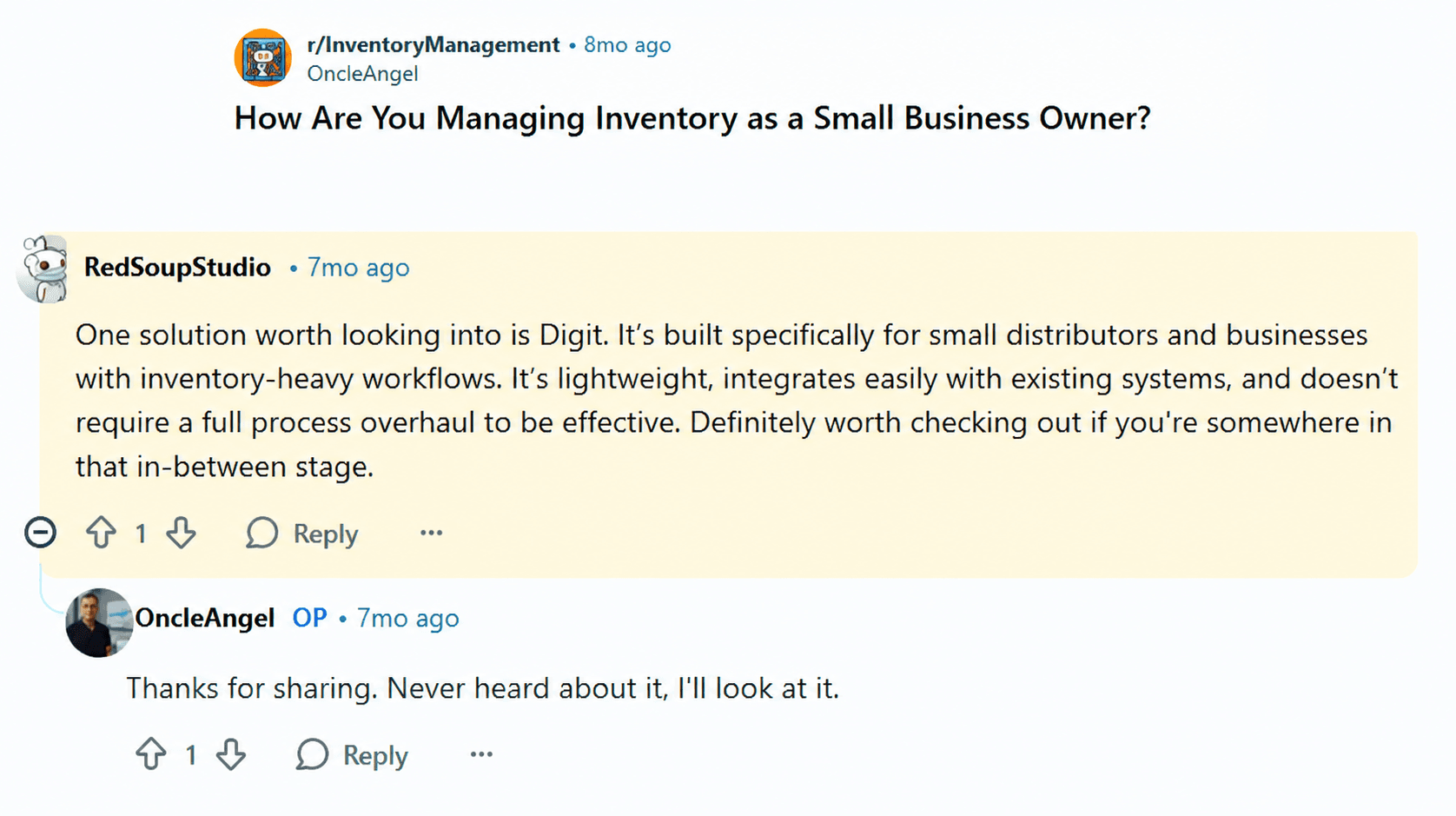
A Reddit user suggested the following:
Step 2: Set Reorder Points (Par Levels)
A Reorder Point (ROP), also known as a Par Level, is the minimum amount of product you must have on hand to stay in business while you wait for a new shipment to arrive. By setting a fixed number, you eliminate the stress of "guessing" when to buy more.
How to Calculate Your ROP
You don't need fancy software to do this; you just need three numbers:
- Average Daily Sales: How many units do you sell on a normal day?
- Lead Time: How many days does it take for your supplier to get a new order to your door?
- Safety Stock: "Emergency" backup stock in case your supplier is late or sales suddenly spike.
The Formula:
(Average Daily Sales $\times Lead Time) + Safety Stock = Reorder Point
Example:
If Mia sells 5 candles a day, her supplier takes 10 days to deliver, and she wants 20 units for emergencies:
(5 times 10) + 20 = 70 units
The Goal: When Mia sees she has 70 candles left, she places an order immediately.
Note: Par levels may change over time, so revisit them several times a year to ensure they are still relevant to the product. If a holiday is coming, boost your stock levels using your recent sales data. A good rule of thumb is to add a 20% to 25% "Safety Stock" buffer to handle the rush.
Step 3: Prioritize With The ABC Method
Prioritizing inventory is a good practice that ensures you never run out of your bestselling products. It helps you focus your time and money on the items that actually pay your bills.
If you spend the same amount of time tracking your bestsellers as you do your slow-movers, you are wasting energy. To fix this, use the 80/20 Rule.
The 80/20 Rule says that “80% of your profit usually comes from only 20% of your products”.
The ABC Inventory Table
To stay organized, divide your products into three categories based on how much money they bring in:
Category | What it is | How to manage it |
A: The VIPs | A small group of items (10–20%) that make up most of your money. | Count these often. Never let them run out. |
B: The Middle | Moderate sellers that move steadily but slowly. | Check these once a month. |
C: The Rest | Cheap items or slow sellers that make very little profit. | Keep it simple. Don't waste time on these. |
By using the ABC method, you stop "obsessing" over items that don't sell. Instead, you focus your cash and your time on the products that actually pay your bills.
Tip: Look at your sales from last year. Highlight the top 5 items that made you the most money; those are your "Category A" products.
Step 4: Run FIFO (First-In, First-Out)
FIFO is a simple rule: sell your oldest stock first.
Think of it like a grocery store, they put the newest milk at the back so you buy the older milk at the front before it expires.
Even if your products don't rot, selling older items first is a smart move. Packaging can get dusty, labels can fade, and trends change quickly. The longer an item sits on a shelf, the more likely it is to become "dead stock" that nobody wants.
Why FIFO is Best for You:
- Your customers get the products in the best condition.
- Items don't sit in the back and get dusty or outdated
- It is the standard method preferred by the IRS and bookkeepers.
Method | Best For | Small Business Fit |
FIFO | Retail, e-commerce, crafts | ✅ Preferred (Best for most) |
LIFO | Huge industries (like oil) | ❌ Too Complex |
Average Cost | Basic goods with stable prices | ⚖️ Sometimes |
Pro Tip: When you get a new shipment, don’t just put it on top of the old pile. Move the old items to the front and put the new stuff in the back!
Step 5: Audit Your Stock Regularly
Even if you use inventory management software, it's still advisable to do a regular physical inventory.
Sometimes even the best software can make mistakes. Theft, damage, and paperwork errors (known as "shrinkage") can cause your records to drift away from reality. You must physically count your items to stay accurate.
Tips to Master Your Audit:
- Run "Cycle Counts" by checking your bestsellers weekly and slower items once a month.
- Do a full year-end count to make sure your tax reports to the IRS are 100% correct.
- Monitor shrinkage closely, it's led to 658k lost retail jobs and $39B in wages. [5]
- Verify your profit by matching your physical shelf stock to the value on your balance sheet.
- Investigate missing items immediately if your losses ever exceed 3% of your total stock.
Tip: Don't wait until December 31st to count everything. Counting just a few items every Friday makes your year-end taxes much faster and less stressful.
Step 6: The Dead Stock Playbook
Dead stock refers to items that haven't sold in 6 to 12 months.
Analysis of small brands shows that dead stock accounts for 12% of total inventory, tying up cash and space that could be used for fast moving items.
How To Clear Old Inventory:
- Discount or Bundle: Create a "Buy One, Get One" deal or a clearance section to quickly get some cash back.
- Flash Sales: Run a 24 hour "Last Chance" sale on social media to create urgency.
- Gift with Purchase: Use slow movers as a free "thank you" gift for customers who spend over a certain amount.
- Liquidate: Sell the remaining items in bulk to discount stores or resellers to empty your shelves.
- Write off: If the items are damaged or unsellable, document them as a loss for tax purposes.
Step 7: Forecast Your Demand
Forecasting helps you avoid the panic of running out of stock right when everyone wants to buy. Instead of guessing, you use your past sales to predict the future. But it doesn't mean you can guess the forecast.
Modern businesses use AI to analyze complex sales patterns and make accurate predictions.
Tools like Netstock or Crest use machine learning to automatically forecast demand and handle seasonal peaks before they occur.
If you are a new business and don't have 12 months of data yet, look at industry trends for similar products to make your best educated guess.
If you aren't using AI yet, follow this guide to track your needs:
Focus Area | Quick Goal | Action Step |
Past Sales | Find your busy months. | Order more stock 8 weeks before your "peak" season. |
Growth | Plan for new customers. | Multiply last year's sales by your growth (ex: +10%). |
Promotions | Prep for big sales. | Stock up before sending marketing emails or ads. |
Safety Stock | Avoid "sold out" panic. | Keep 20% extra for viral posts or influencer ads. |
Step 8: Manage Your Suppliers
Your business is only as fast as your slowest supplier. Building strong relationships ensures you get your materials on time and at the best price.
So, always select reliable partners before placing an order. A good background check can save you from a lot of loss and frustration.
Secondly, always have a backup supplier for your most important material in case your main one has a delay.
Step 9: Organize Your Workspace
This is the last but one of the most important steps.
How you arrange your shelves can make you 20% to 30% faster at shipping orders. This is called "Velocity Slotting." [6]
You can organize your workspace following ways:
- Store "Category A" items near the door or your packing station since you pick them most often.
- Put slow-movers in the back or on high shelves to keep your main workspace clear.
- Go vertical by using tall shelving units to maximize your storage space without needing a bigger room.
Also read: Small Company Failure: How to Avoid the Business Graveyard!
Takeaway:
Most small businesses don’t fail because they lack customers. They fail because their money is stuck in boxes on a shelf instead of in the bank.
At Swyft Filings, we know that once your shop starts growing, you need more than just a good inventory system; you need a real business structure.
Whether you want to turn your hobby into an LLC or set up a C Corp, we make the legal paperwork fast and easy. Let us handle the filings so you can stay focused on selling your products and building your brand.
Start Your LLC or C Corp with Swyft Filings Today!
Bibliography
Avancim. New Study Reveals 95% of Small Businesses Struggle with Inventory Management. Accessed on 16 Feb, 2026
Icape. The $112 Billion Problem. Accessed on 16 Feb, 2026
Netstock. Inventory Management 2024 Benchmark Report. Accessed on 16 Feb, 2026
Net at Work. Netstock Predictor IA Reduces Excess Inventory and Eliminates Stock Outs.Accessed on 16 Feb, 2026
Cloudpick. Shrink in Retail: Key Trends and Statistics for 2025. Accessed on 16 Feb, 2026