
An S corp is a tax status that lets business profits pass directly to owners, skipping corporate tax. Here's what it means, how it works, and if it fits you.
An S corporation (S corp) is a tax designation from the IRS that lets a business pass its income directly to its owners. The business itself does not pay federal income tax.
Key Takeaways
- S corp stands for "Subchapter S corporation," named after a section of the IRS tax code
- Profits and losses pass through to the owner's personal tax return
- S corp status can reduce self-employment taxes for business owners who are earning consistently
- You must meet IRS eligibility rules before electing S corp status
- Electing S Corp status requires filing Form 2553 with the IRS [1]
- An LLC can choose to be taxed as an S corp without changing its legal structure
What Is an S Corp?
The "S" in S corp stands for Subchapter S. That is the section of the Internal Revenue Code that defines the rules for this tax election. The full name is S corporation, but most people just say S corp.
It is not a separate business entity type at the state level. It is a federal tax designation you apply for after forming a corporation or, in many cases, an LLC.
There are two parts to understanding an S corp: the legal side and the tax side
- The legal side. An S corp is a corporation. It is a registered business entity that exists separately from you. That means your personal assets stay protected if the business runs into legal or financial trouble.
- The tax side. This is where S Corps stands apart from most other business structures. The IRS allows S Corps to use pass-through taxation. Instead of the business paying taxes on its profits, those profits pass directly to the owners. Each owner reports their share on their personal tax return and pays taxes at their individual rate.
How Does an S Corp Work?
Say you own an S corp and your business earns $150,000 in profit this year. That profit does not get taxed at the business level. Instead, it flows through to your personal tax return. You pay income tax on it based on your individual tax bracket.
Now here is the part that often gets people's attention. As an S Corp owner who works in the business, you are required to pay yourself a reasonable salary. That salary is subject to payroll taxes, which include Social Security and Medicare. But any remaining profit that gets distributed to you as an owner is not subject to those same payroll taxes.
For someone making a healthy profit, that difference can add up to real savings.
A quick example:
- Net profit: $120,000
- Reasonable salary paid to yourself: $60,000
- Owner distribution: $60,000
- Payroll taxes apply only to the $60,000 salary, not the full $120,000
Compare that to a sole proprietor or single-member LLC. They pay self-employment tax (15.3%) on the entire $120,000 of net profit. An S corp election, if you qualify, can change that math. [2]
Who Qualifies for S Corp Status?
Not every business can elect S corp status. The IRS has a specific list of eligibility rules.
To qualify, your business must:
- Be a domestic business incorporated or organized in the United States
- Have no more than 100 shareholders
- Have only one class of stock
- Have shareholders who are U.S. citizens or residents, no foreign shareholders
- Have shareholders who are individuals, certain trusts, or estates (not other corporations or partnerships)
- Not be a bank, insurance company, or certain other ineligible business types
If you meet all of these, you can file Form 2553 with the IRS to elect S corp status. You'll need to do this by March 15 of the tax year you want the election to take effect, or within 75 days of forming a new business.
How to Set Up an S Corp
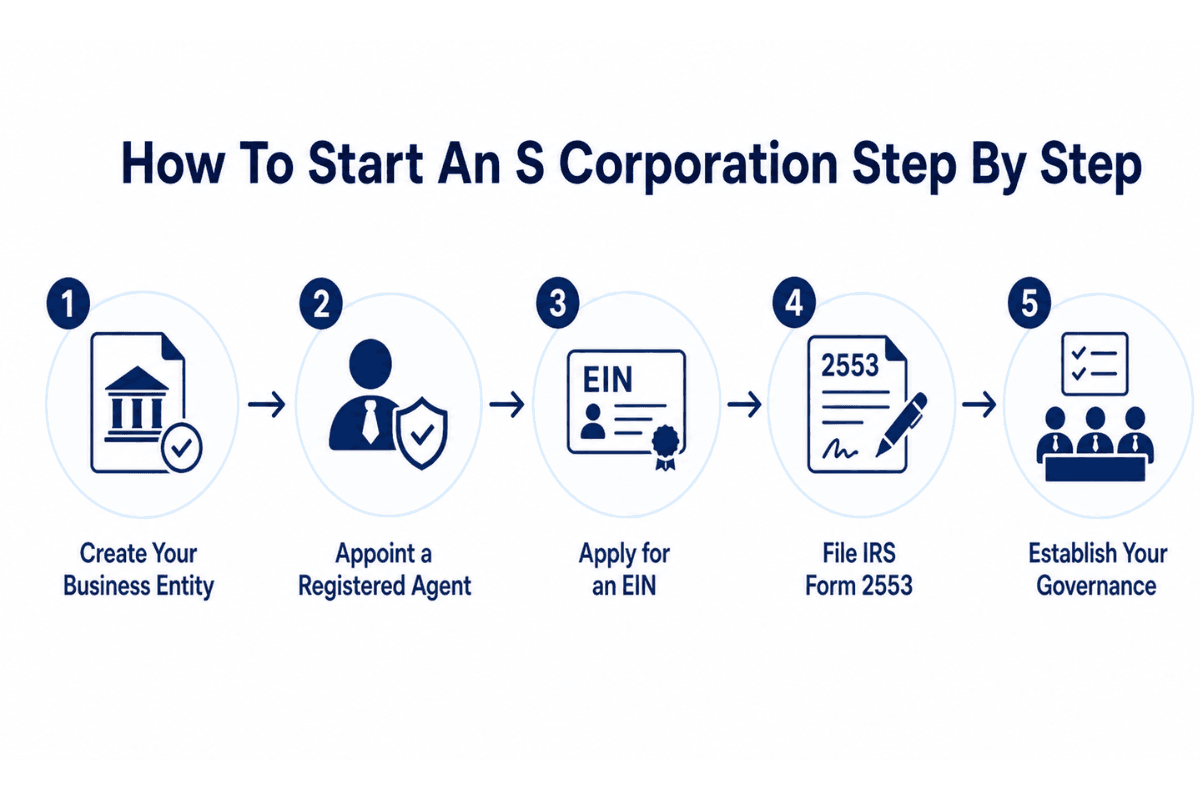
- Step 1: Form your business entity. If you do not already have a corporation or LLC, you will register one with your state.
- Step 2: Get your EIN. Apply for an Employer Identification Number from the IRS. This is your business's tax ID.
- Step 3: File Form 2553. This is the official IRS form to elect S corp status. You will need to file it within 75 days of forming your business or by March 15 of the tax year you want the election to take effect.
- Step 4: Set up payroll. Once you elect S corp status, you need to pay yourself a reasonable salary and run payroll through your business.
- Step 5: Stay compliant. File your annual business taxes, hold required meetings (if you have a corporation), and keep your records organized.
Want to know about S Corp formation in more detail? Read our How To Start an S Corp Online guide for 2026!
S Corp vs. LLC: What Is the Actual Difference?
This is the most common point of confusion, and it comes up because these two things are often compared as if they are the same kind of choice. They are not.
An LLC is a legal structure. An S corp is a tax status.
You can have an LLC that is taxed as an S corp. Many small business owners do exactly this. They form an LLC at the state level for its simplicity and liability protection, then file Form 2553 with the IRS to have the LLC treated as an S corp for tax purposes. The legal structure does not change. Only the tax treatment does.
Here is how the taxes compare:
Feature | LLC (default tax) | S Corp Election |
Legal protection | Yes | Yes |
Pass-through taxes | Yes | Yes |
Self-employment tax on all profits | Yes | No, only on salary |
Payroll required | No | Yes |
Formal compliance | Low | Moderate |
Annual federal filing | Schedule C or 1065 | Form 1120-S + K-1s [3] |
The single biggest difference: An LLC owner with default tax treatment pays self-employment tax on all net income. An LLC that has elected S corp status pays payroll taxes only on the owner's salary, not the full profit amount.
That gap is what drives most people to explore the election.
Still deciding between the two? Read the S Corp vs. LLC comparison on the Swyft Filings to see how each structure plays out for different types of businesses.
How Do S Corp And C Corp Differ?
A C Corp is the default tax structure for corporations. It pays corporate income tax on its profits at the current 21% federal corporate rate. Then, if those profits are distributed to shareholders as dividends, the shareholders pay personal income tax on those dividends, too. A corporation is double-taxed.
An S corp avoids the first layer. Profits flow directly to shareholders, who pay personal income tax at their own rates. No corporate-level tax first. Here is a simplified comparison:
Feature | S Corp | C Corp |
Pays corporate income tax | No | Yes (21% federal) |
Shareholders pay tax on distributions | Yes, at personal rate | Yes, on top of corporate tax |
Max shareholders | 100 | Unlimited |
Foreign shareholders allowed | No | Yes |
Stock classes | One | Multiple |
Best for | Small, profitable businesses | High-growth or investment-seeking companies |
C Corps are often preferred by businesses looking to raise venture capital, bring on many investors, or go public. S Corps are generally a better fit for small business owners who want to take income from the business now and reduce the tax bite along the way.
Not sure which corporate structure is right for your business? The C corp vs. S corp vs. LLCs from Swyft Filings breaks down the trade-offs clearly.
What Is The Reasonable Salary Requirement For An S Corp?
This is the rule that surprises most people when they first look into S corp status.
If you own an S corp and work in the business, the IRS requires you to pay yourself a reasonable salary before taking any distributions. The salary must reflect what you would reasonably pay someone else to perform the same job in your industry.
Without it, every owner would just take all of their income as distributions and skip payroll taxes entirely. The IRS closes that gap by requiring a market-rate salary.
What counts as reasonable?
There is no official formula. The IRS looks at factors like your role, the hours you work, what similar positions pay in your market, and how much profit the business generates. Many CPAs reference industry salary data from sources like the Bureau of Labor Statistics.
What happens if you get it wrong?
If the IRS determines your salary was unreasonably low, it can reclassify some or all of your distributions as wages. That means you could owe back payroll taxes, plus interest and penalties. The IRS watches this more closely for S corps specifically, because the potential for tax savings is significant.
Setting a reasonable, well-documented salary is the single most important compliance step for S Corp owners.
What Are the Benefits of an S Corp?
Here is a clear look at why business owners elect S corp status.
1. Reduced self-employment taxes:
When your business is consistently profitable, splitting income between a salary and owner distributions can meaningfully reduce the amount subject to payroll taxes. At $100,000 in net profit, annual savings after costs typically run $4,000 to $6,000, depending on how the salary is structured and which state you are in.
2. No corporate-level federal income tax:
Profits pass through directly to your personal return. You do not pay taxes at the business level first.
3. Limited liability protection:
As with any LLC or corporation, your personal assets stay separate from business debts and legal claims.
4. Potential QBI deduction:
Eligible S corp owners may qualify for the 20% qualified business income deduction under Section 199A, which reduces taxable income further. [4]
5. Business credibility:
Operating as a corporation can add a layer of credibility with clients, lenders, and vendors.
6. Perpetual existence:
Unlike some LLCs, an S corp continues even if ownership changes. If you ever want to sell your stake, you can do so without requiring approval from other owners, which is not always the case with an LLC.
The Downsides of an S Corp
S corp status is not right for every business. These are the honest trade-offs.
You must run payroll
Once you elect S corp status, you are required to pay yourself through payroll and file payroll tax returns quarterly. This adds administrative work and cost. Payroll services typically run $30 to $150 per month, and Form 1120-S tax preparation adds $800 to $2,000 or more per year, depending on complexity. [5]
The IRS watches S corps closely
Because of the tax savings potential, particularly around salary classification, S Corp returns receive more scrutiny than sole proprietor or standard LLC returns. Getting your reasonable salary right and maintaining accurate records matters a great deal.
Strict eligibility rules
The 100-shareholder limit, single stock class requirement, and no foreign shareholder rule can restrict how you grow, bring in investors, or structure ownership.
It may not pencil out at lower income levels
The additional costs of running an S Corp, payroll, bookkeeping, tax prep, and state fees typically run $3,500 to $5,000 per year. If your net profit is consistently below $60,000 to $75,000 consistently, the savings may not outweigh the cost.
State taxes vary
A few states charge additional taxes or fees on S Corps. California, for example, imposes a 1.5% franchise tax on S corp net income at the state level, which partially offsets the federal savings. Always check your state's specific rules before making the decision.
Thinking about the flip side? If you are already in an S corp and wondering whether it still makes sense, read how to convert an S corp back to an LLC and what that process involves.
Is an S Corp Worth It for a Solo Freelancer?
The honest answer: it depends on your income.
If you are a freelancer or solo consultant and your net profit consistently exceeds $50,000 to $60,000 per year, an S corp election is worth looking at seriously. The payroll tax savings on income above your salary can offset the cost of running the structure.
If you are still in the early stages and your profit is more variable or below that range, the added complexity may not be worth it yet. A single-member LLC with default tax treatment keeps things simple while your business grows.
A professional who understands small business taxes can run the numbers for your specific situation. That conversation is often one of the most valuable things you can do before making the decision.
Bottom Line
An S corp is a structured approach to how your business income is taxed. For the right business at the right income level, it can meaningfully reduce the taxes you pay each year.
The key is to understand whether your situation meets the requirements and whether the ongoing responsibilities make sense for where you are now.
If you are ready to explore whether an S corp election fits your business, the next step is straightforward: review your current income, understand your state's requirements, and talk through the numbers with a tax professional.
This article is for informational purposes only and does not constitute legal or tax advice. Please consult a licensed professional for guidance specific to your situation.
Bibliography
- Internal Revenue Service (IRS). About Form 2553. Accessed on May 05, 2026
- Internal Revenue Service (IRS). Self-Employment Tax. Accessed on May 05, 2026
- Internal Revenue Service (IRS). Schedule K-1 (Form 1120-S). Accessed on May 05, 2026
- Internal Revenue Service (IRS). Qualified Business Income Deduction. Accessed on May 05, 2026
- Internal Revenue Service (IRS). About Form 1120-S. Accessed on May 05, 2026
FAQs
Not automatically. An LLC is a legal structure, while an S corp is a tax status. Your LLC is only treated as an S corp if you filed Form 2553 with the IRS and received approval. Otherwise, it is taxed as a sole proprietorship (single-member) or partnership (multi-member) by default.
Yes. An LLC can elect to be taxed as an S corp while keeping the same legal structure. You simply file Form 2553 with the IRS, and only the tax classification changes—not the LLC itself.
There is no fixed amount because it depends on salary, deductions, and state taxes. For example, if you earn $200,000 and pay yourself a $90,000 salary, payroll taxes apply only to the salary portion, while the rest is taken as distributions and taxed as personal income.
The 2% rule applies to S corp shareholders who own more than 2% of the company. They must include employer-paid health insurance premiums in their W-2 wages, but can later deduct those premiums on their personal tax return.
If your net profit is consistently above $60,000–$75,000 and you actively work in the business, an S corp election may offer tax savings. However, if income is low, variable, or you want simplicity, staying as a standard LLC is often better.