

A DBA ("Doing Business As") is a registered name that lets your business operate under a different name than its legal one and gives your business an official nickname.
Say your name is Jane Smith and you run a freelance bakery. Without a DBA, your business legally operates as "Jane Smith." Every invoice, receipt, and bank account says Jane Smith.
But what if you want to call it "Sweet Jane's Bakery?"
That's where a DBA comes in.
A DBA lets you brand your business under a name that's more memorable, more marketable, and more professional without forming a new legal entity.
This guide explains everything you need to know about DBAs in plain English: what they are, when you need one, how to file, and whether one is right for your business.
Does DBA Mean "Database Administrator" Too?
Yes, and that's a common point of confusion.
In the tech world, DBA stands for Database Administrator, a professional who manages and maintains computer databases.
In the business world, DBA stands for Doing Business As, which is a registered trade name for a business.
This guide is entirely about the business definition of DBA. If you're looking for information about database administrator careers, salaries, or job descriptions, that's a different topic entirely.
What Does DBA Stand For in Business?
DBA stands for "Doing Business As."
It goes by several other names depending on your state:
- Assumed name
- Fictitious business name
- Trade name
All of these terms mean the same thing: your business is operating under a name that is different from its legal name.
Examples:
- John Williams is a sole proprietor who wants to run a landscaping business. His legal business name is "John Williams." He files a DBA for "Green Thumb Landscaping."
- XYZ Enterprises LLC wants to launch a new product line. It files a DBA for "XYZ Home Goods" to keep that brand separate from the main company.
- A franchisee forms 123 Business LLC but operates a Subway location. They register a DBA for "Subway" so customers and the state know what business they're actually running.
What Is a DBA in Simple Terms?
Think of a DBA as a nickname, but an official, registered one.
Your legal name is still your legal name. The DBA is just what you show the world: on your storefront, your website, your business cards, and your bank account.
You are not creating a new company. You are not changing your legal structure. You are simply telling the government: "I plan to do business under this name."
That's it.
What Is the Purpose of a DBA?
The original purpose of DBA laws was consumer protection.
When a business operates under a name different from its legal name, customers deserve to know who they're actually dealing with. DBA registration creates a public record. Anyone can look it up and find out who owns the business behind the name.
Beyond consumer protection, businesses use DBAs for practical reasons too — which we'll cover in the next section.
Why Would a Business Need a DBA?
Here are the most common reasons:
1. You're a Sole Proprietor Who Wants a Real Business Name
If you're a sole proprietor, your business name is legally your full name. A DBA lets you operate under something that sounds like an actual business. As a sole proprietor, your business income is reported on your personal tax return. The IRS explains sole proprietor tax obligations here.[1]
2. You Want More Privacy
If you don't want your personal name on storefronts, ads, or public records, a DBA keeps your name off public-facing materials.
3. Your Bank Requires It
Many banks won't let you open a business bank account under a business name unless you have a registered DBA. You'll need the DBA certificate to open an account under your trade name. This is also one of the top reasons to get a DBA for sole proprietors.
4. You're Launching a New Product Line or Service
If your LLC is called "Miller Construction LLC" and you want to offer interior design services under a separate brand, you don't need to form a new company. Just file a DBA for "Miller Interiors."
5. You're a Franchisee
If you buy a franchise and form an LLC like "Sunrise Foods LLC," you need a DBA to legally operate as "Subway" or whatever franchise brand you've joined.
6. You Want to Rebrand Without Reforming
If your business has grown in a different direction than your original name suggests, a DBA lets you operate under a new name without dissolving and recreating your business entity.
7. You Run an Online Business
If you sell on Etsy, run a blog, or operate a website under a brand name different from your legal name, you may need a DBA, especially if you want to accept payments under that name.
Do I Need a DBA?
Use this to figure out if a DBA applies to your situation:
Situation | Do You Need a DBA? |
Sole proprietor operating under your own name | No |
Sole proprietor using a business name | Yes, in most states |
LLC operating under its registered name | No |
LLC operating under a different name | Yes |
Corporation using a new brand or product line name | Yes |
Franchisee operating under the franchisor’s brand | Yes |
Freelancer invoicing under a brand name | Likely yes |
Online shop under a brand name | Likely yes |
When in doubt, check with your state's Secretary of State office or a business attorney. You can also read our detailed guide on how to determine if you need a DBA to walk through your specific situation.
How Does a DBA Work?
A DBA works like this:
- You choose a name you want to use for your business
- You check that the name is available in your state or county
- You file the DBA paperwork with your state, county, or both
- Some states require you to publish a notice in a local newspaper
- You receive a DBA certificate
- You can now legally operate, open bank accounts, and sign contracts under that name
Your legal entity stays exactly the same. The DBA is just a registered alias layered on top.
A business can have more than one DBA. There's no legal limit to how many trade names you can register, as long as you register each one.
If you want to learn the full process, check out our complete guide on how to register a DBA name.
How to Set Up a DBA for Different Business Types
Sole Proprietorships and Partnerships
Most states require a DBA if you want to operate under any name other than your own. This is the most common reason individual business owners file a DBA. Without it, you can only legally conduct business under your personal name.
LLCs
An LLC already has a registered business name. You only need a DBA if you want to operate under a different name, for example, launching a new brand, entering a new market, or expanding into additional product lines.
Corporations
Same as LLCs. If the corporation wants to operate under a name other than what's on its formation documents, a DBA is required.
Franchisees
You almost always need a DBA. Your legal entity (often an LLC or corporation) is different from the franchise brand name. A DBA bridges that gap legally.
DBA vs. LLC: What's the Difference?
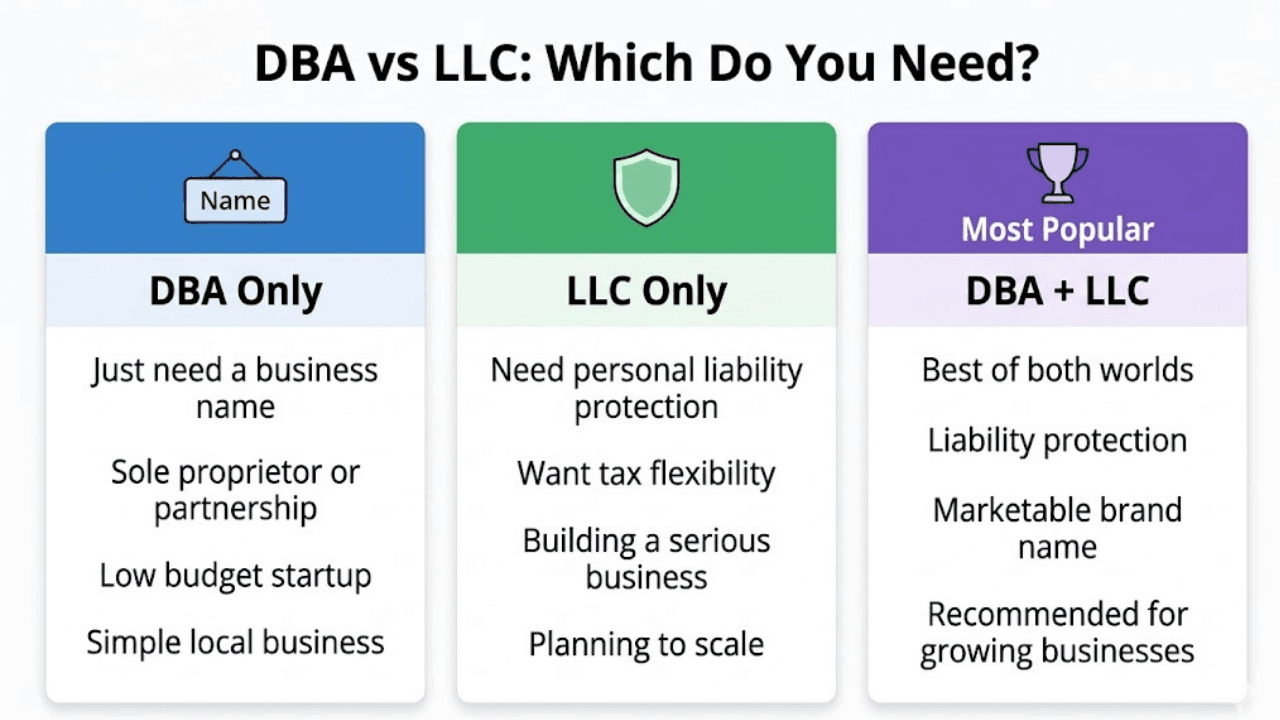
This is the most common point of confusion for new business owners. Here's a direct comparison:
DBA | LLC | |
What it is | A registered business name | A legal business entity |
Creates a new legal entity? | No | Yes |
Liability protection? | No | Yes |
Tax benefits? | No | Yes (flexible tax elections) |
Complexity | Simple | More involved |
Protect personal assets? | No | Generally yes |
The key difference: A DBA is just a name. An LLC is a legal shield. Depending on your goals, you may also want to consider an S Corporation or C Corporation instead of an LLC.
If you're a sole proprietor using a DBA and someone sues your business, your personal assets, including your car, savings, and home, are still at risk. A DBA offers no liability protection.
An LLC creates a separate legal entity. The LLC owns the business. If something goes wrong, the LLC's assets are at risk, not yours personally.
You can have both. Many business owners form an LLC for protection, then file a DBA to operate under a more marketable name. That's a common and smart setup.
Not sure which fits your situation? Use our compare business types tool to decide.
DBA vs. Trademark: What's the Difference?
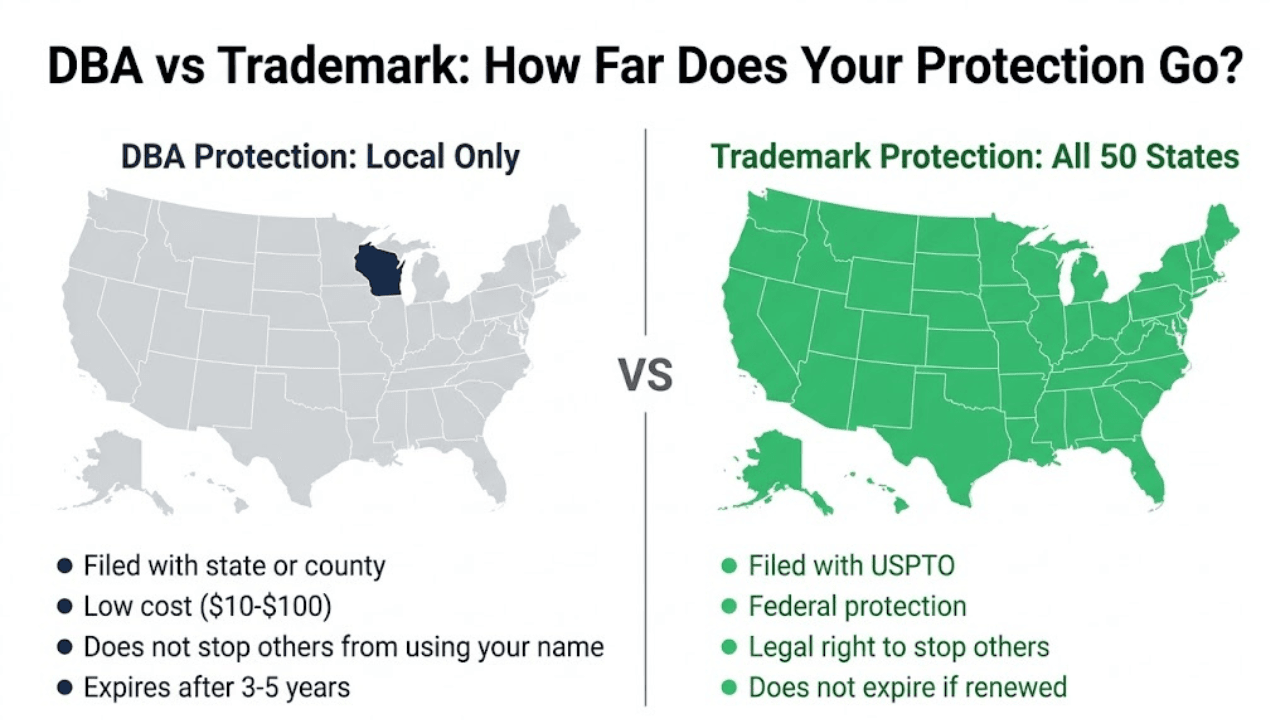
A DBA and a trademark are not the same thing, and this distinction matters.
DBA | Trademark | |
What it protects | Your right to use the name locally | Exclusive nationwide rights to the name |
Who issues it | State or county government | U.S. Patent and Trademark Office (USPTO) |
Scope of protection | Limited to your filing area | Federal in all 50 states |
Can others use the same name? | Yes, in most states | No, you can take legal action |
A DBA tells the public what name you're using. A trademark gives you the legal right to stop others from using the same or a similar name. You can register a federal trademark through the U.S. Patent and Trademark Office (USPTO).[2]
In most states, a DBA does not prevent another business from registering the same name. If someone forms an LLC under your DBA name, you may have to give up the name entirely.
Think of it this way:
- DBA = your business's nickname on paper
- Trademark = the legal shield that protects the nickname
If you're building a brand you plan to grow, protect, or eventually franchise, look into trademarking your name. A DBA alone won't do it.
What Are the Benefits of a DBA?
Branding Flexibility
A DBA lets you operate under a name that actually markets your business. "Jane's Florals" is more compelling than "Jane Elizabeth Thompson."
Low Cost and Simple Process
Filing a DBA is one of the cheapest and fastest things you can do for your business. Most applications cost under $100 and take minutes to complete.
Opens the Door to a Business Bank Account
Most banks require a DBA certificate before they'll let you open an account under a business name. Without it, you're stuck depositing business income into a personal account.
Operate Multiple Brands Under One Entity
Instead of forming three separate LLCs for three product lines, you can file three DBAs under one LLC. Simpler administration, lower costs.
Privacy for Sole Proprietors
A DBA keeps your personal name off storefronts, websites, and ads, while still remaining on public record where it legally needs to be.
What Are the Disadvantages of a DBA?
No Liability Protection
This is the biggest drawback. A DBA is just a name. It does not protect your personal assets from business lawsuits or debts. If personal liability protection is important to you, form an LLC.
Name Is Not Exclusively Yours
In most states, someone else can register the same DBA name. If they form a formal business entity under that name, you may have to change yours. A DBA offers soft local protection at best.
Requires Renewal
Most DBAs expire after three to five years and must be renewed. If you miss the renewal, you lose your registered name. Some states also require a new filing if your address, partners, or officers change.
Filing in Every State
A DBA filed in one state doesn't protect you in another. If you do business in multiple states, you need to register in each one.
Not a Substitute for a Trademark
If brand protection matters to your long-term growth, a DBA isn't enough. You need a federally registered trademark.
Is a DBA Worth It?
For most small business owners, yes, especially if you're a sole proprietor who wants to operate under a real business name.
Here's a quick way to think about it:
A DBA is worth it if:
- You're a sole proprietor or partnership and want a business name
- You need a business bank account under your brand name
- You're launching a new product line or brand under an existing LLC
- You're a franchisee who needs to operate under the franchisor's brand
A DBA may not be enough if:
- You need personal liability protection (get an LLC)
- You want to protect your brand nationally (get a trademark)
- You're building a business you plan to scale significantly
DBA Requirements by Business Type
Business Type | DBA Required? | Notes |
Sole proprietor using personal name | No | Legal name is the business name |
Sole proprietor using a different name | Yes, in most states | Most common DBA use case |
General partnership | Yes, if using other than partners' names | Check your state |
LLC using registered name | No | Already registered |
LLC using a different name | Yes | Must file separately |
Corporation using a different name | Yes | Same as LLC |
Same as LLC | Yes | To operate under the franchisor's brand |
How Long Does a DBA Last?
A DBA is not permanent in most states. Common timelines:
- Most states: 5 years, then renewal is required
- New York: No expiration, DBA does not need to be renewed
- California: 5 years
- Texas: 10 years
Check your state's specific rules. If your DBA expires without renewal, you lose the registration and may need to refile from scratch.
You may also need to file a new DBA if there are changes to:
- Your business address
- Business officers (for corporations)
- Partners (for partnerships)
- Members (for LLCs)
Some states allow amendments. Others require a completely new filing. If you run an LLC and your business information changes, like your name, address, or registered agent, you may also need to file Articles of Amendment for your LLC separately from your DBA update.
Tax Benefits of a DBA: What You Need to Know
A DBA does not change how you're taxed.
Your tax obligations are determined by your legal business structure, not your trade name.
- Sole proprietor with a DBA → still taxed as a sole proprietor
- LLC with a DBA → taxed based on the LLC's tax election
- Corporation with a DBA → taxed as a corporation
A DBA has zero impact on your tax status. If you want tax flexibility, you need to look at your business structure, specifically, whether an LLC or S Corp election makes sense for you. You'll also want to stay on top of your annual report and franchise tax requirements once your business is active.
The Bottom Line
A DBA is one of the simplest and most affordable steps a small business owner can take. It gives your business a real name, opens the door to a business bank account, and lets you market your brand professionally.
But it's important to understand what a DBA is not: it's not liability protection, it's not a trademark, and it's not a replacement for forming a proper business entity.
If you're a sole proprietor who wants to stop doing business in your own name, a DBA is a great first step. If you want full protection, pair it with an LLC and eventually a trademark.
Bibliography
- Internal Revenue Service. Sole Proprietorships. Accessed on May 05, 2026.
- United States Patent and Trademark Office. Home. Accessed on May 05, 2026.