
Choosing the right business structure is an important decision for any founder. Here is a concise summary of the C Corp structure for your business planning.
A C corporation (C corp) is a legal business structure in which the company is treated as a separate entity, distinct from the people who own it. It pays its own taxes and holds its own assets.
It is a popular structure for larger companies, publicly traded firms, and startups seeking outside investment. Companies like Apple, Amazon, and McDonald's are all C corporations.
What Is a C Corporation, Exactly?
A C Corp is a business that is legally and financially separate from its owners. The owners are called shareholders. They invest money into the business by buying shares of stock.
The "C" comes from Subchapter C of the U.S. Internal Revenue Code. That is the section of tax law that controls how these businesses are taxed. It is the default form of corporation. Every corporation starts out as a C corp unless it files a special form with the IRS to become an S corporation.
- It is its own legal entity, separate from any individual owner
- It can own property, sign contracts, and open bank accounts on its own
- Shareholders are not personally responsible for the company's debts or lawsuits
- It can have an unlimited number of shareholders
- It can raise money by selling shares of stock
- It continues to exist even when owners change or leave
This structure is designed for businesses that want to grow, attract investors, or eventually go public through an IPO (initial public offering).
How Does a C Corporation Work?
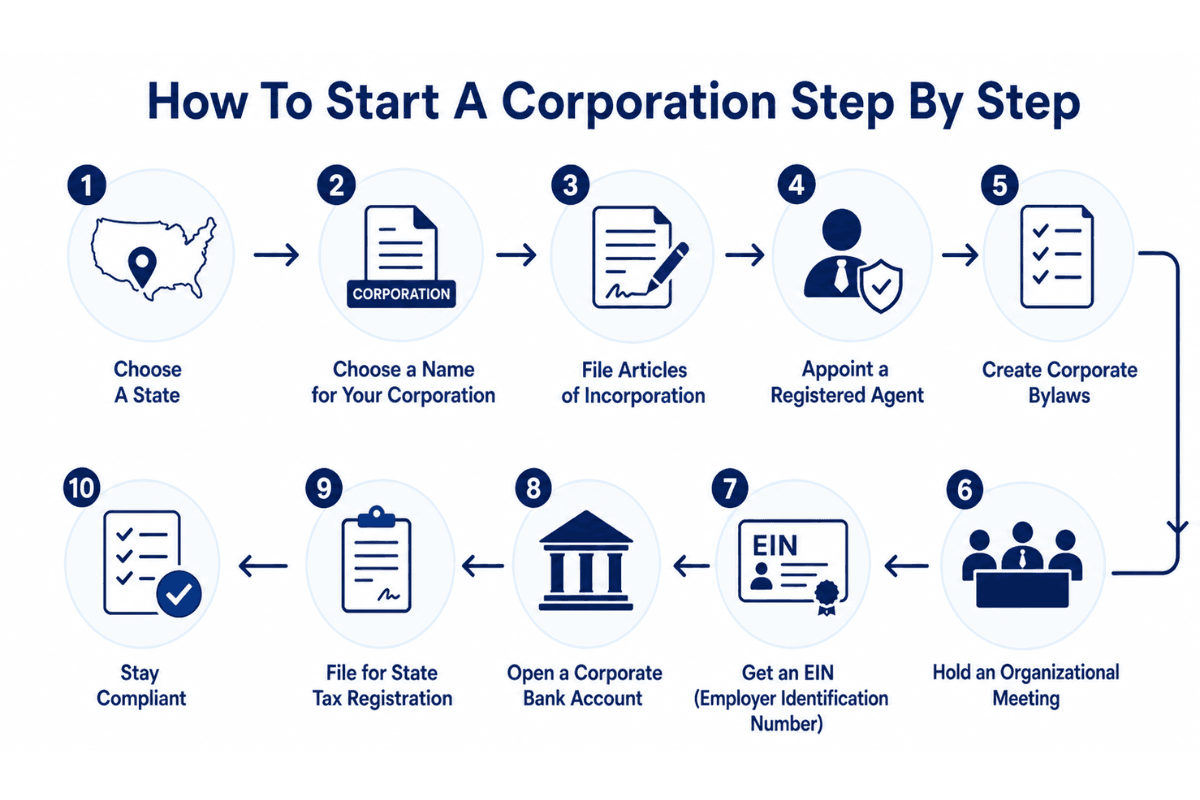
Think of a C corp as a person in the eyes of the law. It exists on its own. You can start one, grow it, sell it, or shut it down, and it stays separate from your personal finances throughout. Here is how the basic structure works:
Shareholders own the company by holding shares of stock. They vote on major decisions and receive a portion of profits when the company pays dividends. A C Corp can have any number of shareholders, including foreign investors and other companies.
A Board of Directors is elected by the shareholders. The board sets the company's overall direction of the company and makes major decisions. They are responsible to the shareholders.
Officers (such as a CEO, CFO, or COO) are appointed by the board. They handle the day-to-day running of the business and report to the board.
This separation of ownership and management is one reason large companies use this structure. A business can continue to operate even when ownership changes hands. The company does not depend on any one person to survive.
Corporate bylaws are the internal rules that govern how the company operates. They cover things like:
- How and when shareholder meetings are held
- How directors are elected and how long they serve
- What officers exist and what their duties are
- How voting works on major decisions
- How records are kept and maintained
Bylaws must be created when the corporation is formed. They should be kept at the company's main office.
Also Read: How to Start a C Corporation Online!
What Are the Advantages of a C Corporation?
1. Limited Liability Protection
Your personal assets are protected. If the business is sued or cannot pay its debts, creditors cannot come after your home, savings account, or personal belongings. You risk only what you invested in the business. This is one of the most important protections a business structure can offer.
2. Unlimited Shareholders
A C Corp can have as many shareholders as it needs. There is no cap. This is very different from an S corporation, which is limited to 100 shareholders. Having no limit means you can bring in many investors as the company grows.
3. Ability to Raise Capital Through Stock
Because a C corp can issue stock, it is much easier to raise large amounts of money. The company can offer stock to investors, employees, and the public. Most venture capitalists and angel investors specifically require C Corp status before investing in a startup. This is partly because C corps can issue different classes of stock, such as preferred stock, which gives investors special rights.
4. Any Type of Shareholder Allowed
A C Corp can be owned by individuals, other corporations, foreign nationals, and investment funds. An S corporation does not allow this. If you plan to bring in foreign investors or institutional investors, a C corp is the structure that makes it possible.
5. Perpetual Existence
A C Corp does not end when an owner dies, retires, or sells their shares. The business continues as long as it is properly maintained. This gives the company stability. It also makes it easier to pass the business to heirs or sell it to new owners.
6. Employee Benefits as a Business Deduction
C corps can deduct the cost of employee benefits from their taxable income. This includes health insurance, retirement plans, life insurance, and other perks. These benefits are also tax-free to employees. This makes it easier to attract and keep good employees.
7. Favorable Tax Planning Options
While double taxation gets a lot of attention, there are ways to reduce it with proper planning. Some owners pay themselves a salary, which the business deducts as an expense. This lowers the company's taxable profit. Some owners also qualify for tax breaks under IRS Section 1202, which allows certain shareholders in qualifying small C corps to exclude a portion of their gain when selling stock.
8. Path to an IPO
If your goal is to take your company public one day, a C Corp is the only practical structure for doing so. Stock exchanges and most investors require this structure. Going public means the company's shares are traded openly, which can dramatically increase its value and liquidity for all shareholders.
Also Read: Corporation vs LLC: Which structure is right for you?
What Are the Disadvantages of a C Corporation?
1. Double Taxation
Double taxation applies only when profits are distributed as dividends. The corporation pays 21% in federal corporate tax on its profits. If the after‑tax earnings are then paid out as dividends, shareholders pay personal income tax on those amounts, creating the two‑layer tax effect. Here is a simple example of how double taxation works:
- Your C corp earns $200,000 in profit
- The company pays 21% in federal corporate tax: $42,000
- That leaves $158,000 in after-tax profit
- If the company distributes that as dividends, shareholders pay personal income tax on it
- Depending on the shareholder's income level, that could mean another 15% to 23.8% (which includes the 3.8% Net Investment Income Tax for high earners)
So the effective tax on that $200,000 could be quite high by the time the money reaches the owner's pocket.
That is double taxation. The same dollar is taxed at the company level and again at the personal level.
There are legal ways to reduce this. Some owners pay themselves a salary instead of dividends. Salaries are a business expense, so they reduce the company's taxable income. A tax professional can guide you in planning around this.
2. More Paperwork and Formal Requirements
Running a C Corp means following a set of rules that do not apply to LLCs or sole proprietorships. These include:
- Holding at least one annual meeting for shareholders and directors
- Keeping minutes of all meetings
- Maintaining a record of all shareholders and their ownership percentages
- Filing annual reports with the state
- Keeping corporate bylaws on file at the main business office
Missing these requirements can put your personal liability protection at risk, a situation sometimes called "piercing the corporate veil." Staying compliant is not just paperwork. It protects you.
3. Higher Costs to Start and Maintain
Forming a C corp costs more than setting up an LLC or sole proprietorship. There are state filing fees, which vary by state. There may be legal fees for drafting incorporation documents. And there are ongoing costs like franchise taxes, registered agent fees, and annual report filings.
The exact costs depend on your state, but expect higher startup and maintenance costs compared to simpler business structures.
4. Greater Regulatory Oversight
C Corps that sell stock to the public must register with the Securities and Exchange Commission (SEC). This brings additional requirements and disclosures. Even before going public, growing companies can face increased regulatory scrutiny as they bring on more investors.
5. Shareholders Cannot Deduct Business Losses
In a C corp, losses stay inside the company. They cannot be passed through to shareholders to offset personal income. An S corp handles this differently: its losses can flow through to owners and reduce their personal tax bills. For a startup that expects to lose money in its early years, this point is worth considering.
How Is a C Corporation Taxed?
A C Corp is taxed as its own separate entity. This is what makes it different from a sole proprietorship, partnership, or LLC (in most cases).
Federal Corporate Income Tax
A C corp files IRS Form 1120 annually. For calendar-year filers, the due date is April 15, 2026. A request for an extension (Form 7004) moves the filing deadline to October 15, 2026. The federal corporate tax rate is a flat 21%. Note that under the Inflation Reduction Act, certain very large corporations may be subject to a 15% Corporate Alternative Minimum Tax (CAMT) on adjusted financial statement income.
State Corporate Income Taxes
Most states impose their own corporate income tax, with 2026 rates ranging from 0% (e.g., SD, WY) to over 11% (e.g., NJ). Several states—including Nevada, Ohio, Texas, and Washington, do not have a corporate income tax but instead impose a gross receipts tax.
Quarterly Estimated Tax Payments
If a C corporation expects to owe federal income tax for the year, it generally must pay quarterly estimated tax. The payments for 2026 are due April 15, June 15, September 15, and December 15 for calendar‑year filers. The exact amount and timing depend on the corporation’s projected tax liability and IRS safe‑harbor rules rather than a single dollar threshold.
What Happens to Dividends
Qualified dividends are taxed at preferential rates of 0%, 15%, or 20%, depending on the shareholder’s income level. In some cases, high‑income taxpayers are also subject to the 3.8% Net Investment Income Tax (NIIT) on their net investment income, which can push the top effective federal rate on qualified dividends to about 23.8%. The NIIT applies only when the taxpayer’s modified adjusted gross income exceeds certain thresholds set by the IRS.
Real-Life Scenarios: Is a C Corp Right for My Situation?
These are three of the most common situations people ask about when they're deciding whether to form a C corporation. Each one comes directly from real search behavior and questions people ask online.
I'm a sole proprietor, and my business is growing. Should I convert to a C corp?
A C corp could make sense here, but it depends on your next steps. If you plan to remain a single-member or small operation and do not need outside investors, converting to an LLC might be simpler and cheaper. If you want to bring in partners, raise investment, or offer employees equity, a C corp gives you tools that an LLC and sole proprietorship do not. Talk to a business formation expert for more guidance.
I have a startup idea, and a potential investor is interested. Should I start as a C Corp?
If you want outside investors, a C Corp is the best choice because most venture capitalists and angel investors will only fund that structure. It allows you to issue different types of stock and offers the Section 1202 tax break, which can make your future exit profits tax-free. While C Corps face "double taxation" on dividends, most startups avoid this by reinvesting all profits back into the company to fuel growth. It is more complex and expensive to set up than an LLC, but it provides the professional framework that serious investors demand. If you plan to scale and eventually sell the company, starting as a C Corp saves you the massive headache of converting your business structure later.
Will double taxation wipe out my savings as a C Corp owner?
Double taxation is real, but it is not automatic. The corporate tax is 21% on profits. However, the shareholder‑level tax only arises if the company actually distributes profits as dividends. Many owners instead pay themselves a reasonable salary, which is deductible at the corporate level, so that income is taxed only once at the personal rate.
If the company keeps profits inside the business for reinvestment and growth, the second layer of tax is deferred. With planning, double taxation is often much smaller in practice than it looks on paper.
Conclusion
A C Corp is a good choice for founders who want to scale, protect their assets, and attract big investors. While the rules are stricter than those of an LLC, the growth potential is unlimited. Let Swyft Filings handle the complex paperwork and legal filings so you can launch your 2026 startup with total confidence.
Official Helpful Sources
- Internal Revenue Service. Forming a Corporation. Accessed on May 4, 2026
- Internal Revenue Service. About Form 1120, U.S. Corporation Income Tax Return. Accessed on May 4, 2026
- Internal Revenue Service. LLC Filing as a Corporation or Partnership. Accessed on May 4, 2026
- Small Business and Entrepreneurship Council. National Small Business Week Data, 2026 (C Corp size data). Accessed on May 4, 2026
FAQs
C corporations are taxed twice because the company first pays corporate income tax on its profits, and then shareholders pay personal income tax on dividends received from those profits.
It depends on your goals. An S corp avoids double taxation but has strict ownership limits, while a C corp is better suited for startups planning to raise funding or go public.
Yes, a C corporation can own an LLC as a subsidiary, which is commonly used to organize different parts of a business structure.
The main disadvantages are double taxation and higher compliance costs, along with more complex reporting and ongoing administrative requirements.
No, you are not legally required to hire a lawyer, but many people use one or a formation service to avoid mistakes due to the legal and tax complexities involved.