

A C corporation (C Corp) is a business that exists as its own legal entity. The company files its own taxes, holds its own assets, and takes on its own debts.
The "C" comes from Subchapter C of the U.S. Internal Revenue Code. That is the section of federal tax law that covers how these businesses are taxed. [1]
Every corporation starts as a C Corp by default. It stays a C Corp unless it files IRS Form 2553 to elect S corporation status.
Some fast facts:
- Shareholders own the company through stock
- The company pays its own federal income taxes at a flat 21% rate
- Shareholders pay personal taxes on any dividends they receive
- The company can have unlimited shareholders of any type
- It can raise money by selling shares of stock
- It continues to exist even if ownership changes
If you are building something serious, this guide covers everything you need to know about C corporations. We start with the basics and go all the way to advanced topics like Section 1202 stock exclusions and VC funding requirements.
How Does a C Corporation Work for Beginners?
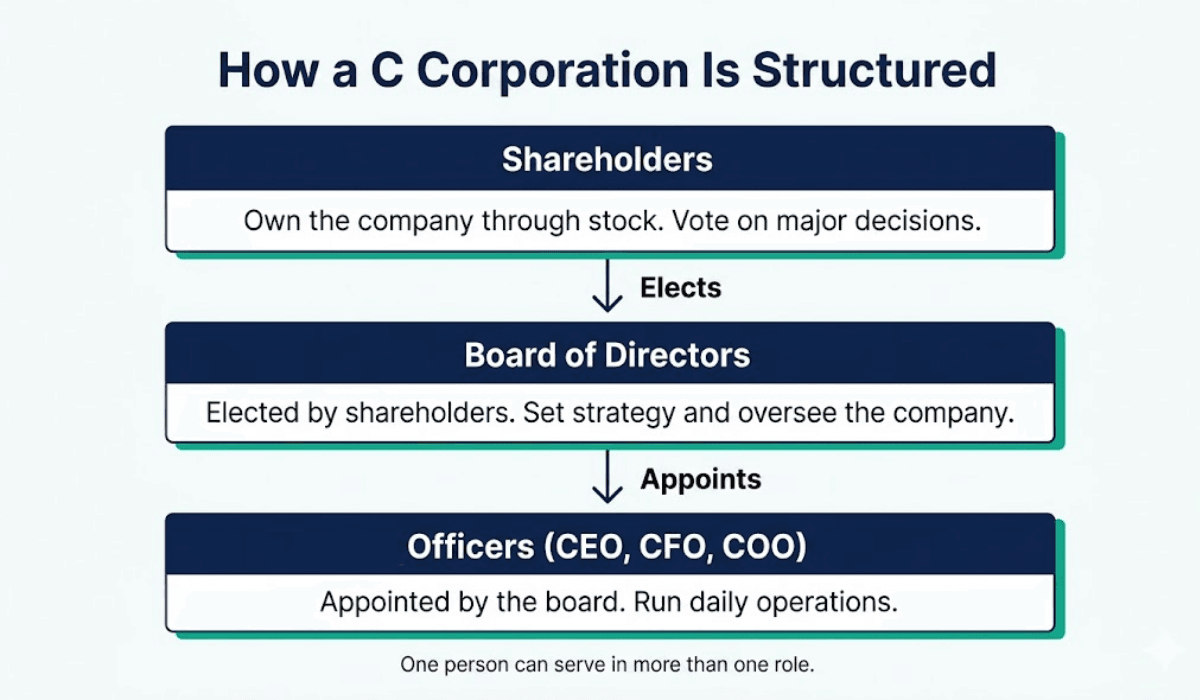
A C Corp is a separate person in the eyes of the law. It can sign contracts, open bank accounts, own property, and get sued. But the people who own it are not personally on the hook for what the company owes.
Here is how the structure works from the inside:
- Shareholders own the company. They buy shares of stock. They vote on major decisions like electing directors or approving a merger. They do not run the business day to day.
- The Board of Directors is elected by shareholders. The board sets the company's direction. It makes big decisions on strategy, executive pay, and major transactions. The board answers to shareholders.
- Officers (like the CEO, CFO, or COO) are appointed by the board (one person can fill more than one role). Officers handle daily operations and report to the board.
- Corporate bylaws are the internal rules of the company. They spell out how meetings work, how directors are elected, and how major decisions get made. You write these when you form the company and keep them on file.
This structure is built for scale. When an owner leaves or sells their shares, the company keeps running. Nothing freezes, or no internal process stops.
What Are the Different Types of C Corporations?
Not all C corps are the same. The term covers a broad category. Here are the main variations you should know about.
How Do Publicly Traded vs. Privately Held C Corporations Differ?
A publicly traded C Corp lists its shares on a stock exchange like the NYSE or NASDAQ. Anyone can buy those shares. These companies must register with the Securities and Exchange Commission (SEC) and follow strict disclosure rules. [2]
A privately held C corp has shareholders but does not list on a public exchange. Most startups and mid-sized companies fall here. They can still raise large amounts of money through private investors, but they have more flexibility in how they run.
What is the Difference Between a Professional Corporation (PC) Vs. Regular C Corp?
A professional corporation (PC) is formed by licensed professionals, such as doctors, lawyers, or accountants. Some states require these professionals to use a PC rather than a standard C corp. The liability protections can differ from state to state.
A regular C corp has no restrictions on the type of business it operates, as long as it is a lawful one.
How do C Corp vs. Benefit Corporation (B Corp) Differ?
A benefit corporation is a legal structure that requires the company to consider social or environmental impact alongside profit. It is available in most states. A B Corp is still taxed like a C Corp, but it has extra legal obligations to pursue a public benefit. A standard C corp has no such requirement. Its primary obligation is to its shareholders.
If you want a mission-driven status, a benefit corporation is one option. But it comes with additional reporting requirements.
Can a C Corp Be a Nonprofit?
No. A C-Corp is a for-profit structure. Nonprofits are formed differently and apply for tax-exempt status under IRS Section 501(c). If you are starting a nonprofit, a C Corp is not the right path. [3]
What Are the Requirements for Starting a C Corporation?
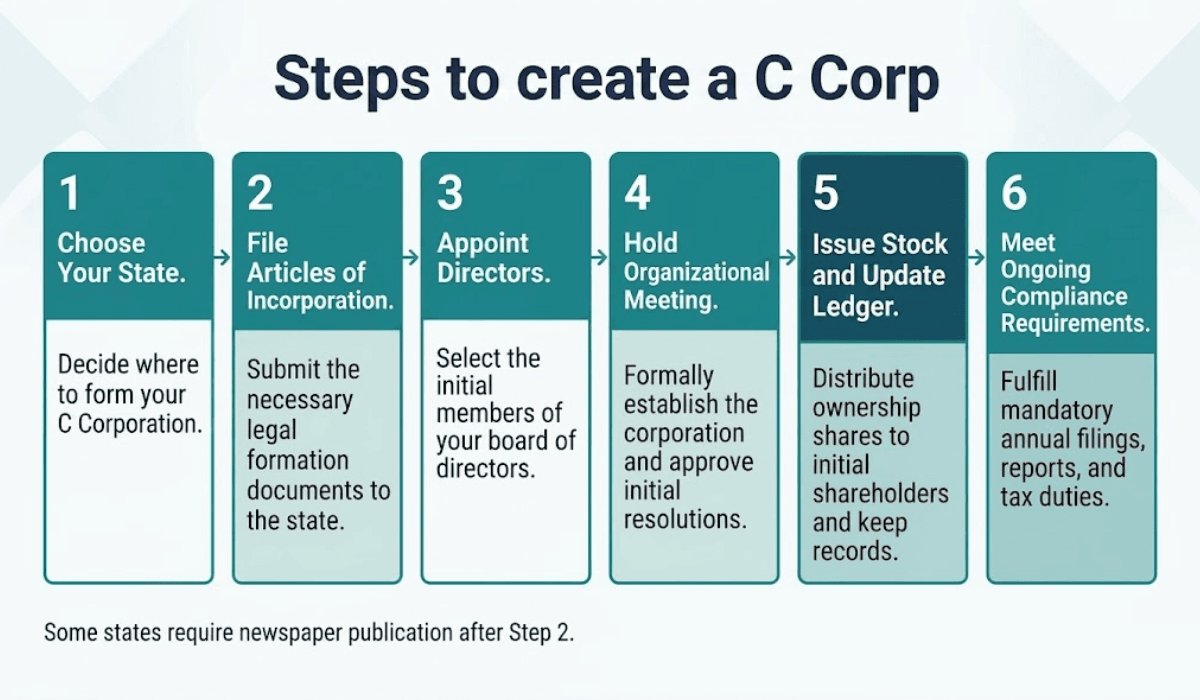
The IRS and each state have specific requirements to form a C corp. Here is what you generally need.
Articles of Incorporation
Every state requires you to file Articles of Incorporation (sometimes called a Certificate of Incorporation) with the state agency that handles business registrations. This document includes:
- The company's legal name
- The company's registered agent and address
- The number of authorized shares and their par value
- The names of initial directors (in some states)
Once the state approves your filing, the company is legally formed.
Company Name Rules
Your name must be unique. It cannot be too similar to another registered business. Most states require you to include a word like "Corporation," "Incorporated," "Company," or an abbreviation (Corp., Inc., Co.) in your name.
Before you file, search your state's business name database to confirm availability.
Director Requirements
Most states require at least one director. Some states tie the minimum number of directors to the number of shareholders. That number is usually no more than three, even then. There is no maximum limit on directors.
Organizational Meeting
After filing, you hold an organizational meeting with the initial board of directors. During that meeting, you:
- Adopt the corporate bylaws
- Approve resolutions for opening bank accounts
- Appoint officers
This meeting should be documented in writing. Keep those records.
Stock Distribution
The company must issue stock to its initial shareholders. Document every share that goes out. Keep a stock ledger and update it with every transfer or new issuance.
Publication Requirements
Some states (Arizona, New York, Nebraska, and Pennsylvania) require you to publish a notice of your corporation's formation in a local newspaper. Check the rules in your state before you assume this step does not apply to you.
Ongoing Compliance Requirements
A C Corp has ongoing obligations every year. These include:
- Filing an annual report with the state
- Holding at least one annual meeting for shareholders and directors
- Keeping minutes of all meetings
- Maintaining updated shareholder records
Missing these steps can put your liability protection at risk. Staying on top of compliance is not optional.
What Are the Primary Advantages of a C Corporation?
Limited Liability Protection
Shareholders are not personally responsible for the company's debts or legal judgments. If the business loses a lawsuit or cannot pay what it owes, creditors cannot come after your personal savings, home, or other assets. You only risk what you put into the business.
This protection is one of the biggest reasons people choose a corporation over a sole proprietorship or general partnership.
Unlimited Shareholders and Any Shareholder Type
A C Corp can have as many shareholders as it needs. There is no cap. Compare that to an S corporation, which is limited to 100 shareholders.
A C Corp also has no restrictions on who can be a shareholder. Individuals, other corporations, foreign nationals, and institutional investment funds can all own shares. An S corp does not allow this. If you want to bring in foreign investors or institutional money, a Corp is the structure that makes it possible.
Ability to Raise Capital Through Stock
Because a C corp can issue stock, raising large amounts of money is much more straightforward. The company can sell shares to private investors, employees, and eventually the public.
C corps can also issue different classes of stock. Common stock and preferred stock can coexist. Preferred stock gives investors special rights, like priority payouts or extra voting power. Most venture capital and private equity deals are structured around preferred stock. This is a key reason investors specifically look for C Corp status before committing funds.
Perpetual Existence
A C Corp continues to exist regardless of what happens to its owners. If a founder dies, retires, or sells their shares, the business keeps going. This stability makes the company easier to sell, transfer to heirs, and attract long-term investors.
Employee Benefits as a Deductible Business Expense
C corps can deduct the cost of employee benefits from taxable income. Health insurance, retirement plans, life insurance, and other perks qualify. Employees also receive these benefits tax-free in most cases. This gives C Corps a meaningful advantage when competing for talent.
Path to an IPO
If your goal is to take the company public, a C Corp is the only structure built for it. Stock exchanges require it. Most institutional investors require it. Going public can dramatically increase the company's value and give shareholders an opportunity to sell their stakes in a liquid market.
What Are the Disadvantages of a C Corporation?
Double Taxation
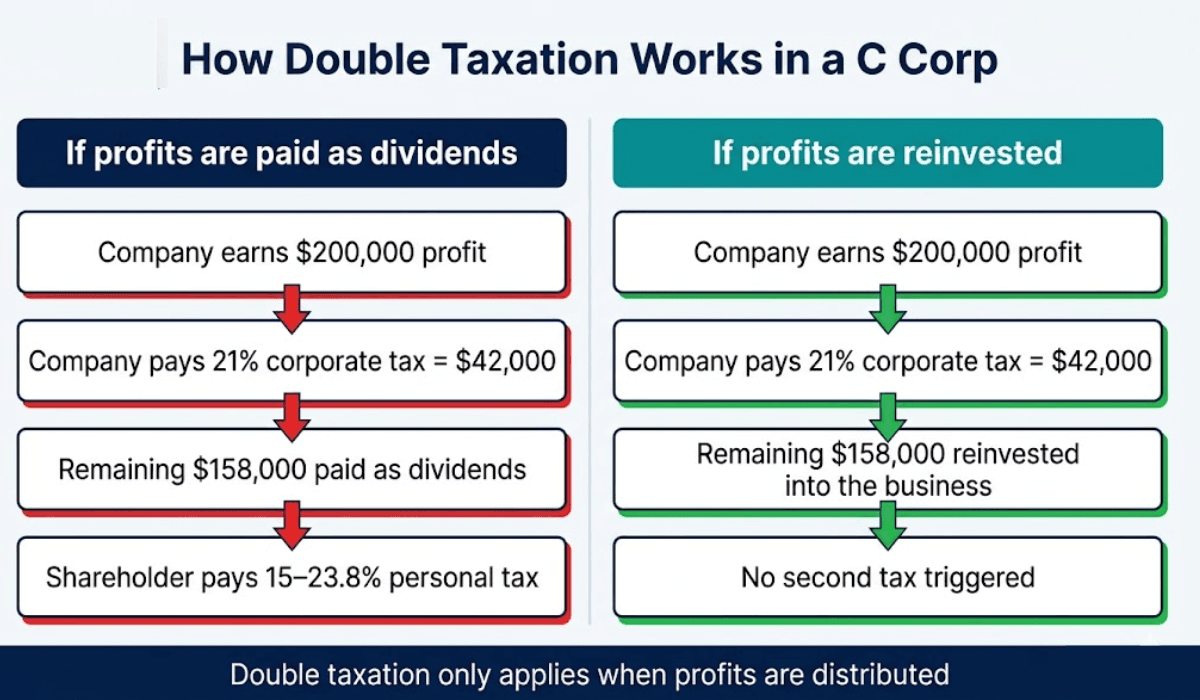
A C Corp pays federal income tax on its profits. If those after-tax profits are then paid to shareholders as dividends, shareholders pay personal income tax on that money too. The same dollar gets taxed twice.
But the good news is that it is manageable. Many owners pay themselves a salary instead of dividends. Salaries are a business expense that reduces the company's taxable income. That salary is then taxed only once, at your personal rate. A tax professional can help you build a strategy around this.
For a deeper look at how double taxation compares across structures, read our guide on C Corp vs S Corp vs LLC.
More Paperwork and Formal Requirements
C corps have more structure than LLCs or sole proprietorships. Annual meetings, meeting minutes, shareholder records, and state filings are all required. Skipping these steps can put your liability protection at risk, a situation called "piercing the corporate veil."
Higher Startup and Maintenance Costs
State filing fees, registered agent fees, franchise taxes, and legal costs add up. A C Corp costs more to start and maintain than a simpler structure.
Shareholders Cannot Deduct Business Losses
If the company loses money, those losses stay inside the corporation. Shareholders cannot use them to offset personal income. The S Corps handles this differently. Pass-through losses can reduce an S Corp owner's personal tax bill.
Why Would a Company Choose to Be a C Corp?
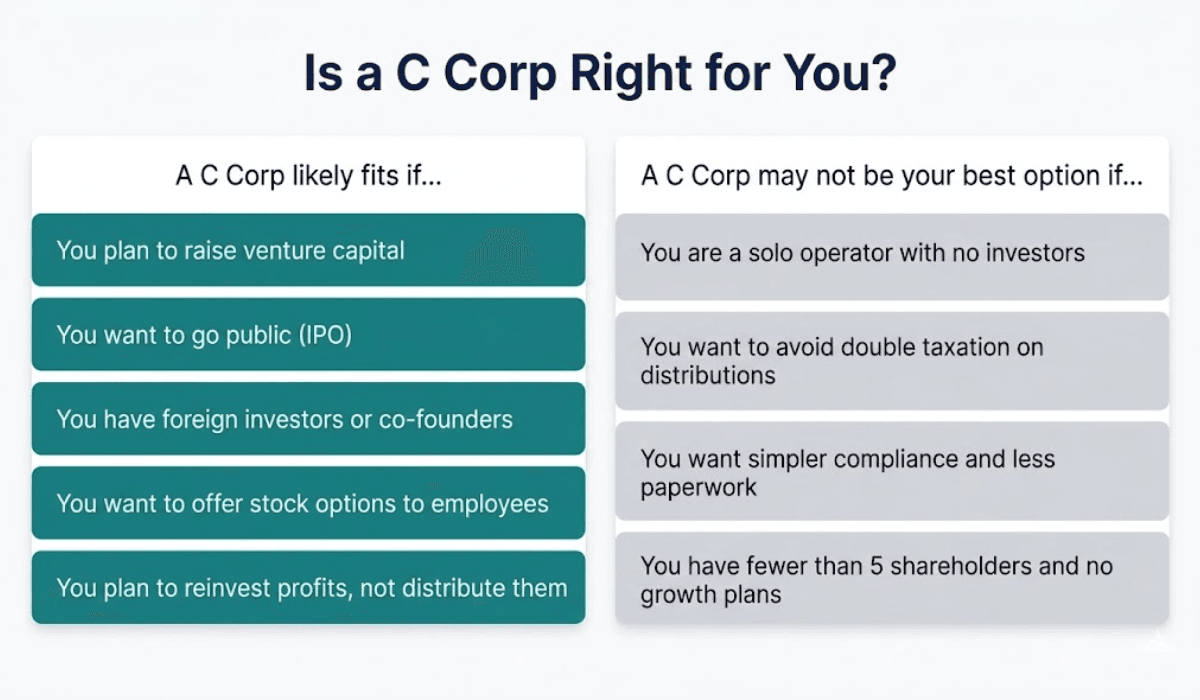
Though this structure is not for everyone, in certain situations, it is the only structure that fits.
You Want Outside Investment
Most venture capital firms and angel investors require a C Corp before they write a check. It supports preferred stock, has no restrictions on who can be a shareholder, and qualifies for tax breaks that make the investment more attractive.
You Plan to Go Public
An IPO requires a C Corp. Stock exchanges and institutional investors will not work with an LLC or S Corp. If an IPO is part of your long-term plan, building on a C Corp from the start keeps that door open.
You Have Foreign Investors or Co-founders
S Corps only allow US citizens and permanent residents as shareholders. A C Corp has no such limit. If your cap table includes anyone outside the US, a C corp is your only option.
You Want to Reinvest Profits, Not Distribute Them
Double taxation only applies when profits are paid out as dividends. If you plan to put every dollar back into growth, the second layer of tax is deferred. Many high-growth startups never trigger it in the early years.
You Want to Offer Equity to Employees
Stock options and equity compensation are standard tools for attracting talent. C corps handles these cleanly. The paperwork and legal framework already exist for it.
Real Scenarios: Who Actually Chooses a C Corp?
These are based on situations founders commonly face when deciding on a business structure.
Scenario 1: The Growing Freelancer
Sarah ran a design studio as a sole proprietor for three years. Business was good. Too good. A client wanted to invest $150,000 to help her scale. Her LLC could not issue preferred stock. She converted to a C corp, closed the deal in six weeks, and hired her first two employees.
Scenario 2: The First-Time Founder Worried About Double Taxation
Marcus heard "double taxation" and almost chose an S Corp. His accountant showed him the math. Because Marcus planned to reinvest all profits back into product development for the first four years, no dividends would be paid. No dividends meant no second tax layer. The C corp made sense.
Scenario 3: The International Founder
Priya was based in India but was building a SaaS product for US customers. Every investor she spoke to required a US-incorporated C corp. She incorporated in Delaware, opened a US bank account, and closed her seed round within three months. Her foreign residency was never a barrier.
Scenario 4: The Small Business Owner Weighing Options
David ran a profitable HVAC company with two partners. No plans for investors. No IPO dreams. A C Corp felt like overkill. He chose an S corp instead, avoided double taxation, and kept profits flowing directly to the three owners.
How Does Double Taxation Work in a C Corporation?
Double taxation only happens when profits are distributed as dividends. If the company keeps its profits and reinvests them into the business, no second layer of tax is triggered at that point.
The first layer: the corporation pays a flat 21% federal income tax on its profits.
The second layer: shareholders pay personal income tax if those after-tax profits are paid out as dividends. For qualified dividends, the rate is 0%, 15%, or 20% depending on the shareholder's income. High-income shareholders may also owe the 3.8% Net Investment Income Tax (NIIT), pushing the top effective rate to around 23.8%.
Ways to reduce the impact:
- Pay yourself a salary. Salaries reduce the company's taxable income. The salary is taxed once at your personal rate, not twice.
- Reinvest profits. If profits stay in the company for growth, the second layer of tax is deferred.
- Use fringe benefits. Health insurance, retirement contributions, and other deductible benefits reduce taxable income.
- Work with a tax professional. Strategic tax planning can significantly lower the real-world impact of double taxation.
Double taxation is real. But in practice, it is smaller than it looks on paper when managed well.
What Is the C Corp Tax Rate in 2026?
The federal corporate income tax rate is a flat 21% on taxable income. There are no brackets. Every C corp pays the same rate.
Filing requirements:
- File IRS Form 1120 annually [4]
- For calendar-year filers, the due date is April 15, 2026
- Extension requests (Form 7004) move the deadline to October 15, 2026
State corporate income taxes:
Most states add their own corporate income tax. Rates range from 0% (South Dakota, Wyoming) to over 11% (New Jersey). Some states, like Texas, Nevada, Ohio, and Washington, do not have a corporate income tax but impose a gross receipts tax instead.
Quarterly estimated tax payments:
If a C Corp expects to owe federal income tax for the year, it must make quarterly estimated payments. For 2026 calendar-year filers, those are due April 15, June 15, September 15, and December 15. The amount is based on projected tax liability and IRS safe-harbor rules.
Taxes on dividends:
Shareholders pay personal income tax on dividends received. Qualified dividends are taxed at 0%, 15%, or 20% depending on income. High earners may also owe the 3.8% NIIT.
Why Do Venture Capitalists Prefer C Corporations for Startups?
This is one of the most important reasons startups choose a C Corp.
Venture capital firms are structured as funds. Those funds have legal and tax requirements. Most VC funds cannot invest in pass-through entities like S Corps or LLCs. It creates complications for their investors, particularly tax-exempt organizations like pension funds or university endowments.
A C corp removes all of that friction. Here is why VC firms prefer it:
- Preferred stock: C corps can issue preferred stock, which gives investors special rights like dividend priority, anti-dilution protection, and liquidation preferences. These terms are standard in every VC deal. They are not possible in an LLC or S Corp.
- Clean equity transfers: Selling or transferring ownership in a C corp is simple. Shares can be issued, transferred, or repriced without the same complexity that partnership interests create.
- Section 1202 QSBS: This is a major tax benefit available only to C Corp shareholders. It allows investors to exclude up to 100% of their capital gains when they sell shares in a qualifying small business. That can mean zero federal tax on millions in gains. VCs know this. It makes C Corp investments far more attractive.
- IPO readiness: Most VC funds plan for an exit through an acquisition or IPO. A C Corp is the only structure that supports both cleanly.
If you plan to raise institutional money, forming a C Corp from the start saves you from a costly and complex conversion later.
What Is Section 1202 Qualified Small Business Stock (QSBS)?
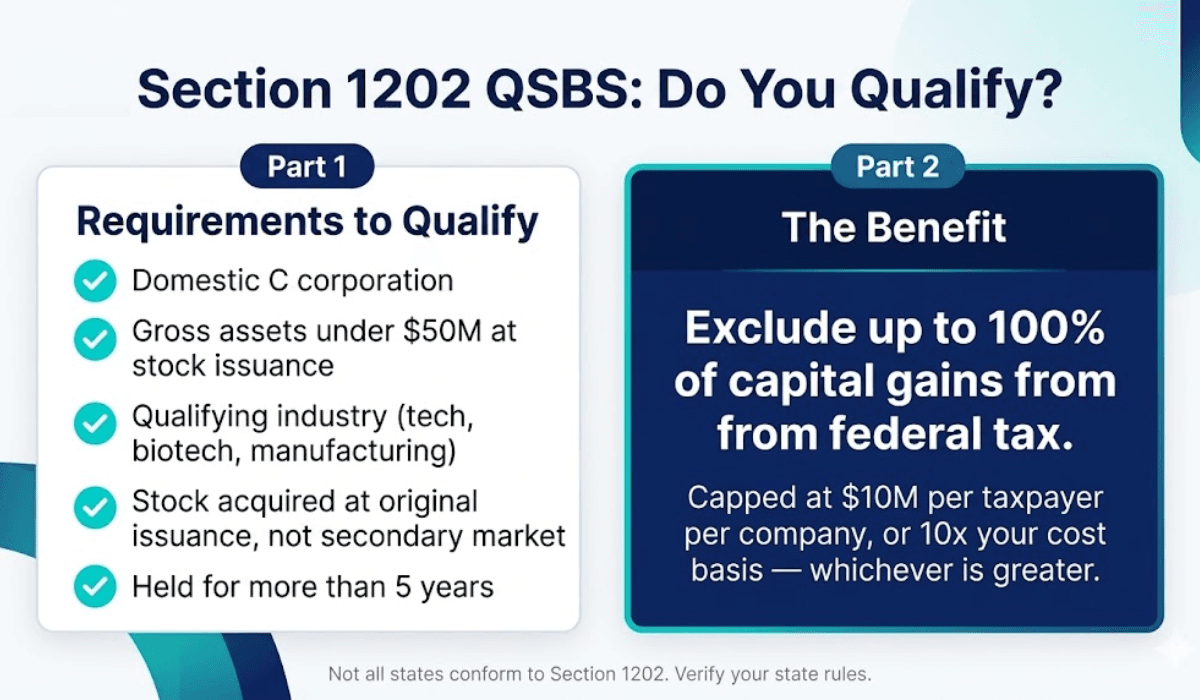
Section 1202 of the Internal Revenue Code is one of the most valuable tax benefits available to C Corp founders and investors. Many people do not know it exists. [5]
Here is the core concept: if you hold stock in a qualifying C corporation for more than five years, you may be able to exclude up to 100% of your capital gains from federal tax when you sell. The exclusion can be worth millions.
Qualifying requirements (as of 2026):
- The company must be a domestic C corporation
- The company's gross assets must be $50 million or less at the time the stock is issued
- The business must operate in a qualifying industry (most technology, biotech, and manufacturing companies qualify; hospitality, professional services like law and finance, and some others do not)
- The stock must be acquired at original issuance, not on the secondary market
- The stock must be held for more than five years
Maximum exclusion:
The exclusion is capped at $10 million per taxpayer per company, or 10x the taxpayer's cost basis, whichever is larger.
State taxes:
Not all states follow the federal QSBS exclusion. California, for example, does not conform to Section 1202. Check your state's rules.
Section 1202 is a compelling reason for founders and early investors to structure as a C Corp from day one. The potential savings are significant. Talk to a tax professional to confirm your situation qualifies.
Is a C Corp Better for International Founders Starting a US Business?
Yes, for most scenarios. An S corporation requires all shareholders to be US citizens or permanent residents. A C Corp has no such restriction. Foreign nationals, foreign companies, and non-resident investors can all own shares.
If you are a founder outside the US and you want to:
- Raise money from US-based investors
- Build a company that is incorporated in the US (often required for VC)
- Eventually, apply for a visa tied to your business ownership
Delaware is the most common state of incorporation for international founders. Delaware has a long history of corporate law, a dedicated court system for business disputes, and is recognized by investors worldwide.
Keep in mind:
If you operate in a different state, you may need to foreign qualify there and pay fees in both states. That cost is often worth it for the investor relationships it opens.
C Corp Fringe Benefits and Employee Tax Deductions
A C corp can deduct the cost of many employee benefits as a business expense. This lowers the company's taxable income. And employees receive these benefits tax-free in most cases.
Common deductible fringe benefits include:
- Health, dental, and vision insurance premiums
- Life insurance (up to IRS limits)
- Retirement plan contributions (401k, pension)
- Education assistance programs
- Dependent care assistance
- Disability insurance
This benefit is meaningful. A C corp can pay for the owner's health insurance through the company, deduct it, and the owner does not pay personal income tax on it. An LLC member or sole proprietor does not get the same treatment. When you are competing for good employees, these benefits matter. And the tax savings are real.
How to Convert an LLC to a C Corp for an IPO
If you started as an LLC and now want to raise VC money or pursue an IPO, conversion is possible. It is also common. But it is not always simple.
The process depends on your state. In some states, you can do a statutory conversion. In others, you form a new C corp and merge the LLC into it. Either way, there are tax and legal considerations to work through.
The earlier you convert, the better. Converting after you have issued equity to multiple LLC members adds complexity. If investors are already involved, everyone has to agree.
Also Read: How To Convert Your Business Entity Type!
Common Mistakes When Setting Up a C Corp for the First Time
- Skipping the organizational meeting: This meeting is where you adopt bylaws, approve resolutions, and appoint officers. Skipping it leaves gaps in your corporate record that can cause problems later.
- Not issuing stock properly: If shares are not properly issued and recorded, ownership disputes can follow. Document every share, every price, and every transfer.
- Choosing the wrong state: Delaware is popular for VC-backed startups. But if you are a small local business with no plans for outside investment, incorporating in your home state is often cheaper and simpler.
- Mixing personal and business finances: If you use your corporate account like a personal one, a court can decide the corporation is not truly separate from you. That puts your personal liability protection at risk.
- Missing annual compliance deadlines: Annual reports, meeting minutes, and tax filings all have due dates. Missing them can result in fees, loss of good standing, or, in some states, administrative dissolution.
- Not talking to a tax professional early: Your tax strategy affects how you structure compensation, dividends, and equity. Getting advice after the fact limits your options.
Final Thoughts
A C corporation gives you serious tools for serious growth. It separates you from your company. It protects your personal assets. It opens the door to institutional investment. And with the right tax planning, it is more efficient than it looks on paper.
The trade-offs are real. Compliance takes effort. The costs are higher than for a simple LLC. And double taxation requires a plan.
But if you are building something that you want to scale, attract investors into, or eventually take public, a C Corp is the structure built for that outcome.
Swyft Filings can handle the formation paperwork so you can focus on building. Start your Corporation today and set your business up the right way.
Bibliography
- Internal Revenue Service. Tax information for corporations. Accessed on May 15, 2026
- U.S. Securities and Exchange Commission. Quick Links. Accessed on May 15, 2026
- Internal Revenue Service. Exemption requirements - 501(c)(3) organizations. Accessed on May 15, 2026
- Internal Revenue Service. About Form 1120. Accessed on May 15, 2026
- Law. cornell.edu. 26 U.S. Code § 1202. Accessed on May 15, 2026