
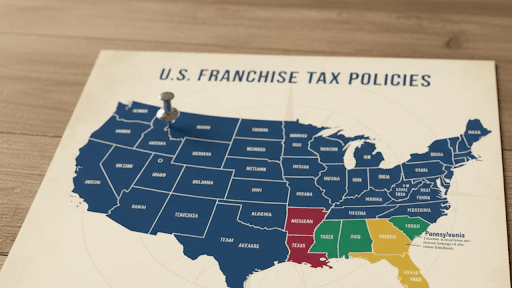
Learn what state franchise taxes are, who must pay them, how they’re calculated, and the consequences of non-payment to keep your business compliant and in good standing.
Key Takeaway:
Franchise Tax vs. Income Tax: Franchise tax is charged for the privilege of doing business in a state, while income tax is based on a business's net profit.
Consequences of Non-Compliance: Failing to pay franchise taxes or file annual reports can result in penalties, loss of good standing, or even the dissolution of your business.
State-Specific Rules: Franchise tax rules vary by state, with some states charging flat fees, while others base taxes on factors like revenue, assets, or the number of shares.
What Is State Franchise Tax?
A franchise tax is basically a state tax that businesses have to pay for the privilege of operating as a corporation of LLC within that state. It is not tied to profits but rather to the right to exist and do business there. Any business that has to register or incorporate with the state will need to pay a franchise tax. This includes:
- C corporations
- Limited partnerships (LPs)
- Limited liability partnerships (LLPs)
- Limited liability companies (LLCs)
Here is the list of states that impose franchise tax on businesses:
- Alabama
- Arkansas
- California
- Delaware
- Illinois
- Georgia
- Louisiana
- Mississippi
- North Carolina
- New York
- Oklahoma
- Tennessee
- Texas
- Ohio
- Oregon
- Wisconsin
- Idaho
- New Mexico
- New Hampshire
- Florida
- District of Columbia
NOTE: Some states impose a franchise tax on certain types of industries. Some states, like Hawaii, Iowa, South Dakota, Vermont, and Maine, apply franchise taxes only to financial institutions. Public utility companies in Maryland have to pay a franchise tax. In Minnesota, only corporations pay the franchise tax. In Texas, the tax applies to a wide variety of businesses, including partnerships.
Who Must Pay State Franchise Tax?
State franchise tax must be paid by most formal business entities, such as:
- Corporations ( C-Corporations and S-Corporations)
- Limited Liability Companies (LLCs)
- Partnerships and Limited Partnerships (LPs)
- Limited Liability Partnerships (LLPs)
Who Doesn’t Pay State Franchise Tax?
The entities that do not pay state franchise tax include:
- Sole proprietorships: They are not considered a separate legal entity from their owner and are not formally registered with the state.
- General partnerships: They are not formally registered entities, unless they register as an LLP (Limited Liability Partnership).
- Certain nonprofit organizations: Qualified nonprofit organizations operating for charitable, educational, or religious purposes are often exempt in many states, though they may still have filing requirements.
- Government entities: Federal and state government entities are typically exempt from state franchise taxes.
Also, businesses in states that have entirely eliminated the tax are not subject to it. Small businesses that have revenue below a certain threshold are also exempt from franchise taxes.
How States Calculate Franchise Tax
Here are standard calculation methods:
Flat Fees
Some states charge a fixed annual fee regardless of business size or income. For example, California imposes an annual minimum franchise tax of $800 on most corporations and LLCs. In Delaware, corporations pay franchise tax based on authorized shares or assumed par value (with a minimum of around $175 and higher amounts depending on company size).
Net Worth or Capital Stock
Many states, such as Tennessee and Mississippi, calculate the tax based on the company’s net worth or the value of its capital stock. The rate is often a percentage or a set dollar amount per thousand dollars of capital.
Gross Receipts/Revenue
The tax can be based on a percentage of the company’s total revenue generated within the state’s borders. In Nevada, a commerce tax ( a form of franchise tax) applies to businesses with gross revenue exceeding a certain threshold ($4,000,000).
Margin (Texas)
Texas uses a unique calculation method based on a company’s “margin.”
Businesses can choose from four methods to calculate the margin:
- Total revenue multiplied by 70%
- Total revenue minus the cost of goods sold (COGS)
- Total revenue minus compensation paid to all personnel
- Total revenue minus $1 million (if applicable)
Authorized Shares (Delaware)
Delaware corporations have two methods for calculating their annual franchise tax:
1. The Authorized Shares Method
This method is based solely on the number of authorized shares, regardless of their par value, issued status, or the corporation’s assets.
- Minimum Tax: The minimum tax is $175 for corporations with 5,000 or fewer authorized shares.
- Maximum Tax: The maximum tax is $200,000 (or $250,000 for “Large Corporate Filers”
- Rate Structure:
- 5,000 shares or less: $175.
- 5,001 to 10,000 shares: $250.
- Each additional 10,000 shares (or portion thereof): an extra $85.
2. Assumed Par Value Capital Method
This method for calculating franchise tax is a bit more complex because it takes into account the total gross assets of the corporation and the number of issued shares.
- Minimum Tax: The minimum tax is $400.
- Maximum Tax: The maximum tax is $200,000, but for "Large Corporate Filers," it can go up to $250,000.
- Rate Structure: The tax rate is $400 for every $1,000,000 (or portion of it) of assumed par value capital.
NOTE: Businesses operating in multiple states may be subject to franchise tax in each state where they have a sufficient connection. The specific rules and calculation methods vary widely. Businesses must consult each state’s tax agency for precise guidance and requirements.
What Happens If You Don’t Pay The State Franchise Tax?
Financial and Legal Consequences
You will face financial penalties and interest if you don’t pay taxes on time. It will keep adding up the longer the tax remains unpaid.
Loss of Good Standing
Your business could lose its “good standing” status with the state. This will affect you to:
- Get loans
- Sign contracts
- Expand into other states
You will run into some serious operational roadblocks without it.
Suspension or Revocation of Authority
The state can suspend or revoke your ability to legally operate. In California, you won’t be able to use the courts to file lawsuits or enforce contracts.
Tax Liens and Levies
The state can put a lien on your assets if you ignore the taxes for too long. They could seize and sell things like bank accounts or property to pay off the debt.
Personal Liability
LLCs and corporations protect you from personal liability. The protection can be lost if your business goes out of good standing or gets dissolved.
Damage to Reputation and Credit
Not being able to pay taxes can seriously hurt your business’s reputation and credit score. You won’t be able to get loans or maintain good relationships with suppliers and investors.
Administrative Dissolution
The state could dissolve your business if non-payment continues.
Criminal Charges
Business owners could also face criminal charges, hefty fines, or even prison time in cases where tax evasion is deliberate.
NOTE: The California Franchise Tax Board can suspend your business, preventing you from using the courts, signing contracts, or protecting your business name.
What Is The Difference Between Franchise Tax and Income Tax?
Aspect | Franchise Tax | Income Tax |
Tax Base | Based on metrics like a company’s net worth, capital stock, total assets, gross receipts, or a flat fee. | Based on the business’s net profit (total revenue minus expenses). |
Profitability | Must often be paid regardless of whether the business makes a profit or incurs a loss during the tax year. | Only applies if the business has a taxable income. |
Purpose | A fee for the legal privilege of existing as a business entity or operating within a specific state’s borders. | A tax on the actual earnings or gains of the business entity or individual. |
Governing Body | Levied only by state or local governments, there is no federal | Levied by both the federal government (IRS) and most state governments. |
Application | Not all states impose a franchise tax, and rules vary widely by jurisdiction. | More consistently applied across states and the federal government. |
Filing | Often requires separate forms and has deadlines that may differ from income tax returns. | Often integrated with the federal return process or has standard deadlines. |
Franchise Tax vs. Annual Report: What’s The Difference?
Feature | Franchise Tax | Annual Report |
Purpose | This is a tax that the state imposes for the privilege of operating or existing as a legal entity within that state. | This is more of an administrative filing. It is how you keep the state updated on your company’s current information. It helps maintain your legal good standing. |
Calculation | The calculation methods vary by state. Some states charge a flat fee, while others base it on factors like the company’s net worth, revenue, or assets. | It is usually just a flat filing fee, though this can vary depending on the state and the type of entity you have. |
Information Required | You will typically need to provide financial details, like revenue or asset values, so the state can calculate the tax you owe. | You will need to provide basic business details like your company’s name, address, registered agent information, and the names and addresses of your officers or directors. |
Where Filed | You will file this with the state’s tax authority, such as the Department of Taxation or the Comptroller’s office. | You will file this report with the state’s business registration agency. |
Both franchise taxes and annual reports play a key role in maintaining your business’s legal standing in your state. If you fail to file or pay, either one could result in penalties, loss of good standing, or even dissolution of your business.
If you are feeling overwhelmed with these filings, Swyft Filings can help you navigate both franchise tax and annual requirements. We handle the filing process for you. We:
- Ensure on-time submission
- Provide expert guidance on complex state rules
- Review documents for accuracy
- Send reminders for upcoming deadlines
Start the process now to ensure everything is accurate so you can focus on running your business.
Frequently Asked Questions (FAQs)
1. Who must pay the franchise tax in Texas?
Each taxable entity formed in the state or doing business in Texas must file and pay the tax. The entities are:
- Corporations
- LLCs (Single-member LLCs, and series LLCs)
- Banks
- State limited banking associations
- S corporations
- Savings and loan associations
- Professional corporations
- partnerships (general, limited, and limited liability);
- trusts
- professional associations;
- business associations;
- joint ventures; and
- other legal entities
2. Which states have no franchise tax?
South Dakota and Wyoming do not impose a franchise tax.
3. What is the difference between franchise tax and sales tax?
Franchise tax is a tax on the privilege of doing business in a state, which is calculated based on a company’s net worth or capital stock. Sales tax is a consumption tax paid by the end consumer on the purchase of goods or services. The primary distinction lies in what is being taxed and who is responsible for paying it.
4. Does an LLC have to file a franchise tax?
It depends entirely on the state or states in which it is formed.
5. What happens if you don’t file the franchise tax?
It can result in significant penalties, interest charges, and loss of your business’s legal standing to operate in the state.