


Not sure whether to choose a sole proprietorship or a single-member LLC in 2026? Learn the key differences in liability protection, taxes, and costs before you decide.
Many small businesses start as sole proprietorships for simplicity. But as revenue grows (even to $10k–$50k/year), unlimited personal liability risks your home, savings, and peace of mind from client disputes or bad contracts. So, is filing an LLC really worth it? Let’s find out together…
Your dream of starting a business is finally coming true.
What started as a hobby or side hustle has turned into a small business. The first few invoices are out, but now comes the first "grown-up" hurdle of entrepreneurship: ‘legally filing your business’.
Many new business owners know they need a structure, but stay in decision paralysis with questions like:
- Should I Form a Sole Proprietorship or a Single Member LLC?
- Is an LLC safer than a sole proprietorship?
- Can a Sole Proprietorship be converted into a Single Member LLC?
Here is the truth:
A Single Member LLC (costs just $50–$500) shields your assets and keeps taxes simple. However, a sole proprietorship costs nothing but puts your personal assets at risk if the business suffers setbacks.
Let’s compare both options as we move ahead.
Why The Sole Proprietorship Vs LLC Decision Matters in 2026?
In 2026, the stakes for self employment have never been higher.
As freelancers and online sellers handle more data and larger contracts, we face constant liability risks, such as theft and client disputes. This is why larger vendors now prioritize 'legally formed' partners over individuals.
The SBA’s guidance backs it, too. It says; Your business structure influences taxes and how much of your personal assets are at risk. (Small Business Administration) [1]
Image
According to Google Trends data, searches for LLC consistently outperform those for Sole Proprietorship in the U.S. over the past five years. This trend indicates that entrepreneurs are increasingly choosing to form LLCs for the legal protection and credibility they offer.
Google Trends data is not the only indicator of the popularity of business formation. It is backed by the following stats:
- The highest number of LLCs, 5.48 million, was formed in the year 2023
- There were 21.6 million active LLCs in the United States as of 2024
- 63% growth is seen in the business formation between 2019 and 2025
- 5.6 million new business applications were filed in 2025, as per the Census Bureau.
- In 2025, 85% of businesses formed were LLCs, 10% corporations, 3% partnerships, and 2% others [2]
What Is A Sole Proprietorship?
A sole proprietorship is the simplest business structure in the U.S. When a business is owned, managed, and controlled by a single individual without formally registering as a separate legal entity, it is a sole proprietorship by default. [3]
In this business structure, the owner and business are legally seen as a single entity. There is no separation between the personal assets (house, car, bank balance) of the owners and the business. Thus, it carries the highest liability risks like business debts, legal disputes, and financial losses.
The 2026 relevance
While this format has historically been used in retail stores, hair salons, and restaurants, it is now the starting point for millions of modern freelancers and creators.
What Is The Difference Between An "Owner" And A "Sole Proprietor"?
These two terms are often confused, but they mean different things in a legal sense:
👉 Owner is just a role. It means you have rights to profits. You can be an owner in a giant corporation, a partnership, an LLC, or even a lemonade stand. | 👉A sole proprietor is a legal status. It means you run a business without forming a separate legal entity. There's no legal wall between you and the business. |
What Are The Advantages Of Sole Proprietorship?
A sole proprietorship is the ultimate "lean startup" model. This structure offers four advantages:
1. It Offers Instant Market Entry:
A sole proprietorship starts the moment you perform a service and get paid. You don't need state level registration, filing, or complex paperwork to exist. If you are freelancing or consulting under your own name, you are already one.
2. No Administrative Formalities
You are exempt from the costly corporate maintenance that burdens other structures. Unlike an LLC or Corporation, there are:
- No mandatory annual reports to file with the Secretary of State.
- No "Franchise Taxes" (the flat fees some states charge just for the right to exist).
- No requirement for formal Operating Agreements or corporate bylaws.
While you may still need a local business license or a specialized permit (like a health or professional permit), the basic legal structure of a sole proprietorship costs $0 to maintain at the state level.
3. 100% Business Control:
You have complete control over the business decisions. You can change your business model, increase your pricing, or enter a new market instantly without any votes or approvals. You sign contracts in your name because you and your business are not separate entities.
4. Simple taxes:
The IRS treats a sole proprietorship as a "disregarded entity." It means you don't file a separate business tax return. Instead, you simply report your business income and expenses on your personal tax return (Schedule C of Form 1040).
Note: While you don't have corporate formalities, you still have tax compliance. In 2026, the IRS still requires you to pay self-employment tax (Social Security and Medicare) if your net earnings are $400 or more.
What Are The Main Drawbacks Of A Sole Proprietorship?
The simplicity of a sole proprietorship comes with the high risk in terms of personal security. In the litigious market of 2026, these three "deal breakers" are why most growing businesses eventually move to an LLC.
1. Unlimited Personal Liability:
This is the most dangerous risk. Because you and the business are legally the same person, any business issue is a personal trouble. If your business is sued or cannot pay its debts, a judge can allow people to take your personal property (house, car, savings).
2. It Is Hard To Raise Money Alone:
Since you are the only one in charge, it is very hard to find big investors or "Angel" funders. Most professional investors prefer to invest in a formal company rather than a single person. This makes it difficult to secure the cash you need to grow your business.
3. It Is Hard To Keep Money Separate:
When you don't have a separate business bank account, your personal money and business money get mixed together. This means you will have to manually separate the business and personal expenses. And if you miss any expense, you won't really know your actual profit or loss.
4. You May Look Less Professional:
Many big companies and vendors only sign contracts with "official" businesses. If you just use your personal name, it looks like you have a side hobby rather than a real company. Having a formal business entity helps you earn the trust of vendors and high-paying clients.
For more details, read: Forming a Sole Proprietorship: Pros and cons!
What Is A Single Member LLC?
A single member LLC (SMLLC) is an LLC with one owner (“member”). It is a legal entity created under state law that stands as a separate "person" from you.
An LLC is an intentional choice to build a wall between your business and your life. The primary point of an LLC is to create a "Corporate Veil." This is a legal shield that protects your home, your car, and your personal bank account.
If your business is sued or cannot pay its debts, the law implies that the problem belongs to the LLC, not to you personally.
Number of LLCs formed in the past 5 years:
Year | LLC Formations (in millions) | Growth Rate | Trend |
2021 | 5.4 million | +22.7% | 🚀 |
2022 | 5.0 million | -7.4% | 📉 |
2023 | 5.48 million | +9.6% | 📈 |
2024 | 5.2 million | -5.1% | 📉 |
2025 | 5.6 million | +7.7% | 📈 |
What Are The Benefits Of A Single Member LLC?
Forming an LLC is a strategic move for any serious entrepreneur in 2026. Here are the four biggest reasons to make it official:
1. Limited Liability Protection:
The LLC is its own legal "person" with its own bank accounts and tax ID. This means the business is responsible for its own debts and legal mistakes. If the business is sued, your personal home, car, and savings remain protected.
A Redditor commented this on a post:

2. Identity & Privacy:
A Single Member LLC is required to have an Employer Identification Number (EIN) from the IRS. Instead of giving out your Social Security Number to every client and vendor on W-9 forms, you use your EIN. This reduces your risk of personal identity theft.
3. Tax Flexibility
The IRS treats a single member LLC as a "disregarded entity by default." This means that even though your business is a separate legal "person" in your state, the IRS "ignores" the entity, so profits pass through directly to your personal tax return (Schedule C).
Note: Unlike sole proprietorships, LLCs give you tax choices. You can stay simple (report on your personal taxes like a sole proprietor). Or pick S-Corp to save on self-employment taxes when profits exceed your salary (great for businesses earning $50k+).
4. Full Management Control:
Unlike a big corporation, you don't have to deal with a board of directors or complicated voting rules in an SMLLC. You stay in 100% control of every business decision, but you should still have an operating agreement that legally separates you from your business entity.
Note: When you are an LLC, you never sign a contract as "John Doe." You must sign as:
[XYZ LLC NAME], a [Your State] limited liability company
By: __________________________ (Your Signature)
Name: John Doe
Title: Managing Member
5. Enhanced Professional Credibility:
Adding ‘LLC’ to your business name changes how the investors and vendors see you. It signals that you are a registered and compliant business. This official status is often the "key" that unlocks bigger contracts and better wholesale prices.
What Are The Disadvantages Of A Single Member LLC?
While the LLC offers a powerful shield, it requires more responsibility than a sole proprietorship. Here is why an LLC might be a hurdle for some founders:
Mandatory Formation And Ongoing Costs:
An LLC is a legal entity that you cannot set and forget. It needs regular maintenance. You must pay the state filing fee ($50 to $500) to start. Most states also require Annual Reports and Franchise Taxes.
⚠️ If you forget these payments, the state can "dissolve" your business, and you will lose your legal protection.
Filing Fees for Single-Member LLCs Vary By State
State | LLC Filing Fee |
Delaware | $110 |
California | $70 |
Florida | $125 |
Texas | $300 |
Nevada | $425 |
For more information, read: How to Form an LLC in Each U.S. State (50 State Guides)!
Strict Naming And Publication Rules:
An LLC requires you to add LLC to your business name. Some states (like New York) even require you to pay to publish a notice of your business in a local newspaper, which adds extra cost.
The Registered Agent Requirement:
Every LLC must name a Registered Agent. This is a person or service that stays at a fixed address to receive legal papers if you are sued. While you can sometimes be your own agent, many owners hire professional services to keep their home address off public records.
Risk Of "Piercing The Veil":
The LLC shield is not invincible. If you mix personal and business money, commit fraud, or ignore business formalities, the court can hold you personally responsible for all business debts and decide to "pierce the corporate veil [3]
Also Read: Your First Year as an LLC Owner: A Guide to Compliance, Setup, and Growth!
What’s The Difference Between An LLC And A Sole Proprietorship?
No. | Factor | Sole Proprietorship | Single-Member LLC |
1 | Legal separation | None | Separate legal entity |
2 | Personal asset risk | Higher exposure for business debts/liability | Typically, more protection, but not absolute |
3 | Privacy | Uses your SSN (High risk) | Uses a separate EIN (High privacy). |
4 | Banking Rules | Optional separation. | Mandatory separation to keep protection |
5 | Formation | Often no state formation filing | File Articles of Organization with the state |
6 | Taxes (default) | Pass-through on personal return | Usually the same by default (disregarded entity) [4] |
7 | Ongoing requirements | Minimal | Annual/biennial reports/fees in many states |
8 | Credibility | "Hobbyist" status. | "Official Business" status. |
When Is It Best To Have A Sole Proprietorship?
A sole proprietorship tends to make sense when:
- You’re testing a business idea and want to keep costs near zero
- Your work is low risk (no products, minimal contracts, low chance of damage)
- You don’t plan to take on debt, inventory, or contractors yet
- You’re okay upgrading later (and your risk is truly low)
Best Fit Examples For 2026:
- Freelance writing, basic design work, tutoring
- Low risk digital services with a tight scope + strong contracts
Read: Why Sole Proprietors Should Form an LLC to Protect & Grow Their Business!
When Is It Best To Have A Single-Member LLC?
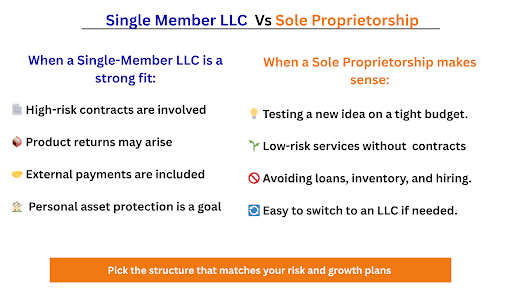
A single member LLC is often the smarter move when:
- You sign contracts where a dispute could turn expensive
- You sell products (returns, defects, safety complaints)
- You do consulting where advice could create financial loss claims
- You hire contractors or manage client budgets
- You have meaningful personal assets you want to keep separate
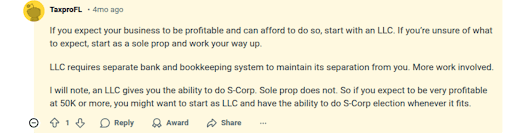
Here’s what a Redditor commented on a post:
How To Convert A Sole Proprietorship Into An LLC?
If you started as a sole proprietor, converting in 2026 is common, and it’s usually a simple process if you take the help of a business filing service.
Steps to convert a sole proprietorship to an LLC:
- Choose your LLC name and check availability with your state
- File Articles of Organization with your state (online in most states)
- Get an EIN (recommended for banking/taxes; may be required depending on how you operate)
- Create an Operating Agreement (helps to prove separation)
- Open a separate business bank account (non negotiable if you want liability protection)
- Update contracts + invoices to the LLC name
- Update licenses/permits + DBA if you use a trade name
- Keep clean records (commingling funds is a common way liability protection gets weakened)
Still unsure? Use this rule:
If a client dispute could realistically threaten your savings or home, an LLC is usually the safer default. (And if you’re still in test mode with low exposure, start simple for a week or two and then upgrade fast when revenue or risk rises.)
Takeaway:
A sole proprietorship wins on simplicity, but it also removes the legal boundary between your business problems and your personal life.
A single-member LLC adds cost and maintenance, but it’s designed to provide that separation and give you more options as your business grows.
The best 2026 decision is the one that fits your risk profile today and keeps you ready for more clients, bigger contracts, and higher stakes.
If you're ready to form an LLC, Swyft Filings offers an easy and affordable way to get started, with expert guidance along the way. Protect your business and move forward with confidence with us!
FAQ:
Q1 Is an LLC safer than a sole proprietorship?
A1 Yes, because an LLC creates a separate legal entity that can help shield personal assets from business liabilities, while a sole proprietorship does not. However, protection can be lost if you don’t properly maintain the LLC.
Q2 Is my single member LLC an S or C corp?
A2 Not automatically. The IRS generally treats a single-member LLC as a disregarded entity unless you elect corporate taxation. [4]
Q3 Do I need an EIN as a sole proprietor?
A3 It depends (employees, certain tax filings, banking needs). Many sole proprietors use an EIN to avoid using an SSN on forms and to simplify banking and vendor paperwork.
Q4 Does the LLC lose its shield because it's "disregarded"?
A4 No! This is a common point of confusion. The term "disregarded" applies only to the IRS. In a courtroom, your LLC is still a "regarded" legal entity that protects your personal assets. You get the tax simplicity of a human but the legal armor of a company.
Q5 What happens if the single member of an LLC becomes incapacitated?
A5 If a sole member becomes incapacitated, the LLC "freezes." Without a backup plan, no one can legally sign contracts, pay employees, or access bank accounts. A court must appoint a guardian to take over, which is slow and expensive. Having an Operating Agreement with a successor prevents this gridlock.
Bibliography
- SBA. Choose a business structure. Accessed on 19 Feb
- SmallBizStatics.How Many LLCs Are Formed Each Year in the United States. Accessed on 19 Feb
- NOLO. Are You Personally Liable for Your Business's Debts .Accessed on 19 Feb
- IRS. Single member limited liability companies. Accessed on 19 Feb