

Being your own registered agent can risk privacy, missed legal notices, compliance issues, and penalties. A professional service helps protect your LLC.
Yes, you can legally be your own registered agent in most states. But being allowed to do something and it being a good idea are two different things.
For many LLC owners, acting as their own registered agent creates real risks, including missed legal notices, privacy exposure, and compliance gaps that can cost far more than a professional service ever would.
Here are the seven most common reasons business owners run into trouble doing it themselves.
What Is a Registered Agent?
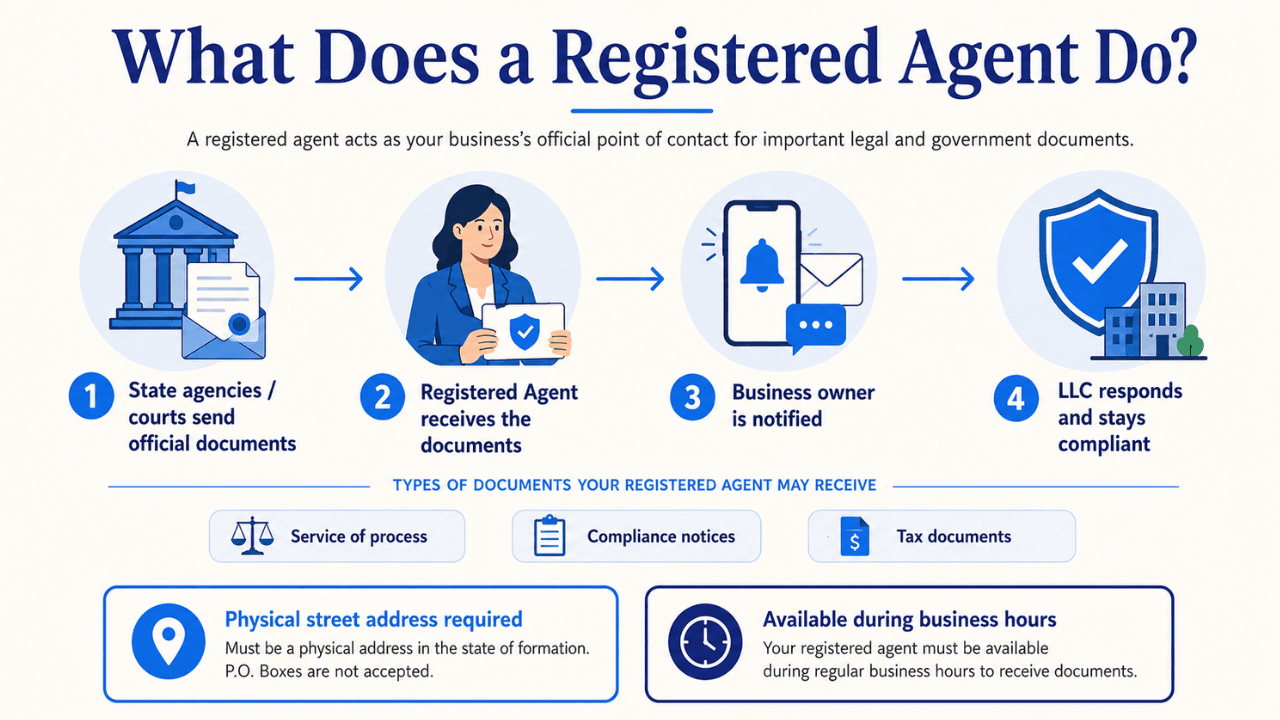
A registered agent is the person or company your LLC designates to receive official legal and government correspondence on its behalf. This includes lawsuits, service of process, state compliance notices, and tax documents.
Every LLC is required by state law to maintain a registered agent with a physical address in the state where it's formed. No registered agent means your formation documents can be rejected, and operating without one puts your LLC at risk of dissolution.
7 Risks of Being Your Own Registered Agent
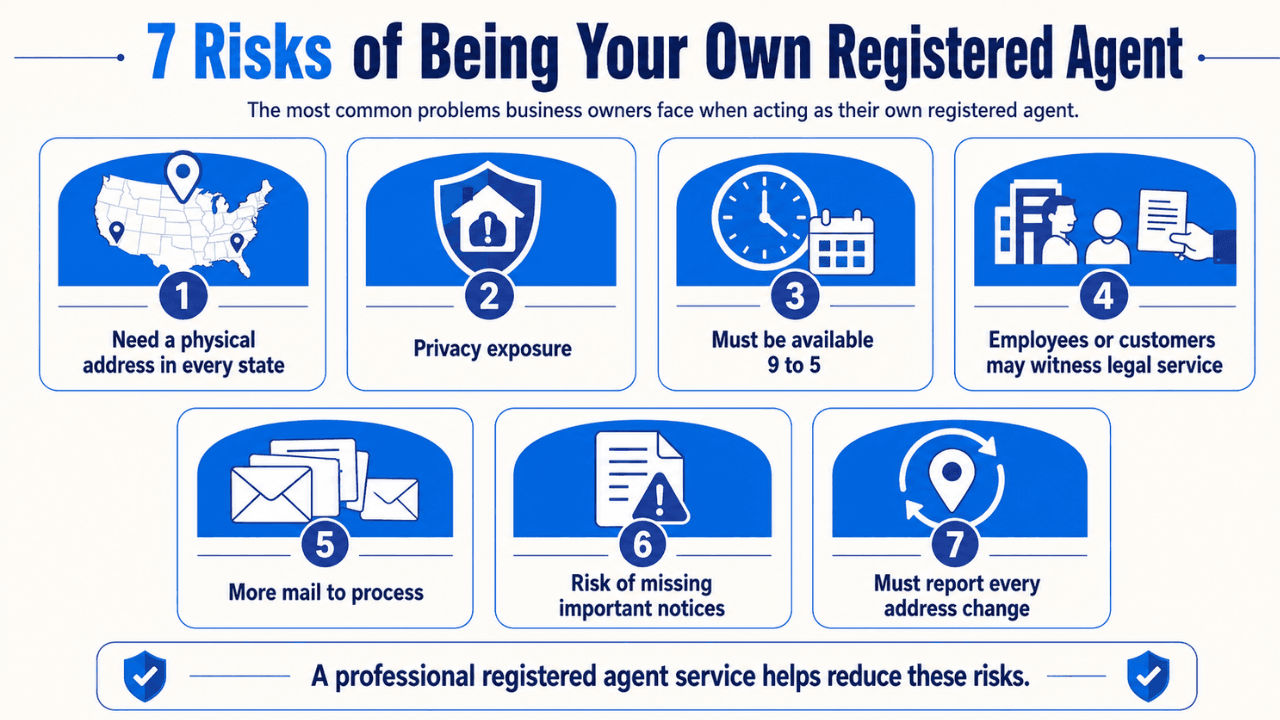
1. You Must Have a Physical Address in Every State You Do Business
If you register your LLC to conduct business in multiple states, you need a registered agent with a physical address in each one. Not a P.O. box. An actual street address where someone is present during business hours.
Opening and staffing offices across multiple states just to meet this requirement isn't practical for most small businesses. A professional registered agent service like Swyft Filings covers all 50 states under a single arrangement, no extra offices, no extra overhead.
2. You Will Compromise Your Privacy
When you file your formation documents, your registered agent's name and address become part of the public record on your state's Secretary of State website. Anyone can look it up.
If you work from home, as many small business owners do, that means your home address is publicly listed and searchable. Creditors, solicitors, opposing parties in a lawsuit, and process servers all have access to it.
Using a professional registered agent service means their address appears in public filings, not yours.
3. You Must Be Available During Normal Business Hours
A registered agent must be physically present at the registered address from 9 a.m. to 5 p.m., Monday through Friday, every week of the year, no exceptions.
That means no off-site client meetings, no travel, no working remotely, and no vacation unless someone is covering your address. For most business owners who are frequently out of the office, this requirement is almost impossible to meet consistently. And if a process server arrives when no one is there, the legal consequences can be serious.
4. Your Employees and Customers Could See Sensitive Information
This is the risk most business owners don't think about until it's too late.
If your business is sued, a process server or law enforcement officer will deliver the service of process documents directly to your registered address, in person. If that address is your office, the delivery happens in front of your employees. If customers are present, they see it too.
Being served with legal documents in front of your team or clients is embarrassing at best. At worst, it damages trust and raises questions you don't want to answer. A registered agent service receives all official documents at its office and forwards them to you privately, with no one else involved.
5. You Will Have Significantly More Mail to Process
Once your address is on the public record, expect an influx of mail, most of it junk, but all of it requiring attention. You need to open every envelope to check what's legitimate and what isn't.
That pile is easy to let grow. And when it grows, important documents get buried. A professional registered agent sorts through incoming mail, discards the junk, and flags anything that requires your immediate attention.
6. You May Miss Important Notices With Serious Consequences
Running a business is busy. A critical legal notice or compliance deadline that gets set aside during a hectic week can escalate fast.
Missing a service of process means you don't respond to the lawsuit. Courts don't wait. In multiple documented cases, businesses have received default judgments, courts ruling against them, simply because the registered agent was unavailable, had moved, or failed to act on documents they received. In one Texas case, a court upheld a default judgment against two LLCs after the process server couldn't locate the registered agent at the address on file. The businesses had simply failed to update their registration. The judgment stood.
Missing a state compliance notice can result in penalties, loss of your certificate of good standing, or administrative dissolution of your LLC.
A registered agent service has systems in place specifically to ensure nothing gets missed and every time-sensitive document reaches you promptly.
7. You're Responsible for Reporting Every Address Change
Move your business? Change offices? You're required to file updated registered agent information with every state where your LLC is registered, and do it promptly. Many states charge a filing fee for each address change.
If you forget or delay, your registered address on file is outdated. Service of process goes to the wrong location. You never receive it. The legal consequences are yours to deal with, not the state's.
A professional registered agent service handles this automatically. You never file an address change or pay those fees.
Stay Compliant and Protect Your Business with Swyft Filings Registered Agent Service
Swyft Filings provides registered agent service in all 50 states, with document forwarding, compliance alerts, and a secure online portal to access your official documents anytime. Stay compliant, protect your privacy, and focus on what actually moves your business forward.